


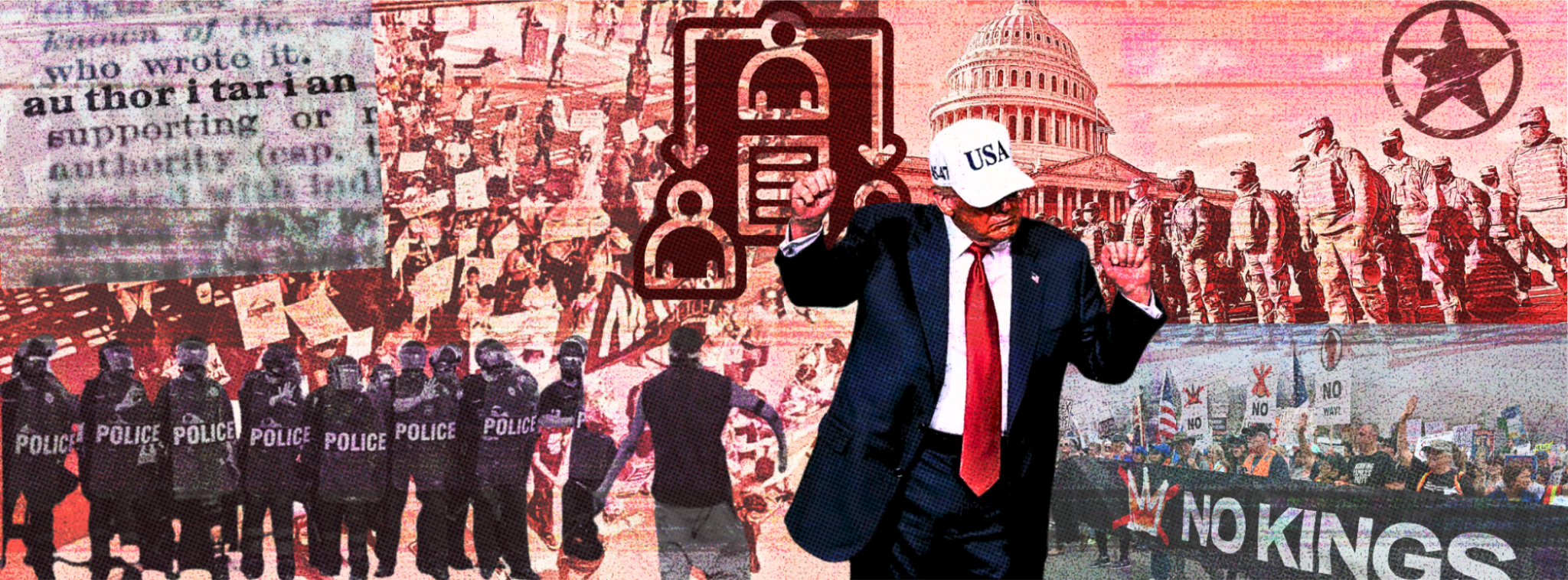
This piece is part of “The Quiet War,” a series tracking how state violence operates in plain sight — from border militarization to urban occupation, examining how authoritarianism arrives not with fanfare but with bureaucracy, memes, and manufactured consent.
I. If This Were Somewhere Else, We’d Know What to Call It
Imagine, for a moment, that the following were happening in another country: Courts issue rulings that the executive branch openly ignores. Armed federal agents operate domestically with expanding powers, detaining people without clear charges or due process. Media organizations face economic pressure and legal threats for publishing unfavorable coverage. Political opponents are labeled enemies, traitors or existential threats to the nation itself, and not by fringe actors, but by the actual head of state.
Now ask the obvious question: If this were happening somewhere else, what would the headlines say? They wouldn’t lead with euphemisms. They wouldn’t call it “polarization” or “controversy” or “institutional strain.” They wouldn’t speak delicately about competing narratives or both sides. They would say the word Americans seem uniquely hesitant to use about ourselves. They would call it authoritarianism.
That hesitation matters more than we like to admit. Because the danger right now isn’t that people don’t feel something is wrong. They do. You can hear it in the anxiety, the quiet fear and the way conversations keep circling the same unease without ever quite landing. The problem is that we keep being told (explicitly and implicitly) that naming what’s happening would be irresponsible. Alarmist. Divisive. Unhelpful. Unprofessional.
We are encouraged to trust the process even as the process is hollowed out. To focus on norms while those norms are openly violated. To take comfort in the fact that the machinery of government still exists, that elections still happen, that courts still issue opinions, as if the presence of familiar forms guarantees democratic substance.
But history doesn’t work that way. Authoritarian systems rarely arrive announcing themselves. They emerge gradually, through normalization, legalism and language that softens reality until it becomes difficult to grasp what’s been lost. The institutions remain. The names remain. What changes is how power actually operates - and who is protected by it.
This is why language matters. Not as a branding exercise, but as a survival one. If we can’t describe the terrain accurately, we can’t orient ourselves within it, let alone resist what’s unfolding. What I’m basically trying to say is that authoritarianism advances fastest when it’s trapped behind polite language.
II. Authoritarianism Doesn’t Look Like Collapse — It Looks Like Control
One of the most comforting myths about authoritarianism is that it announces itself through chaos. That it feels unmistakably like breakdown. That things fall apart so visibly, so dramatically, that no one could mistake what’s happening.
But that isn’t how strongman rule usually works.
Authoritarian systems don’t abolish order. They impose a different one. What looks like disorder from the outside is often something else entirely: selective enforcement, quiet consolidation and the steady tightening of hierarchy. The appearance of confusion masks the fact that power is becoming more concentrated, more personalized and way less accountable.
This is where many Americans get stuck. We look around and see familiar institutions still standing. Laws are still on the books. Elections still occur. Courts still issue rulings. Congress still meets (barely). News still gets published. From a distance, the scaffolding of democracy remains intact.
And so we assume that whatever else is happening, it can’t be authoritarian. Not yet. But authoritarianism doesn’t require eliminating institutions. It requires bending them. Laws don’t disappear; they’re enforced unevenly. Courts still rule, but their decisions are ignored when they threaten power and amplified when they serve it. Elections continue, but the costs of opposing the ruling faction quietly rise. Media outlets remain legal, yet face financial pressure, lawsuits and intimidation that shape what gets said and what doesn’t.
What changes isn’t the presence of rules. It’s who the rules apply to.
Some people experience the law as rigid and punishing. Others experience it as flexible, forgiving or entirely irrelevant. Accountability moves downward. Protection moves upward. Over time, this undemocratic unevenness stops feeling exceptional and starts feeling normal.
This is why authoritarianism can coexist with daily routines. Schools still open. Bills still get paid. Work still happens. Life goes on…just with a growing awareness, often unspoken, of where the lines are and who you shouldn’t cross. That’s not collapse. It’s consolidation. The system isn’t breaking down. It’s deciding who it’s for.
III. How You Know the Slide Is Real
One reason authoritarianism is so hard to confront is that people expect a single unmistakable moment, like a coup, or a declaration or tanks rolling through city streets. But countries don’t usually lose the rule of law all at once. They lose it piece by piece, in ways that feel administrative, legal and even boring.
People who’ve lived and worked in weakening democracies tend to notice the signs earlier, not because they’re more cynical, but because they’ve seen the pattern before. It begins when the law stops protecting speech and starts disciplining it. Not through outright bans, but through investigations, licensing threats, financial pressure and the quiet message that criticizing power comes with consequences. Media outlets don’t vanish; they become more cautious. Activists don’t disappear; they burn out, lawyer up or scale back. Free speech technically exists, but exercising it becomes risky in ways it wasn’t before.
Then the courts change, not all at once, and not everywhere. Judges still hear cases. Rulings still get issued. But loyalty starts to matter more than independence. Decisions that favor those in power are enforced swiftly; decisions that constrain them are delayed, ignored, or punished. Over time, people stop expecting the courts to protect them and start seeing them as another arm of the political order.
Corruption follows naturally. When those at the top no longer fear consequences, self-dealing becomes normal. Contracts flow to friends and donors. Pardons reward loyalty. Laws are applied as weapons or shields, depending on who you are. None of this feels shocking once it’s established. It feels like how things are done.
Meanwhile, enforcement becomes arbitrary and frightening. Police and federal agents operate with widening discretion and narrowing oversight. Complaints go nowhere. Violations pile up without accountability. The message is unmistakable: resistance will be costly, and appeals to fairness will not save you.
And beneath all of it, fear spreads. Not the loud kind, not constant panic - but a low, ambient fear that settles into everyday life. Fear of drawing attention. Fear of saying the wrong thing at work. Fear of being misinterpreted online. Fear of what happens if power decides you’re a problem. Even those inside the system feel it, because they know how quickly protection can turn into persecution.
This is the point many people misunderstand. Authoritarianism doesn’t require universal terror. It requires enough uncertainty that people begin to police themselves. When this pattern emerges - pressured media, captured courts, normalized corruption, arbitrary enforcement and a culture of fear - it no longer makes sense to describe what’s happening as mere dysfunction. It has a name. And the longer we avoid it, the harder it becomes to reverse.
IV. When Naming the Law Becomes the Crime
One of the clearest signs that a system is tilting toward authoritarianism is not the abuse of power itself, but the reaction to anyone who names it. For example, just last week, a group of Democratic lawmakers (several of them military veterans) released a short video reminding service members of something that is not controversial, radical or new: under the Uniform Code of Military Justice, troops are obligated to refuse illegal orders. That principle exists precisely because history is filled with atrocities committed by people who claimed they were “just following orders.”
The response from the president was immediate and chilling. He accused the lawmakers of “seditious behavior,” called them traitors, demanded their arrest and suggested (without ambiguity) that such behavior was punishable by death.
This is worth sitting with. No one in the video called for rebellion. No one urged troops to disobey lawful authority. They cited existing law and constitutional oaths. Yet the act of reminding the military that the law places limits on executive power was recast as an existential threat to the nation. This is not confusion. It is strategy. Authoritarian systems invert reality by redefining legality itself. Loyalty becomes lawful. Dissent becomes criminal. Defending the Constitution is reframed as undermining the state. The crime is no longer disobedience, it’s refusing to suspend your judgment on command.
Equally telling was the reaction from institutional gatekeepers. The House Speaker didn’t challenge the substance of the threat. He deferred to prosecutors. Senior administration officials compared the video to enemy propaganda. The question was no longer whether the president was wrong, but whether the law could be stretched enough to make his anger actionable.
This is how the linguistic terrain shifts. Words like “sedition,” “terrorism,” and “enemy” are not deployed accidentally. They are designed to collapse legal distinctions, to move the debate from right and wrong to loyalty and punishment. Once that shift takes hold, the specific facts matter less than the allegiance being demanded. And when even stating what the law says is treated as a provocation, the message to everyone else is clear: silence is safer than accuracy.
This is why language matters so much at this stage. Not because words are everything, but because they set the boundaries of what people believe they are allowed to see, say and resist. When power insists that naming the law is treason, it’s telling you exactly how fragile its authority really is. And how far it’s willing to go to protect it.
V. This Isn’t Abstract — It’s Material
Authoritarian drift doesn’t just show up in rhetoric. It shows up in budgets, enforcement priorities and who gets protected when resources are scarce. Just look at where money flows. For example, Department of Homeland Security funding has exploded, even as housing, healthcare and social programs strain under the weight of everyday need. Immigration enforcement agencies operate with near-impunity, while courts issue rulings they cannot enforce. The message isn’t subtle: coercion is fully funded, while care is conditional.
Look also at who pays. Blue states send tens of billions more to Washington each year than they receive back, essentially subsidizing a federal system that increasingly works against their residents while amplifying the political power of states with far less democratic representation. That imbalance isn’t accidental. It helps lock in a system where economic contribution and political voice are deliberately disconnected.
And look at what’s withheld. Public investment that could stabilize housing, healthcare and wages is treated as unrealistic or radical, while emergency powers, surveillance authorities and militarized enforcement expand without hesitation. This is the political economy of authoritarianism. When people are made precarious, order starts to look appealing. When systems fail to meet basic needs, “security” becomes the substitute promise.
Control thrives where solidarity is starved. That’s not dysfunction. It’s design.
VI. The Window Is Still Open — But Not for Long
The most dangerous lie we tell ourselves is that there will be a clean moment, later, when the threat becomes undeniable and action finally feels justified. History doesn’t work that way. Authoritarian systems rarely announce their arrival. They consolidate in the pauses between outrage, in the spaces where people wait for permission that never comes.
What we are living through now is not the beginning of something unfamiliar. It is the decisive middle. The phase where elections still happen, courts still speak and dissent still exists, but on an increasingly tilted field. This stage can be reversed. Once it hardens though, that reversal may take generations.
The difference matters. It tells us that normal politics is no longer enough, but that resistance is still possible. It tells us that the cost of inaction is rising faster than the cost of confrontation. And it tells us that waiting for institutions to save themselves is a gamble we are unlikely to win. This is because democracy doesn’t survive on autopilot. It survives when people remember that it was never a gift from above, but something ordinary people built, defended and expanded under pressure.
The window hasn’t closed. But it is narrowing. And what happens next depends on whether we are willing to name what’s happening — and act accordingly.
References
Armitage, C. (2025, November 2). 67% of Democrats want more aggressive action: Can they deliver? The Existentialist Republic.

Armitage, C. (2025, October 24). Between democracy and dictatorship: Where we are and how long we have. The Existentialist Republic.
Bowman, H. (2025, October 29). How will you know that America has become a dictatorship? After 20 years living in one, I can tell you. Slate Magazine. https://slate.com/news-and-politics/2025/10/is-america-a-dictatorship-king-trump.html
DeVega, C. (2025, November 13). Donald Trump’s path to authoritarian rule is wide open. Salon.com. https://www.salon.com/2025/11/13/donald-trumps-path-to-authoritarian-rule-is-wide-open/
Feinberg, A., & Garcia, E. (2025, November 20). Trump demands arrest of Dems who told troops to refuse illegal orders. The Independent. https://www.independent.co.uk/news/world/americas/us-politics/trump-arrest-democrats-troops-illegal-orders-b2869176.html
____________________________________________________________________________
Means and Meaning publishes every Tuesday. If you found value in this analysis, I’d be very grateful if you’d consider buying me a coffee — your support helps me dedicate time to this work while keeping all content free and accessible.
You can also support this project by subscribing (it’s free!), sharing with others who might appreciate it, or joining the conversation in the comments. Sometimes the best antidote to anxiety is knowing you’re not alone in seeing what’s happening.
Next week, we’ll examine another piece of the machinery — and another opportunity to resist it.
Until then, keep questioning, keep connecting, and keep believing that another world is possible.
~ Chris