


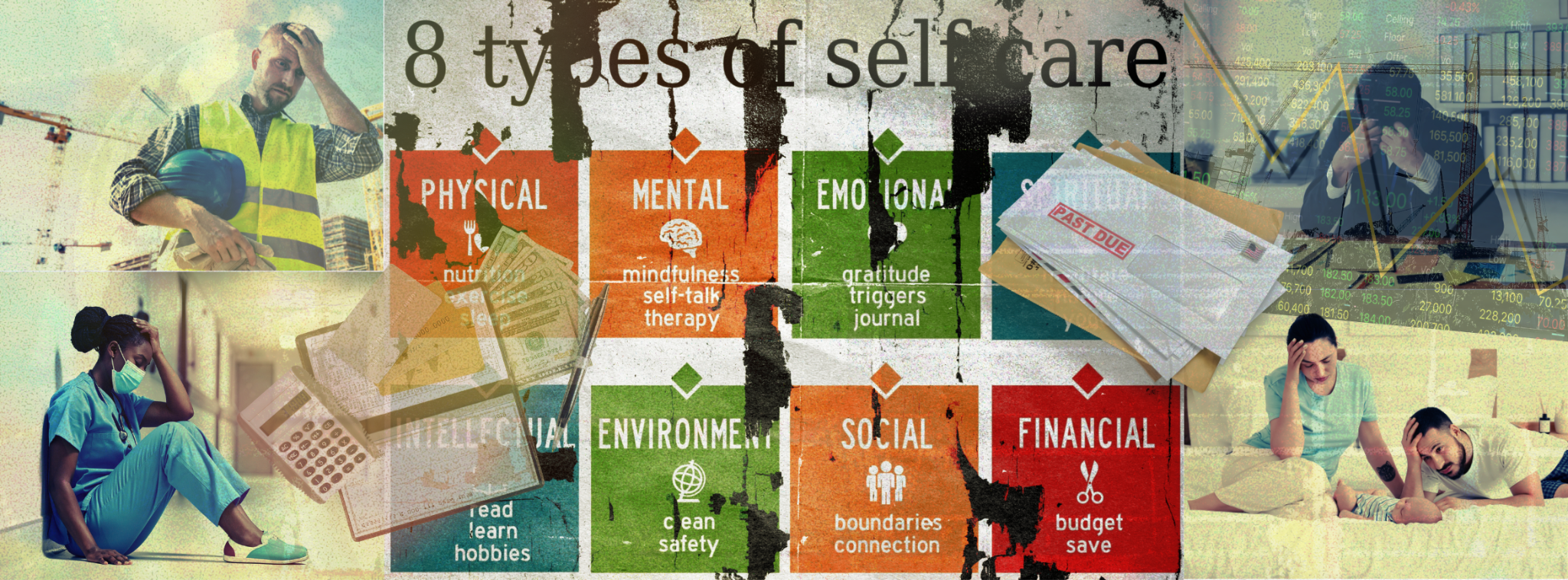
This piece is part of “Precarity Diaries,” a series exploring life under permanent instability — from economic anxiety to social isolation, examining how systemic insecurity shapes our relationships, health and possibilities.
I. The Mirage of “Fix Yourself” in a Breaking Economy
Everywhere you look, self-care is offered like a panacea: light a calming candle, take a deep breath, drink more water, write something in a gratitude journal or download another mindfulness app. It’s marketed as “resilience,” but in practice it functions as a pressure valve for a system that keeps tightening the screws. When the world feels unlivable, the culture tells you to become more flexible. More adaptable. More self-regulated. More endlessly repairable. Anything, really, except less exploited.
But the math doesn’t lie. And people can feel math in their bones. Sixty-four percent of American workers now live paycheck to paycheck, according to ADP’s latest survey - up from 46% just two years ago. That’s not a mindset problem; that’s a widespread structural failure. “We’re getting nowhere,” one millennial told CNN after describing how his wage gains were swallowed whole by rising costs. He didn’t need a gratitude journal. He needed an economy that didn’t punish him for existing.
Mainstream wellness culture frames burnout as a personal misalignment or a failure of discipline. But what do you call it when people are doing everything right and still sinking? When the typical household must spend $1,043 more every month just to buy what they bought in 2021? When 24% of households spend over 95% of their income on necessities alone? You can’t deep-breathe your way out of that kind of arithmetic.
Self-care was supposed to help us feel human again. Instead, it’s become a coping mechanism for inhuman conditions. We’re told to soothe ourselves through an affordability crisis, meditate through wage stagnation, and stretch through the slow implosion of the middle class. Anyone who cracks under that pressure is told they haven’t been taking good enough care of themselves.
But the truth is simpler - and far more damning: People aren’t breaking down because they’re weak. They’re breaking down because the system is working exactly as designed.
II. A K-Shaped Economy, or Why “Harder Work” Isn’t the Problem
The economy isn’t “struggling.” It’s splitting. And most people can feel the tear long before they can name its shape. Economists call it the K-shaped recovery - the kind where one line shoots upward for the wealthy while the other plunges for everyone else. But the term doesn’t quite capture the lived reality, the sense of watching prosperity accelerate in the lane next to you while your own lane sinks into potholes and gravel. It feels less like a letter of the alphabet and more like a split in the floor beneath your feet.
The numbers make the divide unmistakable. As Newsweek reported, wage growth for the lowest-earning Americans has slowed to its weakest pace in years, while higher-income households continue to surge ahead. The Atlanta Fed’s data shows wage growth “sharply slowing for the lowest-earning quartile,” even as the wealthy ride the tailwinds of stock market gains and asset appreciation. One economist called it “an increasingly K-shaped U.S. economy,” a polite academic way of saying: the rich are accelerating, and the rest are stalling out.
And yet, while this split widens, political leaders insist the problem isn’t the economy - it’s our perception of it. Inflation was “a con job,” we’re told. Groceries are “down,” we’re told. The system is fine, we’re told. We just aren’t appreciating it correctly. The result is a kind of civic cognitive dissonance, a collective bewilderment that comes from being blamed for noticing what is plainly happening in our own lives.
As CNN’s analysis put it, Americans “don’t take kindly to politicians who refuse to see voters’ lived experiences - especially when they’re smacked in the face with high prices on every supermarket trip.” Exactly. Reality is not a branding problem. Reality is what people can’t afford anymore.
III. The Cruelest Gaslighting: Exhaustion as an Economic Strategy
Burnout is the great American misunderstanding. We treat it like a mental health quirk, a personal failing, a sign that you haven’t hydrated enough or mastered the right breathing technique. But exhaustion in this economy isn’t an accident - it’s policy. It’s strategy. It’s how a system running on overwork and underpay keeps itself upright.
Listen to the way politicians talk about the economy and you can see the strategy in real time. When the president insists “we have no inflation,” while grocery bills keep climbing, it’s not just a lie - it’s a message: your suffering is not real. As Federal Reserve Chair Jerome Powell put it plainly, “Consumers are not interested in that story. Their prices are higher.” That line alone is a quiet indictment of the political class, a reminder that statistical optimism doesn’t put food in anyone’s cart.
But this pattern isn’t new. Biden did it when he told people the economy was “on fire” while they felt it burning them alive. Trump is doing it now, denying the cost of living crisis even as families spend $208 more per month just to tread water - over $1,000 more than in early 2021. Both administrations committed the same sin: insisting that if people simply felt differently, the pain would go away.
Matthew Desmond’s argument lands here like a hammer: poverty persists because the wealthy benefit from it. The same is true of burnout. Exhausted workers are more compliant. Overwhelmed people have fewer options. A population stretched thin is easier to discipline.
And this is where “self-care” slides neatly into the script. Instead of regulating corporations, we tell workers to do yoga. Instead of raising wages, we hand teachers a mindfulness app. Instead of confronting the structural violence of low pay and high costs, we urge everyone to “set better boundaries” - as if the real problem is insufficient journaling.
Burnout isn’t a personal crisis. It’s a political outcome. A feature, not a glitch. A system working exactly as designed.
IV. When the Middle Class Vanishes: What We’ve Lost, and Who Took It
For all the talk about budgeting apps, side hustles, and “learning to live within your means,” the truth is brutally simple: the pillars that once made a middle-class life possible have been sawed off one by one. This isn’t about individual choices. It’s about political decisions that turned collective goods into private luxuries.
Housing, once the anchor of postwar stability, is now a speculative asset class. The median single-family home has nearly tripled in price since 2012, soaring from $164,000 to $466,000. The cost of raising a child has blown past $400,000, more than doubling since 2000. Wages, meanwhile, have crawled forward at a fraction of that pace. As Investopedia notes, wages have risen only 2.1x over the same period - the math speaks for itself.
Zoom out further and the structural picture sharpens. Since 1979, economic productivity has grown 87%, but typical workers’ pay has grown only 32%. That missing 55 percentage points didn’t evaporate - it was siphoned upward into profits, executive compensation and shareholder payouts. The EPI pay-productivity gap isn’t an economic anomaly; it’s the blueprint of upward redistribution.
Other foundations eroded too. Charles Hugh Smith points out that in the mid-1980s, healthcare was actually affordable and accessible and public infrastructure still functioned without collapsing under deferred maintenance. He describes today’s landscape bluntly: “Private wealth has soared… while the bottom 60% are experiencing decay and decline,” and “housing is no longer affordable for the bottom 80% of the populace.”
This is what’s been stolen: the material basis of a livable life. And it’s no coincidence that the rise of “self-care culture” tracks neatly with this dismantling. When society abandons collective care - housing, healthcare, wages, infrastructure, time - the market rushes in to sell coping mechanisms. The more unbearable everyday life becomes, the more profitable the wellness industry becomes.
You’re not failing to budget properly. You’re living in an economy where the things that once made life stable have been converted into revenue streams for someone else.
V. What Real Care Would Look Like
The wellness industry wants you to believe that resilience comes from within - that if you could just find the right morning routine, the right affirmations or the right breathwork protocol, you’d be able to withstand anything. But that’s not how resilience actually works.
Real resilience isn’t built in isolation. It’s built in community, in security, in the knowledge that your basic needs won’t collapse beneath you. It comes from material conditions, not mental exercises.
You want to know what actually produces resilient people? Living wages that don’t require three jobs to afford rent. Affordable housing that doesn’t swallow 50% or more of your paycheck. Universal healthcare that doesn’t bankrupt you for getting sick. Paid time off that’s actually enough to recover from exhaustion, not just delay it. Shorter workweeks that give people time to be human beings instead of production units. Public infrastructure that functions without crumbling. Democratic workplaces where workers have a say in the conditions of their labor.
These aren’t luxuries. They’re the foundations of a livable life. And every society that has built them - from the Nordic countries to postwar America at its most functional - has discovered the same truth: when you take care of people structurally, you don’t need to sell them survival strategies individually.
But we’ve gone the opposite direction. We’ve dismantled collective care and replaced it with an entire economy of coping mechanisms. The meditation app industry is worth billions. The self-help market keeps expanding. Wellness retreats, productivity coaches, biohacking supplements - all of it thriving precisely because the baseline conditions of life have become so unlivable that people will pay anything for relief.
This is the con: Capitalism creates the crisis, then sells you the cure. It guts your wages, inflates your costs, extracts your time and monetizes your exhaustion. Then it hands you a jade roller and a journal prompt and tells you the problem is your failure to practice adequate self-care.
No amount of self-care can fix an economy that runs on self-sacrifice. And the people selling you resilience know this. They know that meditation won’t pay your rent. They know gratitude won’t lower grocery prices. They know breathwork won’t give you back the 20 hours a week you lose to unpaid emotional labor and administrative friction. But as long as you’re focused on fixing yourself, you’re not focused on changing the system.
That’s the real function of self-care culture under late capitalism: it privatizes systemic failure. It turns political problems into personal responsibilities. It makes you believe that if you’re still struggling, you must not be trying hard enough - when the truth is that you’re struggling because you’re being systematically drained.
So the real question isn’t how we can take better care of ourselves. It’s how much longer we’ll pretend that this is a life anyone should have to survive.
Because survival isn’t the benchmark. It never should have been. The benchmark is flourishing - the ability to rest without guilt, to plan beyond next month and to feel secure enough to imagine a future instead of just bracing for the next crisis.
And that kind of life isn’t built one wellness routine at a time. It’s built collectively, structurally, through the hard work of demanding, and building, a society that actually takes care of people. Real care isn’t a product you can buy. It’s a world we have to fight for.
References
Cameron, H. (2025, November 20). Number of Americans living paycheck to paycheck surges. Newsweek. https://www.newsweek.com/number-americans-living-paycheck-paycheck-surges-11079125
Egan, M. (2025, November 13). ‘Things are pretty crappy.’ 1 in 4 US households are living paycheck to paycheck. CNN. https://www.cnn.com/2025/11/13/economy/job-prices-debt-economy
Fowler, J. (2025, November 24). Late-Stage capitalism. The Humanity Archive. https://substack.com/home/post/p-179779508
Goldman, D. (2025, November 4). Trump denies inflation is hurting Americans. It’s the same mistake that haunted Biden. CNN. https://www.cnn.com/2025/11/04/business/trump-biden-economy-inflation
Lowrey, A. (2023, May 14). The war on poverty is over. rich people won. The Atlantic. https://www.theatlantic.com/ideas/archive/2023/05/poverty-in-america-book-matthew-desmond-interview/674058/?utm_campaign=the-atlantic&utm_content=edit-promo&utm_medium=social&utm_source=facebook
Smith, C. H. (2025, November 18). What we’ve lost. Charles Hugh Smith’s Substack. https://substack.com/inbox/post/179301034
The Productivity–Pay Gap. (2025, September 3). Economic Policy Institute. https://www.epi.org/productivity-pay-gap/
Young, G. (2025, September 21). When almost nobody can afford kids, marriage, or a new Car—Has the ‘Middle class’ just disappeared? Investopedia. https://www.investopedia.com/when-almost-nobody-can-afford-kids-marriage-or-a-new-car-has-the-middle-class-just-disappeared-11813600
____________________________________________________________________________
Means and Meaning publishes every Tuesday. If you found value in this analysis, I’d be very grateful if you’d consider buying me a coffee — your support helps me dedicate time to this work while keeping all content free and accessible.
You can also support this project by subscribing (it’s free!), sharing with others who might appreciate it, or joining the conversation in the comments. Sometimes the best antidote to anxiety is knowing you’re not alone in seeing what’s happening.
Next week, we’ll examine another piece of the machinery — and another opportunity to resist it.
Until then, keep questioning, keep connecting, and keep believing that another world is possible.
~ Chris