


This piece is part of "Precarity Diaries," a series exploring life under permanent instability — from economic anxiety to social isolation, examining how systemic insecurity shapes our relationships, health and possibilities.
I. The Weight We All Carry
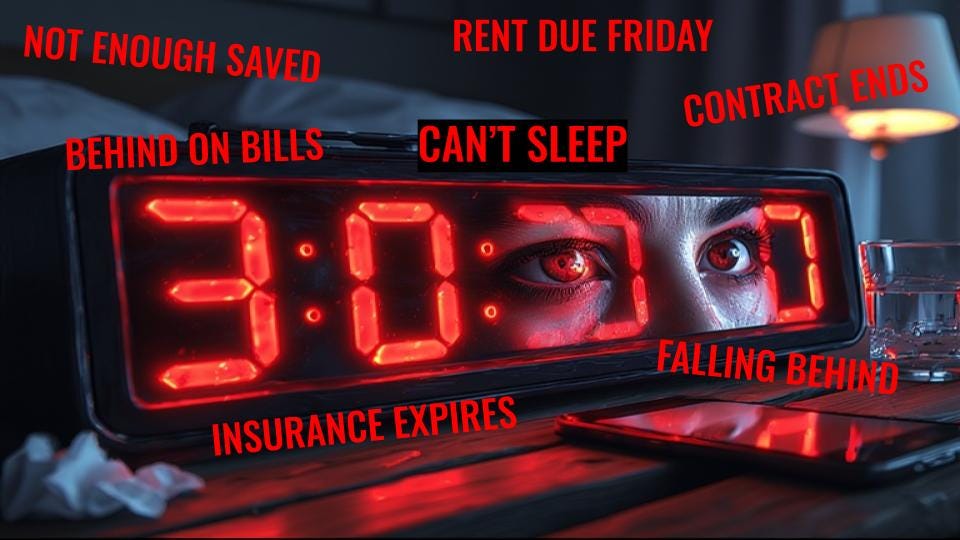
It starts at 3am.
Eyes snap open. Heart already racing. The mental ticker tape begins: rent due Friday, health insurance expires next month, contract ends in December, haven't saved enough, never save enough, falling behind, always behind, relationships are crumbling, never going to get ahead, if I can’t sleep soon tomorrow will be awful.
The chest tightness follows. That familiar weight pressing down, making each breath feel borrowed. By morning, you're exhausted from fighting battles that exist entirely in a future that may never come. But probably will. Because these days, the worst-case scenarios often keep coming true.
Everyone you know is struggling with some version of this. Anxiety has become our shared language. "How are you?" gets answered with nervous laughter and "You know, hanging in there." Similar to “How’s it going?” being met with a shrug and “it’s…going!” We trade coping mechanisms like recipes: meditation apps, breathing exercises, CBD oils, prescription names whispered like incantations.
We've been taught to see this as personal failure. Not strong enough. Not mindful enough. Not grateful enough. But here's what they don't want us to understand: when everyone is anxious, it's not a million individual problems. It's one big system working exactly as designed.
This isn't a bug. It's a feature.
II. Manufacturing Instability (The Material Roots)
Precarity isn't new, but its totalizing nature is. Previous generations faced uncertainty, but they also had anchors: stable jobs, predictable pensions, affordable housing, the reasonable expectation that hard work led somewhere. Those anchors have been systematically destroyed.
Consider the math of modern existence. The gig economy promises "flexibility" but delivers chaos — income that fluctuates wildly, no benefits, no security, always one algorithm change away from destitution. Add student debt that compounds faster than wages grow. Layer on housing costs that devour 50% or more of income. Healthcare tied to employment you can lose at will. Retirement a fantasy you can't afford to imagine.
This isn't accidental. Unstable workers are ideal workers under capitalism. Too anxious to organize. Too desperate to demand better. Competing against each other for scraps instead of questioning who took the meal. The destruction of predictability isn't collateral damage — it's the point.
As Paul Harrison recently noted in The Conversation, we now have executives openly admitting they're part of the "anxiety economy." The CEO of Life360 — an app that tracks family members' locations — casually acknowledged her company profits from parental fears. But this is bigger than tracking apps. It's an entire economic system that cultivates anxiety, harvests it, and sells it back to us as solutions that only deepen the original wound.
The formula is elegant in its cruelty: Create instability. Monetize the fear. Repeat.
III. The Architecture of Anxiety
The machinery of precarity operates through interlocking systems, each reinforcing the others in a perfect storm of instability.
Work: The foundation of the anxiety architecture. At-will employment means you can be fired for any reason or no reason. The gig economy fragments work into "tasks" with no benefits, no protection, no future. Even "good jobs" demand perfectionism that, as Leslie notes in her Medium piece, transforms "healthy striving into pathological perfectionism." We internalize the overseer, monitoring ourselves more harshly than any boss could.
Housing: When half your income goes to rent, every month becomes a high-wire act. One missed paycheck means eviction. No wonder we accept any abuse at work — homelessness lurks one conflict away. The housing crisis isn't separate from workplace exploitation; they're dance partners in the precarity waltz.
Healthcare: Tied to employment you can lose at any moment. Need therapy for work-induced anxiety? Better keep that job to maintain insurance. It's a hostage situation dressed up as a benefit package. Miss open enrollment? Hope you don't get sick. Lose your job? Your prescriptions just became unaffordable luxuries.
Relationships: Precarity infects our personal lives too. How do you build lasting connections when you might need to move for work? How do you plan a future with someone when you can't plan next month? Dating becomes networking. Friends become potential roommates. Every relationship carries the shadow of economic calculation.
And through it all, the phone - that portal of perpetual anxiety. Always on call for the gig that might come through. Always checking for the email that could end everything. Always scrolling through others' curated lives, measuring your instability against their performed success. As the Life360 CEO admitted, tech companies literally profit from our need to monitor, track, and try to control what can't be controlled.
The architecture works because each pillar supports the others. Lose your job, lose your health insurance, risk losing your home, strain your relationships. It's not a safety net — it's a spider web, and we're not the spider.
IV. Medicalizing Structural Violence
Here's the cruelest trick of all: they've convinced us that our perfectly rational response to irrational conditions is actually a personal defect.
You can't sleep because you're worried about making rent? That's "generalized anxiety disorder." Exhausted from working three gigs with no benefits? Must be "depression." Can't focus in an open office with constant Slack notifications? Sounds like "ADHD." The therapy industrial complex, as NeuroLaunch's editorial team notes, has turned "every emotional hiccup" into a disorder requiring professional intervention.
The system creates the conditions for distress, then sells us the cure. But the cure never addresses the cause — it just helps us tolerate the intolerable. As Leslie observes, "The growing mental health industry itself demonstrates capitalism's remarkable ability to monetize the very problems it creates." Workplace stress generates demand for therapy, which becomes packaged as another consumer service.
The pharmaceutical companies have perfected this game. Feeling anxious about precarious employment? Here's a pill. Can't afford the pill? That'll make you more anxious. Need therapy to deal with the anxiety about affording anxiety medication? That'll be $200 per session, and your insurance covers 10 sessions per year. The therapy industrial complex promises "quick fixes for complex psychological issues," but what if the issues aren't psychological? What if they're economic?
Self-care becomes the ultimate deflection. Burned out from working 60-hour weeks? Try this meditation app. Can't afford vacation? Practice gratitude. Worried about climate collapse? Have you considered yoga? These aren't solutions — they're pacifiers, designed to quiet our distress without addressing its source.
The message is clear: if you're struggling, it's because you're not managing your mental health properly. Not because wages have stagnated while costs have soared. Not because job security has evaporated. Not because the social safety net has been shredded. No, it's because you haven't downloaded the right app or found the right therapist or tried the right medication.
This isn't to dismiss the reality of mental illness or the value of good therapy. But when everyone is anxious, when depression rates soar alongside inequality metrics, when suicide becomes a "death of despair" epidemic — maybe we need to look at the conditions creating the distress, not just the distress itself.
V. The Anxiety Economy
Charles Hugh Smith and his correspondent Bart D. have given this nightmare a perfect name: the Anxiety Economy. An economy literally designed to make us feel "uncertain about our ability to meet future needs" while "actively blocking people from disengaging." Let's follow the money. Who profits when anxiety becomes the baseline human condition?
Big Pharma leads the parade. Antidepressants, anti-anxiety meds, ADHD medications — a $15 billion market in the US alone. They're not curing anxiety; they're managing it, ensuring a customer base that needs refills forever. Side effects? Try this other medication. Can't afford it? That's another source of anxiety we can medicate.
The Wellness Industry swoops in for those who distrust pharma. Meditation apps (calm your mind for $14.99/month), wellness retreats ($3,000 to learn to breathe), productivity planners (organize your way out of systemic chaos). As Leslie noted, even "digital detox retreats" commodify the solution to problems created by commodification itself.
Insurance Companies feast on manufactured fear. As Smith observes, we're "bombarded with stories of house fires, chronic illnesses and car crashes" that "make us feel that the risks we face are way bigger than they actually are." Every anxiety becomes an insurance product. Pet insurance. Identity theft insurance. Insurance for your insurance.
Productivity Apps promise to help you squeeze more output from your depleted self. Time trackers, focus apps, optimization tools — because surely the problem is your inefficiency, not that you're doing three people's jobs. The perfect scam: selling solutions to problems created by the very system selling the solutions.
But here's the deeper horror: anxious workers are profitable workers. Too stressed to organize. Too precarious to resist. Competing against each other for scraps instead of questioning who took the meal. The anxiety isn't a bug — it's the product. As Paul Harrison noted about Life360, executives now openly admit they're part of the "anxiety economy," monetizing our fears.
The productivity paradox reveals the scam: anxious workers work more hours but produce less value. We're hamsters on wheels, running faster to stay in place. Burnout becomes a feature, not a bug — it ensures a constantly refreshed supply of desperate workers willing to accept any conditions.
The connection to "deaths of despair" — suicide, overdose, alcoholism — shows where this leads. When anxiety becomes unbearable, when the treadmill never stops, some people simply step off. These aren't personal tragedies; they're systemic murders. The anxiety economy doesn't just profit from distress; it literally kills.
VI. From Individual Suffering to Collective Power
Here's the secret they don't want you to discover: anxiety thrives in isolation but withers in solidarity.
The relief that washes over you when someone says "me too, I thought it was just me" — that's not just emotional comfort. That's political awakening. It's the moment you stop seeing your struggles as personal failures and start recognizing systemic patterns. It's the difference between thinking "I'm bad with money" and realizing "wages haven't kept up with costs for 40 years."
History shows us what happens when precarious people find each other. The Great Depression didn't break Americans — it radicalized them. Factory workers who'd been told they were replaceable built unions that transformed the economy. Farmers facing foreclosure organized and literally blocked sheriff's sales. The unemployed formed councils and demanded — and won — relief programs. Misery became militancy when people realized their individual struggles were collective conditions.
Today's precarity is creating its own forms of resistance. Starbucks workers, despite every union-busting tactic, are organizing store by store across the country. Graduate students are recognizing they're workers, not apprentices. Tenants are forming unions. Mutual aid networks — people directly helping people without profit motive — are exploding in every city.
The relief of realizing it's not just you is step one. Step two is understanding that if it's not just you, then individual solutions won't work. You can't self-care your way out of systemic exploitation. You can't budget your way out of poverty wages. You can't meditate your way out of precarity.
But here's what you can do: talk to your coworkers about wages. Share your salary. Question why your boss makes 300 times what you do. Join or form a union. Show up for your neighbors. Build networks of support that exist outside the market. Practice saying "no" to impossible demands — and backing up others who do the same.
The anxiety economy requires our isolation. Every person who thinks their struggles are personal failures is a person who won't fight back. But every conversation that breaks that isolation weakens their control. Every time we choose solidarity over competition, mutual aid over market solutions, collective action over individual coping — we chip away at the system that profits from our distress.
This isn't about positive thinking or believing everything will be okay. It's about recognizing that our anxiety has material causes and material solutions. It's about understanding that the same system creating our individual distress creates the conditions for collective resistance. We're not anxious because we're weak. We're anxious because we're human beings trying to survive in an inhumane system. And humans, when we come together, have a remarkable history of changing systems that seem unchangeable.
The choice isn't between anxiety and calm. It's between isolated suffering and collective power. Between accepting that this is just how things are and insisting that another world is possible. It is. We've done it before. We're doing it now, in a thousand small ways that don't make headlines but make survival possible. And we'll keep doing it, together, until anxiety is just a feeling again — not an entire economy.
References
Leslie. (2025, May 20). The Anxiety Economy: How Late-Stage Capitalism Manufactures Mental Distress. Medium. https://medium.com/perspective-matters/the-anxiety-economy-how-late-stage-capitalism-manufactures-mental-distress-87e75ebf6cf1
NeuroLaunch.com. (2024, October 1). Therapy Industrial Complex: Examining the Commercialization of Mental Health care. https://neurolaunch.com/therapy-industrial-complex/#google_vignette
Smith, C. H. (2024, June 24). The anxiety economy. Axisofeasy.com. https://axisofeasy.com/oftwominds/the-anxiety-economy/
Vass, S. (2025, September 17). The ‘anxiety economy’ is booming. But should companies be profiting from our fears? The Conversation. https://doi.org/10.64628/aa.cwnsfmju7
____________________________________________________________________________
Means and Meaning publishes every Tuesday. If you found value in this analysis, I'd be very grateful if you'd consider buying me a coffee — your support helps me dedicate time to this work while keeping all content free and accessible.
You can also support this project by subscribing (it's free!), sharing with others who might appreciate it, or joining the conversation in the comments. Sometimes the best antidote to anxiety is knowing you're not alone in seeing what's happening.
Next week, we'll examine another piece of the machinery — and another opportunity to resist it.
Until then, keep questioning, keep connecting and keep believing that another world is possible.
~ Chris
Great article! You are sooo right. We are up against a system meant to hold us back and there is no individual resolution.