


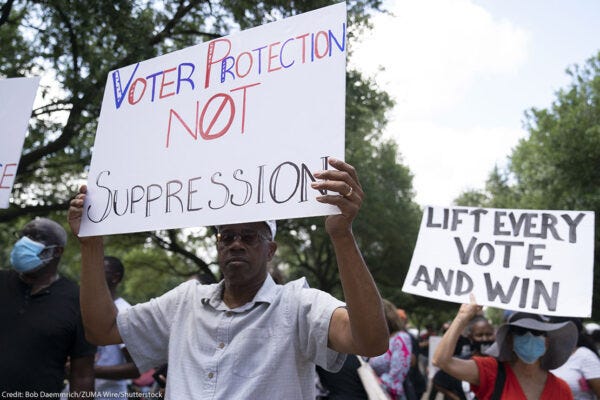
The Quiet War is an ongoing series about the war that doesn’t make the front page. Each installment traces the infrastructure of repression being built while most people’s attention is elsewhere: the surveillance systems, the detention machinery, the erosion of rights that happens not in dramatic confrontation but in court rulings, executive orders, and procurement contracts. Sometimes that infrastructure targets people. Sometimes it targets the vote itself. This war is quiet by design. Naming it is the first act of resistance.
I. The Machine
No president in American history has ever canceled a federal election. Not during the Civil War, when 600,000 Americans were dying. Not during two World Wars. Not during the Great Depression. But this president has floated the idea multiple times, telling Reuters “we shouldn’t even have an election” and remarking to Zelensky that canceling elections during a war sounded like “a good thing.” His press secretary assured the country he was joking.
As it turned out, he wasn’t building the machinery to cancel the election. He was building the machinery to control its outcome.
Three days ago, the Postmaster General testified before Congress that the Postal Service would restrict the delivery of mail-in ballots in states that refuse to hand over their voter rolls to the federal government. Three weeks ago, the Supreme Court completed what Justice Kagan called the “now-completed demolition of the Voting Rights Act,” a ruling she warned lays the groundwork for “the largest reduction in minority representation since the era following Reconstruction.” Last month, Tennessee eliminated its only majority-Black congressional district, in Memphis, the city where Martin Luther King Jr. was assassinated. ProPublica has documented that at least 75 career election security officials across the federal government have been replaced by roughly two dozen political appointees, ten of whom actively worked to overturn the 2020 election.
The people who held the line last time are gone. The people who tried to break it are now in charge.
This is not a collection of separate news stories. It is an architecture, built deliberately across courts, legislatures, executive orders, and now the postal service, designed to ensure that the most fundamental act of democratic participation cannot threaten the structure of power. The Quiet War came for surveillance. It came for protest. This week, it came for the vote.
II. The Courts
The quietest weapon in the machine is the one most people never hear firing.
In 2013, the Supreme Court gutted Section 5 of the Voting Rights Act, the provision that required states with histories of voter suppression to get federal approval before changing their election rules. In 2021, the Court gutted Section 2 as applied to voting restrictions, making it effectively impossible to challenge discriminatory barriers to casting a ballot. And this April, in Louisiana v. Callais, the Court finished the job, eviscerating Section 2 as applied to redistricting. Justice Kagan, joined by Sotomayor and Jackson, called it “this latest chapter in the majority’s now-completed demolition of the Voting Rights Act.” Three rulings across thirteen years. The demolition was incremental, procedural, and by the time the full picture became visible, the structure was already gone.
The practical consequences arrived immediately. In an unsigned shadow docket order, the Court allowed Alabama to implement a redistricting map that multiple lower courts had found to be intentionally discriminatory against Black voters, reassigning hundreds of thousands of voters to new districts in a matter of days. In Tennessee, the governor signed new district lines that carved up Memphis, the state’s only majority-Black congressional district, and distributed those voters across multiple white districts. The NAACP’s General Counsel, Kristen Clarke, did not mince words: “A democracy without Black representation is not a democracy. This is where the KKK was born and where MLK was assassinated.”
In North Carolina, state Representative Rodney Pierce, a Black Democrat, dropped his redistricting lawsuit entirely. “There is no longer a path open to us to protect the voting rights of Black citizens in my part of the State,” he said. “It’s a sad day for our democracy.” Fair Fight Action and Black Voters Matter Fund estimate that close to 200 state legislative seats, mostly representing majority-Black districts in the South, are now at risk of elimination.
The vote still exists. The legal infrastructure to make it meaningful has been methodically dismantled. As Justice Marshall once wrote, and Kagan echoed this spring, what remains is “the right to cast meaningless ballots.”
III. The Postal Service and the Purge
Three days ago, Postmaster General David Steiner sat before the Senate and confirmed that the United States Postal Service, a constitutionally mandated institution older than the political parties themselves, would restrict the delivery of mail-in ballots in states that refuse to surrender their voter rolls to the federal government. He framed the proposal as ensuring “the right ballots are going to the right people.” Senator Elissa Slotkin framed it differently, calling Steiner a “pawn” and warning: “The Postal Service is one of the most important institutions in our country. Don’t taint it with the obsession of this one man.”
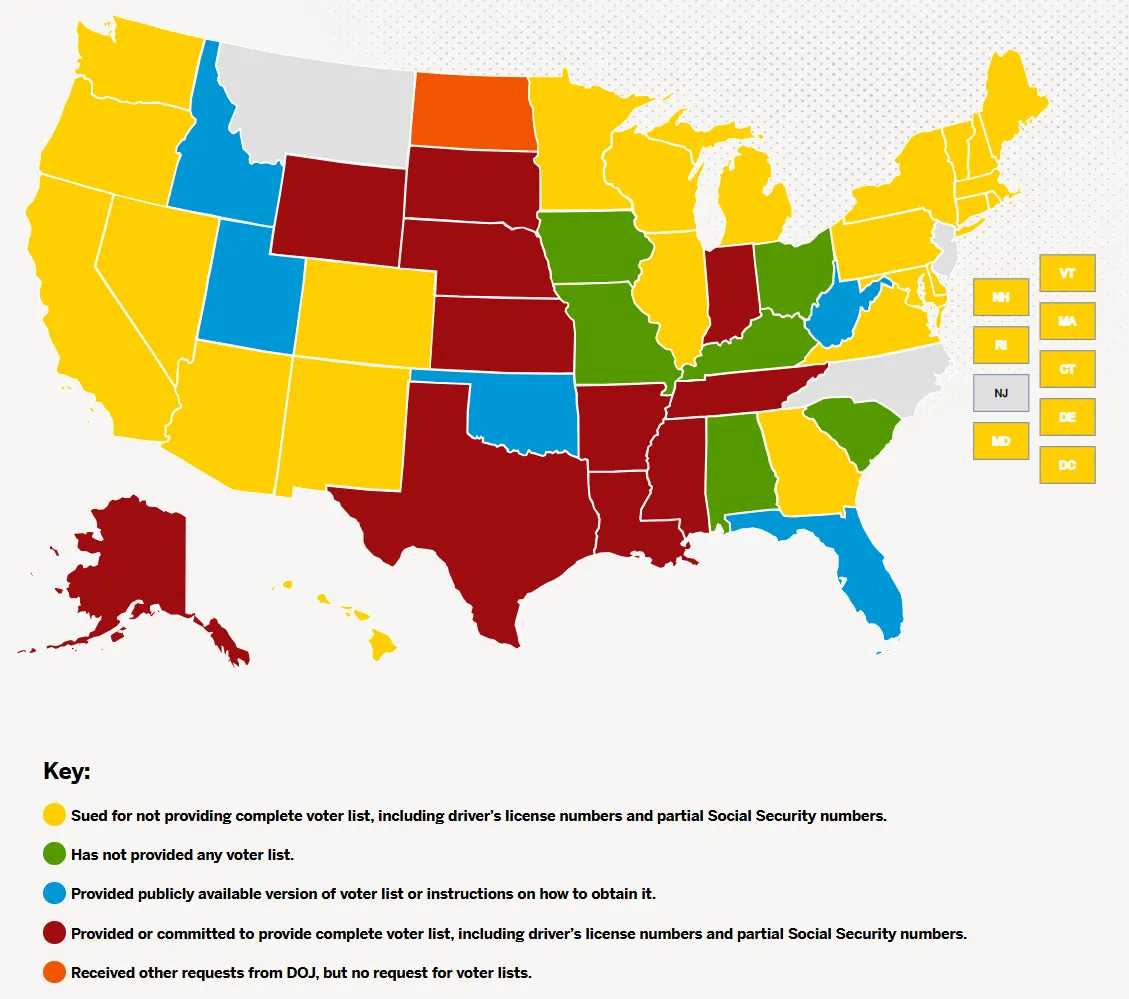
The voter rolls Steiner wants are the same ones the Department of Justice has sued 24 states to obtain, data that includes names, addresses, dates of birth, Social Security numbers, party affiliation, and voting history. Eleven states have already complied. In those states, voter data was funneled through a system called SAVE, a database originally built to verify immigration status for Medicaid and food assistance, never designed for elections, and modified by DOGE engineers to process bulk voter queries. Over 33 million voters have been run through it. When Texas checked the results, roughly 25% of those flagged had already provided proof of citizenship. Nearly 70% had previously documented their eligibility. The system is engineered to produce false positives at scale, and every false positive is a citizen who must prove they belong or lose their registration. Federal Judge David Carter, reviewing the DOJ’s campaign, called it “unprecedented and illegal” and wrote: “The taking of democracy does not occur in one fell swoop; it is chipped away piece-by-piece until there is nothing left.”
Meanwhile, Congress is working to codify the machinery. The MEGA Act would mandate centralized voter databases in every state, require purges every 30 days using these same error-prone federal systems, place flagged voters on publicly available lists, impose strict photo ID requirements, and ban universal mail voting. More than 69 million women who changed their name at marriage would find a birth certificate alone insufficient to register. Over 21 million voting-age citizens lack easy access to documents proving citizenship. The burden of proof falls entirely on the citizen, every single time.
And then there is the intimidation. Steve Bannon, one of the president’s closest allies, pledged on his podcast that “we’re going to have ICE surround the polls come November,” and went further the next day, calling for U.S. Army troops at polling sites, despite federal law prohibiting military deployment at elections. Senator Mark Warner explained why such threats work even if they are never carried out: “You don’t need to do a lot to discourage people from voting.” One ICE vehicle parked outside a polling place in a Latino neighborhood does the work of a thousand purged registrations. The chilling effect does not require execution. It requires only the credible promise of force.
IV. What the Machinery Protects
This spring, the administration started a war with Iran that closed the Strait of Hormuz, spiked fuel prices, drove inflation to its highest point in years, and cratered the president’s approval into the high 30s. Working families are choosing between groceries and gas. The administration’s response has not been to address the pain. It has been to build an architecture ensuring that the pain cannot be expressed through the ballot box. Gramsci had a term for the moment when a ruling class can no longer generate consent: hegemonic crisis. The response is never to change course. It is to constrain the mechanisms through which dissent is expressed.
Two days ago, Speaker Mike Johnson made that logic explicit. Speaking to donors at the Faith and Freedom Coalition conference, he warned that if Democrats win the House, “impeachment’s not even the big concern. They’ll go after Trump’s family, donors, friends and Cabinet members. Half of you in this room will be targeted. I run the protection program. I’ll take care of you.” The Speaker of the House just described his constitutional role as running a protection racket for the president’s inner circle. That is what the machinery protects. Not the republic. Not the voters. The impunity of the people in the room.
Hannah Fried of All Voting Is Local, who watched the 2020 overturn attempt from the inside, put it plainly: “Election deniers don’t have to change the laws or the policies. They will take what they want by any means.” And Brendan Fischer of the Campaign Legal Center named what ProPublica documented: “The election denial movement is now interwoven within the federal government.” It is no longer a movement trying to capture the state. It is the state.
The Quiet War’s two fronts are now complete. Contain the protest. Constrain the vote. Neither dissent nor democracy can reach the people making the decisions.
V. What You Need To Do
Forty-three weeks ago, this publication began with a piece about ICE and the language of disappearance. I argued that when the state removes a person from their community and deposits them into a system designed to make them invisible, we should call that what it is. Since then, I have traced the architecture of that disappearance across surveillance systems, detention machinery, free speech zones, and the containment of protest. Each piece has documented a different mechanism. Each mechanism serves the same function: making dissent invisible to the people in power.
This piece documents the final mechanism. The machinery is no longer designed to disappear people, though it still does that. It is designed to disappear the vote itself. Not by banning elections, which would be too visible, and too obviously unconstitutional. But by chipping away at the infrastructure of participation until the election still happens but its outcome has been determined before a single ballot is cast. Gerrymandered maps that predetermine winners. Voter purges that remove citizens from the rolls using databases that flag the eligible and the ineligible alike. A postal service that would refuse to deliver your ballot unless your state surrenders your data. Judges who gut the laws that protect your representation. And a Speaker of the House who tells a room full of donors that his job is running a protection program for the president’s inner circle.
The machinery has one vulnerability. It is calibrated for low turnout. Every tactic documented in this piece is designed to reduce participation, not to withstand a surge of it. Suppression works in the margins. It does not survive overwhelming numbers.
So here is what I need you to do, not eventually, not when it feels convenient, but now. Check your voter registration today. If you have moved, re-register immediately. Learn your state’s deadlines for mail-in ballots, early voting, and registration. Make a voting plan and write it down. Then talk to five people this week. Ask if they are registered. Ask if they have a plan. Help them make one. Do not assume someone else will do this. The machinery is counting on exactly that assumption.
November 3, 2026. The most important thing you will do this year is not reading this piece. It is casting a ballot and making sure everyone around you does the same. The machine they built while you weren’t looking has one flaw they are praying you won’t discover: what happens when you show up anyway?
References
Berman, A. (n.d.). Project 2026: Trump’s plan to rig the next election. Mother Jones. https://www.motherjones.com/politics/2025/09/donald-trump-plan-to-rig-2026-midterm-elections-voter-suppression-gerrymandering-certification/
Clark, D. B., & Fifield, J. (2026, April 13). Inside Trump’s effort to “Take over” the midterm elections. ProPublica. https://www.propublica.org/article/trump-midterm-elections-takeover?utm_campaign=propublica-sprout&utm_content=1780137527&utm_medium=social&utm_source=facebook&fbclid=IwY2xjawSUFFhleHRuA2FlbQIxMABicmlkETE4OVJOcXhYTWVvcG82ZlRVc3J0YwZhcHBfaWQQMjIyMDM5MTc4ODIwMDg5MgABHmhSZVMjmUuHOHazK32NR43JhHYl6o8Wo9i0ULoK2erd5LQ8xIjivnS1YUoh_aem_rM6C3RC1Sdq5yovMPezkqg
Commander, A. (2026, June 26). Mike Johnson warns impeachment not ‘The big concern’ if DEMs win midterms. Newsweek. https://www.newsweek.com/mike-johnson-warns-impeachment-not-the-big-concern-if-dems-win-midterms-12128568
Dallek, R. (2026, June 9). Talk of canceling elections shows Trump is unfit for office. The Bulwark.

Ibarguen, E. (2026, June 24). Postal Service would restrict mail-in voting under Trump proposal, chief says. Politico. https://www.politico.com/news/2026/06/24/usps-mail-in-voting-state-voter-rolls-00974142
Jackson, M. (2026, June 8). Donald Trump will resign in 2027. The first domino falls this November. Uncensored Objection. Law. Facts. No Spin.

Lithwick, D., & Stern, M. J. (2026, June 3). The Supreme Court just transformed its horrible voting rights ruling into something more calamitous. Slate Magazine. https://slate.com/news-and-politics/2026/06/supreme-court-alabama-map-voting-horror-alito-sotomayor.html
Lo Wang, H. (2026, May 18). Why the Supreme Court’s voting rights ruling could play a big role at the local level. NPR. https://www.npr.org/2026/05/18/nx-s1-5812837/supreme-court-voting-rights-act-state-local-redistricting
LOUISIANA v. CALLAIS. (2026). In S. Court, SUPREME COURT OF THE UNITED STATES. https://www.supremecourt.gov/opinions/25pdf/24-109_21o3.pdf
Resistance, C. (2026, February 2). Midterms 2026: The machine they built while you weren’t looking. Critical Resistance.

Rumpf, S. (2026, May 8). NAACP Sues Tennessee Over Redistricting That Wiped Out State’s Only Majority-Black District. Mediaite. https://www.mediaite.com/politics/naacp-sues-tennessee-over-redistricting-that-wiped-out-states-only-majority-black-district/
Tomasky, M. (2026a, February 27). It Can Now Be Plainly Said: Trump Is Planning a November Coup d’État. The New Republic. https://newrepublic.com/post/207138/trump-coup-detat-midterm-elections?utm_campaign=SF_TNR&utm_source=Facebook&utm_medium=social&fbclid=IwY2xjawSBPc1leHRuA2FlbQIxMABicmlkETFFT0hqczJtRDZrYWduQ2s4c3J0YwZhcHBfaWQQMjIyMDM5MTc4ODIwMDg5MgABHnx4JHVNw4f2ZAssSTR-Rzkvm6arshQfYNMawUzQDvS98JVySD1PmZRV7kmY_aem_Z-8-jAfUfdLSfNLBPG6Kdg
Wendler. J. (2026, February 8). Democrats sound alarm about possible voter intimidation in midterms. Politico. https://www.politico.com/news/2026/02/08/democrats-sound-alarm-voter-intimidation-midterms-00770677
____________________________________________________________________________
Means and Meaning publishes every Tuesday. If you found value in this analysis, I’d be very grateful if you’d consider buying me a coffee — your support helps me dedicate time to this work while keeping all content free and accessible.
You can also support this project by subscribing (it’s free!), sharing with others who might appreciate it, or joining the conversation in the comments. Sometimes the best antidote to anxiety is knowing you’re not alone in seeing what’s happening.
Next week, we’ll examine another piece of the machinery — and another opportunity to resist it.
Until then, keep questioning, keep connecting, and keep believing that another world is possible.
~ Chris