


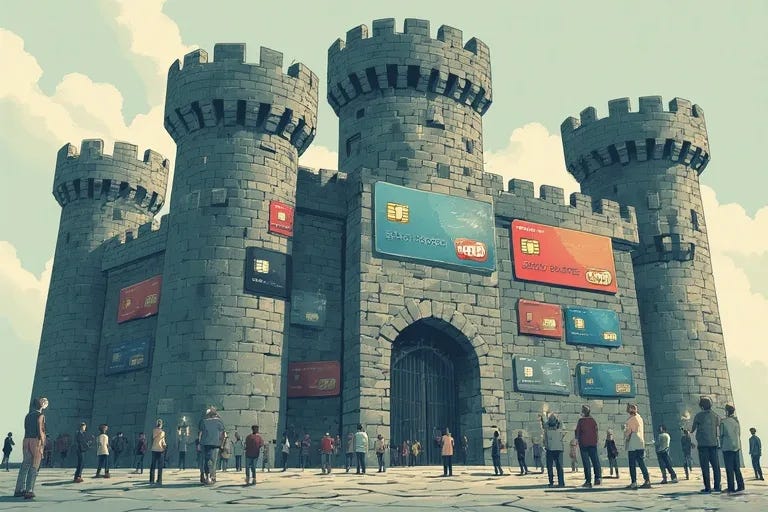
I. The Monthly Drain That Never Ends
Try to cancel any subscription and watch the maze unfold. Exit buttons that don't work. "Special offers" to reconsider. Chat windows begging you to stay. Twenty minutes later, you might escape — or you might somehow end up paying more than before.
This is the new normal: a life lived in monthly installments, where ownership is obsolete and every company wants to be your digital landlord.
Check your bank statement. Count the recurring charges. Software that used to come in a box. Music you once owned on disc. Features in your car that were built in but now require activation. Even your grocery store wants you to subscribe for free delivery — as if buying food weren't recurring enough.
We joke about "subscription fatigue," but what we're really describing is something more sinister: the complete transformation of customers into revenue streams, of products into services, of ownership into eternal debt.
And here's the thing that should terrify us: we're not just renting entertainment or software anymore. We're renting access to basic functionality. We're paying, forever, for things that used to be ours. We've entered the age of rentier capitalism perfected — where everything is landlord, and everyone is tenant.
II. From Ownership to Eternal Renting (The Political Economy)
Rentier capitalism isn't new. It's as old as feudalism, where lords extracted wealth simply by owning land. But today's digital rentiers have perfected the art: they've made us pay rent on things that cost nothing to reproduce.
Think about what Adobe did. They used to sell Photoshop in a box — you bought it, you owned it, it worked forever. Now? Creative Cloud subscriptions extract $60/month, forever. The software isn't meaningfully better. Adobe just realized they could make more money as digital landlords than as producers.
This is rentier capitalism in its purest form: income derived from ownership of assets rather than from productive activities. And here's the perverse genius — in the digital realm, the "asset" costs nothing to duplicate. Every new subscription is pure profit extraction.
The shift happened gradually, then suddenly. Companies discovered that Wall Street loves "recurring revenue." Stock prices soar when firms announce they're moving to subscription models. Why? Because predictable extraction beats innovation every time. Why improve your product when you can just lock customers into monthly payments?
Microsoft forces Office into subscriptions. Car companies make heated seats a monthly fee. Peloton charges you to use the bike you already bought. Even farmers can't repair their own tractors without paying John Deere for software access. Every industry is asking the same question: how can we transform customers into tenants?
This isn't innovation. It's not "disruption." It's the return to feudalism, dressed up in Silicon Valley rhetoric. We're witnessing the systematic transformation of an ownership society into a rentier's paradise — where a tiny class extracts wealth from everyone else, forever, for access to things that already exist.
III. The Architecture of Digital Feudalism
Map the subscription sprawl in your life. It's everywhere, metastasizing across every industry like digital kudzu.
Entertainment: Netflix, Hulu, Disney+, HBO Max, Apple TV+, Spotify, YouTube Premium. Remember when we complained about cable bundling? Now we've recreated it at twice the price.
Work: Microsoft Office, Adobe Creative Suite, Zoom, Slack, every specialized software that once came on a disc. Your tools of production are now held hostage monthly.
Fitness: Peloton bikes that won't function without subscriptions. Tonal machines — thousands of dollars of equipment mounted to your wall that becomes useless without $60/month access. Apps that lock your own workout data behind paywalls.
Transportation: BMW charging for heated seats. Tesla's "Full Self-Driving" as eternal promise, eternal payment. Features built into your car, waiting to be "unlocked" by your credit card.
Even the absurd: Subscription toothbrushes. Monthly sock deliveries. "Surprise" box services that commodify the act of shopping itself.
The architecture is deliberate. Free trials that require credit cards. Cancellation processes designed by psychological warfare experts. Annual "deals" that lock you in. Features gradually moved behind paywalls — what was free yesterday costs extra today.
They've built a maze where escape requires effort, but staying requires only inertia. Where ownership is impossible and access is contingent. Where missing a payment doesn't just mean losing service — it means losing your critical work files, your carefully-crafted playlists, your detailed fitness history, your digital life.
This is digital feudalism: a system where you own nothing, rent everything, and live at the mercy of terms of service that change at corporate whim. Where your home gym equipment becomes a very expensive wall decoration if you miss a payment.
IV. The Language of Extraction
They've weaponized language to make theft feel like innovation.
"Software as a Service" — No, it's Software as a Shackle. The software already exists. The "service" is them allowing you to use what you used to own.
"Membership benefits" — Translation: We've taken basic features and locked them behind a paywall. Your "benefit" is accessing what should be standard.
"Convenience" — The ultimate con. Is it convenient to manage 47 different subscriptions? To never truly own anything? They've redefined convenience as dependence.
"Ecosystem" — Not a thriving natural environment, but a digital trap where everything requires everything else. Leave Apple's "ecosystem" and watch your life fall apart.
"Freemium" — Here's a broken version. Want it to actually work? Pay forever.
"Cancellation protection" — Protection from what? From keeping your own money?
"Seamless experience" — So seamless you don't notice the hand in your pocket every month.
"Unlock premium features" — They're already in the product. You're not unlocking them; you're paying ransom for your own device's capabilities.
Watch how they frame it as freedom: "No large upfront costs!" "Always the latest version!" "Access anywhere!" But what they're really saying is: You'll never stop paying. You'll never own anything. You'll never be free.
The most insidious part? They've convinced us to use their language. We say "I have Spotify" not "I rent access to music." We say "my Creative Cloud" not "Adobe's software I'm leasing." The colonization is so complete we've internalized our own exploitation.
When language shapes thought, and they control the language, they control how we think about our own dispossession. As the anti-apartheid activist Stephen Biko once reminded us: “The most potent weapon in the hands of the oppressor is the mind of the oppressed.”
V. Following the Money Up
Let's do some napkin math that will ruin your day.
The average American household now spends $273/month on subscriptions. That’s $3,276 yearly - more than many people’s annual raise. More than many get back in tax refunds. Money that flows relentlessly upward, month after month, creating wealth for shareholders while the rest of us get poorer by autopay.
Think about Adobe. They turned Photoshop from a one-time purchase into an eternal payment plan. What used to cost $700 once now costs that every single year — forever. It's the same software. Same features. But now it's a hostage you pay ransom on monthly.
This model was so profitable that every company copied it. Microsoft Office became Microsoft 365. Useful apps became subscription traps. Your car's heated seats became a monthly fee. And here's the sick irony: a whole new industry has emerged to "help" you manage subscriptions. Truebill, Trim, Rocket Money — apps that take a cut to cancel the services you forgot you had. Capitalism creating problems to sell solutions to the problems it created. It's extraction all the way down.
The stock market tells the real story. When companies announce subscription transitions, share prices soar. Investors know recurring revenue is the holy grail — predictable, growing, unstoppable. Every subscriber is an annuity. Every customer a captured revenue stream.
This isn't conspiracy. It's celebrated openly in earnings calls: "subscriber retention," "negative churn," "lifetime value." They're not talking about providing value to you. They're calculating how much value they can extract from you before you break.
The connection to housing is obvious: when everything's rent, no one builds wealth except landlords. Digital or physical, the principle remains: those who own extract from those who don't, forever, until there's nothing left to extract.
VI. Where It All Points
We've been here before. Feudalism: where lords owned everything and serfs paid eternal rent for the privilege of existing. We called it progress when that system died, when ownership became possible for ordinary people. Property rights, we were told, were the foundation of freedom itself.
Now we're speedrunning backward. The lords are digital, the manor is a server farm, but the relationship is the same: they own, we pay, forever. This is capitalism eating its own promises. The American Dream was built on ownership — your own home, your own car, your own business. Work hard, save money, buy things, build wealth. That was the deal. But rentier capitalism breaks the deal entirely. No matter how hard you work, you'll never own the tools you need. No matter how much you save, it all flows upward in monthly installments.
What happens when an entire generation never owns anything? When homes are unaffordable, cars are leased, music is rented, and even your resume template requires a subscription? When the concept of "mine" becomes meaningless because everything is contingent, temporary, revocable?
We're finding out. It's a generation that can't build wealth, can't pass down assets, can't achieve the stability their parents took for granted. It's learned helplessness as economic policy. It's feudalism with better marketing.
But here's what they don't want us to notice: the seeds of resistance are already sprouting. Piracy is surging — not because people are thieves, but because they remember what ownership felt like. Open-source alternatives multiply. Password sharing becomes an act of solidarity (especially when streaming companies clamp down on attempts to do so). Communities build free versions of what corporations lock away. Every cracked software, every shared login, every libre alternative is a small insurrection against the rentier class.
The system seems totalizing, but it's more fragile than it looks. It depends on our compliance, our exhaustion, our resignation. It requires us to accept that this is just how things are now.
But we don't have to accept it. We can share. We can build. We can refuse. We can remember that everything they charge us to access costs them nothing to provide. We can demand a world where technology serves human flourishing, not endless extraction.
The subscription model isn't inevitable. It's a choice — their choice to extract, our choice to resist. Another world is possible. One where we own our tools, our creations, our lives. Where innovation serves humanity, not shareholders. Where the digital commons belongs to everyone.
That world begins the moment we stop clicking "agree" and start asking why we're paying rent for what should be ours.
References
Greig, J. (2021, September 21). Average consumer spending $273 per month on subscription services: report. ZDNET. https://www.zdnet.com/article/average-consumer-spending-273-per-month-on-subscription-services-report/
—
Means and Meaning publishes every Tuesday. If you found value in this analysis, I'd be grateful if you'd consider buying me a coffee — your support helps me dedicate time to this work while keeping all content free and accessible.
You can also support this project by subscribing (it's free!), sharing with others who might appreciate it, or joining the conversation in the comments.
Next week, we'll examine another piece of the machinery — and another opportunity to resist it.
Until then, keep questioning, keep connecting, and keep believing that another world is possible.
~ Chris
Let's just bring back piratebay.
Although I could not have articulated this as you did Chris, it's something I've been fighting my entire adult life, to the extent of living outside of society most of it. And at 60, that has kept me solvent, independent and without monthly bills other than basic utilities.