


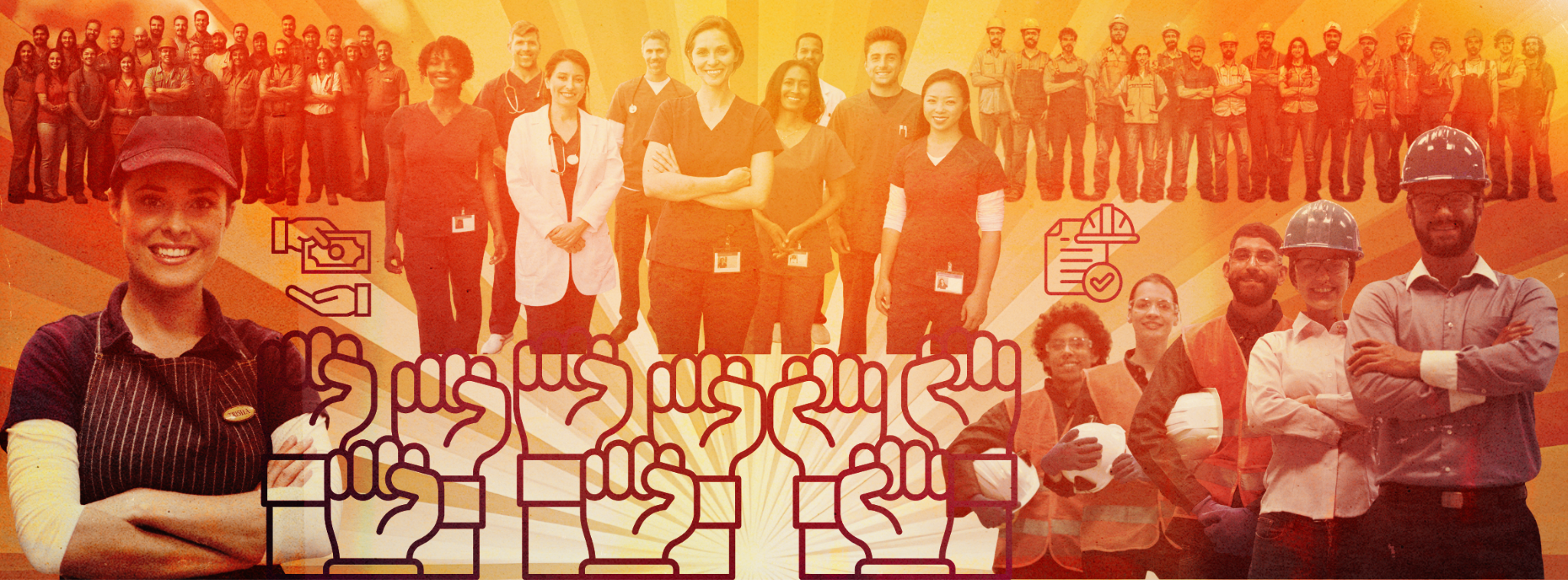
This piece is part of “Workers Rising,” a series celebrating and analyzing labor struggles past and present — from shop floors to app-based gigs, exploring how workers build power against increasingly creative forms of exploitation.
I. Setting the Stage: What Did “Winning” Even Look Like in 2025?
By almost any surface measure, 2025 looked like a bad year for working people. A grinding authoritarian drift. Courts hostile to labor. Capital more consolidated, more algorithmic and more insulated than ever. And to punctuate it all, the longest government shutdown in U.S. history - a 43-day demonstration of how casually workers’ lives can be used as leverage in elite political games.
In moments like this, it’s easy to conclude that labor lost (or at least stalled). There was no single general strike wave that shut the country down. No sweeping pro-worker legislation that reset the balance of power. No dramatic turning point that made exploitation suddenly impossible. For anyone watching headlines instead of shop floors, the year felt defined more by damage control than victory.
But that reaction misunderstands what power looked like in 2025. No, this wasn’t a year of cinematic triumphs. But it was a year of competence. Of workers organizing in industries long written off as impossible, including banking, subcontracted entertainment, tech-adjacent manufacturing, grocery chains, hospitals and federal agencies. Of first contracts secured. Of shutdowns endured collectively rather than individually. Of strikes authorized, injunctions won, pensions defended, rehire protections established and organizing campaigns sustained under open threat.
The question worth asking isn’t whether labor “won big.” It’s whether workers learned how to fight and survive under conditions designed to break them. In that sense, 2025 wasn’t empty. It was instructive.
II. What Was Really Being Fought Over
Beneath the surface diversity of these fights (involving everyone from dockworkers and nurses to bank tellers, writers and federal employees) the conflict was remarkably consistent.
Workers weren’t just asking for “more.” They were pushing back against a system that increasingly treats human labor as a flexible cost to be squeezed, paused, outsourced or even switched off entirely. Whether it was warehouse injury rates, unsafe nurse staffing, contingent contracts in media or federal workers ordered to labor without pay during a shutdown, the underlying message from above was the same: your needs are secondary to the machine.
This is how exploitation works in mature capitalism. Not as a singular villain, but as a structure that extracts time, energy and stability while insulating those at the top from risk. Workers absorb volatility. Corporations pocket predictability.
Union drives and contract fights in 2025 exposed that arrangement by forcing a simple confrontation: labor only functions if workers consent to participate. When that consent is withdrawn, whether through a strike, a work slowdown, a mass authorization vote or even a lawsuit, the system subsequently falters.
What I feel made 2025 notable wasn’t just the number of campaigns, but their clarity. Workers increasingly understood that power doesn’t come from appealing to fairness or corporate goodwill. It comes from organization, coordination and collective leverage. From acting not as isolated employees, but as a social force.
That shift in consciousness matters. Because once workers see themselves as producers of value, and not merely as recipients of benevolence, then the terms of struggle fundamentally change.
III. The Architecture of Precarity
If 2025 taught us anything, it’s that exploitation has gotten more designed. It’s no longer just about long hours or low pay. It’s about building systems where insecurity is the default setting.
Across industries, employers relied on the same architecture. Short-term contracts that reset just before benefits kick in. Staffing algorithms that keep workplaces permanently understaffed. Job “flexibility” that really means unpredictable schedules and disposable workers. Layers of subcontractors and corporate shells that make accountability hard to locate and even harder to enforce.
The government shutdown revealed this logic in a particularly brutal way. Hundreds of thousands of federal workers were deemed “essential” enough to keep working, but not essential enough to be paid on time. The message was unmistakable: continuity of the system mattered more than the lives of the people running it.
Private employers operate on the same principle. Airlines run skeleton crews. Hospitals rely on constant overtime. Warehouses treat injury as churn. Media companies normalize freelance labor without rehire guarantees. Each model shifts risk downward, forcing workers to absorb instability so profits remain smooth at the top.
What unions disrupted in 2025 wasn’t just a paycheck imbalance. They exposed the scaffolding itself, the way precarity is manufactured and enforced. By demanding staffing minimums, rehire protections, guaranteed hours, COLA clauses, and strike-ready contracts workers weren’t asking for luxury. They were demanding insulation from a system designed to keep them permanently off balance.
IV. The Battle Over What Gets Called “Reasonable”
Every labor fight is also a fight over language. Not in some abstract media-theory way, but in the everyday terms that decide what sounds “extreme,” what sounds “practical” and what gets treated as inevitable.
In 2025, bosses and politicians leaned hard on a familiar vocabulary. Shutdowns were framed as “fiscal discipline.” Wage stagnation as “economic reality.” Union demands as “disruptive.” Child labor rollbacks as “flexibility.” Precarious work as “opportunity.” The goal was never persuasion, it was normalization. Make exploitation sound like physics. What workers and their allies did (sometimes quietly, sometimes loudly) was refuse that framing.
When federal employees said it was unacceptable to be ordered to work without pay, they weren’t making a partisan argument. They were redefining what “essential” actually means. When nurses centered safe staffing as patient care, not just labor conditions, they collapsed the false divide between worker and public good. When states moved to ban captive-audience meetings or extend unemployment benefits to striking workers, they rejected the idea that neutrality means subordination.
Even defensive fights mattered here. Blocking child labor expansions. Holding the line on collective bargaining bans. Preventing the erosion of basic protections. These weren’t presented as radical departures, they were framed as common sense, basic dignity and democratic accountability.
That reframing is power. Because once the public starts asking why inflation is treated as unavoidable but poverty wages are treated as policy, the debate shifts. The terms get reset. And suddenly, it’s no longer workers who sound unreasonable - it’s the system that demands endless sacrifice, quietly and without consent.
V. The Numbers Behind the Momentum
Strip away the rhetoric and the pattern becomes visible in the numbers.
Unions won close to 80% of representation elections in 2025. Tens of thousands of workers organized, not just in logistics and manufacturing, but also in banking, healthcare, entertainment, grocery and public employment. First contracts delivered wage increases ranging from the high single digits to nearly 40% over multi-year agreements. Inflation protections returned. Pension plans were defended. Health benefits were preserved where they were under direct attack. And none of this crashed the economy.
During the longest government shutdown in U.S. history, however, 670,000 federal workers were furloughed, 730,000 worked without pay, and at least 60,000 private-sector jobs vanished in the ripple effects. The economy lost $11 billion in permanent output, while members of Congress continued collecting full paychecks. The lesson was brutal but clarifying: workers already subsidize the system with their insecurity.
Against that backdrop, labor’s gains were modest - and that’s precisely the point. These contracts didn’t bankrupt corporations. They barely dented annual profits. What they did was redistribute risk and confidence downward, where it actually changes lives.
When wage increases, job protections, and inflation safeguards are collectively owned and collectively defended, their impact multiplies. They become standards. Reference points. Proof.
Public approval of unions remained near historic highs throughout the year, and not as destiny, but as terrain. Workers used that terrain deliberately and without illusion. Hope didn’t come from fantasy economic transformation. It came from workers learning how to take back a small, durable share of the wealth they already create.
VI. Where It All Points — History, Continuity, and What Comes Next
If 2025 felt chaotic, that’s because labor history usually is. Looking back a century, the CIO didn’t announce itself with a clean victory; it emerged through uneven shop-floor fights, partial wins and brutal repression before reshaping American industry. Public-sector unionization arrived only after waves of illegal strikes and protracted court battles. After President Reagan fired 13,000 federal air traffic controllers, outlawed their union (PATCO), and signaled that strikes would be met with state power in 1981, labor didn’t disappear - it rebuilt defensively, learning how to survive hostile terrain before learning how to advance again. Even the Fight for $15 took a decade to move from ridicule to normalization, not through sudden triumph but through relentless repetition.
The pattern is consistent: labor does not move in straight lines. It accumulates skills. It stores memory. It relearns how to act together. And that’s what made 2025 significant - not because it delivered a climax, and not because it avoided defeat, but because workers fought without illusions and without surrender. They organized knowing contracts would be hard to win. They struck knowing the state might intervene. They defended gains knowing the next round would come.
And when the social fabric was stress-tested during the longest government shutdown in U.S. history, the difference between strong and weak worker institutions became undeniable. Where unions were embedded, communities weathered the shock better. Where they weren’t, the damage deepened. Not accidentally, but structurally.
This aligns with what decades of data now confirm: unions don’t just raise wages. They stabilize communities, protect democratic participation, and slow the extraction of wealth and power upward. They are not charity. They are infrastructure.
So what won in 2025? Not everything. Not even close. But something essential did: the habit of collective action. The shared understanding that gains come from organization, not just outrage - and that even modest victories matter when they are defended together.
History doesn’t reward hope alone. But it has always responded to workers who refuse to fight alone.
References
Cohn, E., & Sherer, J. (2025, August 18). 2025 Worker-Led State policy victories show how states can—and Must—Do more to hold the line against escalating federal attacks on workers’ rights | Portside. Portside. https://portside.org/2025-08-18/2025-worker-led-state-policy-victories-show-how-states-can-and-must-do-more-hold-line
McNicholas, C., Poydock, M., Shierholz, H., & Wething, H. (2025, August 20). Unions aren’t just good for workers—they also benefit communities and democracy. Economic Policy Institute. https://www.epi.org/publication/unions-arent-just-good-for-workers-they-also-benefit-communities-and-democracy/
Quinnell, K., & Roberts, S. (2025, July 10). Worker Wins: Our Union is Strong. aflcio.org. https://aflcio.org/2025/7/10/worker-wins-our-union-strong
Rosenberg, J. (2025, January 1). What can we anticipate from the labor movement in 2025? On the Line.

Recent organizing wins show power in every sector | Union Label and Service Trades Department, AFL-CIO. (2025, November 19). https://unionlabel.org/2025/11/19/recent-organizing-wins-show-power-in-every-sector/
Zahn, M., & Singh, N. (2025, November 13). Government shutdown impact: By the numbers. ABC News. https://abcnews.go.com/Business/government-shutdown-impact-numbers/story?id=127484037
____________________________________________________________________________
Means and Meaning publishes every Tuesday. If you found value in this analysis, I’d be very grateful if you’d consider buying me a coffee — your support helps me dedicate time to this work while keeping all content free and accessible.
You can also support this project by subscribing (it’s free!), sharing with others who might appreciate it, or joining the conversation in the comments. Sometimes the best antidote to anxiety is knowing you’re not alone in seeing what’s happening.
Next week, we’ll examine another piece of the machinery — and another opportunity to resist it.
Until then, keep questioning, keep connecting, and keep believing that another world is possible.
~ Chris