


History Rhymes is an ongoing series tracing the echoes between past struggles and present crises. Each installment revisits a moment of resistance, from labor uprisings to political repression, to reveal the patterns that persist, the forces that evolve, and the lessons we can use now. History doesn’t repeat, but power does. And so does the courage to challenge it.
I. The Tankers Are Stalled
The Strait of Hormuz is 21 miles wide. Only six of those miles carry the shipping lanes, two lanes moving in opposite directions with a two-mile buffer between them. Through that corridor flows roughly one fifth of all the oil consumed on earth. One in every three barrels shipped by sea passes through this gap between Iran and Oman on its way to the refineries, the gas stations, the power grids, the entire infrastructure of modern life.
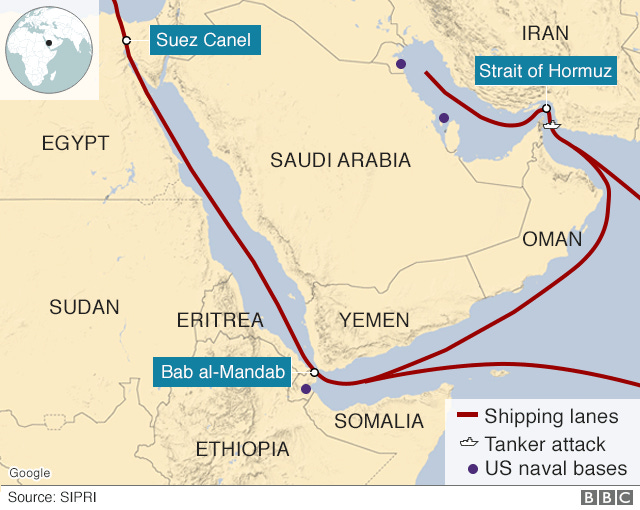
On March 2, 2026, Iran closed it.
The IRGC announced that any vessel attempting to pass would be set ablaze, and they meant it. Five tankers have been hit. Two workers are dead. Around 150 ships sit stranded on either side of the strait, their crews waiting, their cargo worth billions going nowhere. Brent crude has swung between $90 and $113 a barrel since the strikes began. Gas in the United States has climbed from $3.48 to $3.99 in four weeks. Maersk, the world’s shipping barometer, has suspended all crossings. Insurance companies have pulled war risk coverage entirely, which means that even if a captain wanted to run the strait, no underwriter on earth will back the voyage. This week, Bahrain introduced a draft UN Security Council resolution authorizing the use of “all necessary means” to reopen the waterway. Russia and China will almost certainly veto it.
This feels unprecedented. It is not. The Strait of Hormuz has been a flashpoint for as long as empires have valued what flows through it. The commodity has changed. The technology has changed. But the geography has not. And the pattern, where outside powers project force onto this narrow passage and discover that the passage answers to no one, is older than oil, older than tankers, older than the nation-states now fighting over it. This has happened before, and it will happen again. Unless we understand why.
II. The First Empires at the Narrows
Long before oil made Hormuz the most dangerous waterway on earth, it was one of the most vibrant. During the fifteenth century, the island kingdom of Hormuz controlled all traffic in and out of the Persian Gulf and served as the commercial crossroads of the known world. When China’s Ming dynasty sent Admiral Zheng He with treasure fleets across the Indian Ocean in the early 1400s, they stopped at Hormuz. A Timurid ambassador named Abd al-Razzaq visited in 1442 and described a port with “no equal on the face of the earth,” where merchants arrived from Egypt, Syria, China, India, Bengal, Zanzibar and Southeast Asia, where adherents of various religions dealt equitably with all, and where the city had earned the name Dar al-Aman: the Abode of Security.
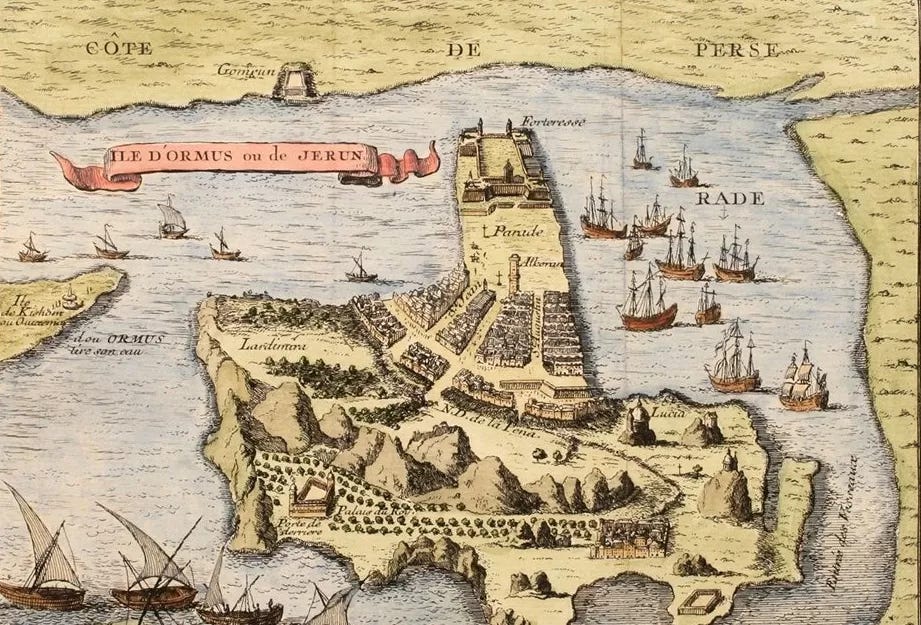
The Kingdom of Hormuz as depicted in a European map by Bellin in 1746 (Picture source: Map and Maps)
That security ended in 1507, when the Portuguese sailed around Africa and seized the island. They built a fortress and a customs house, issued paid permits called cartazas to anyone wishing to trade in Gulf waters, and extracted tolls from every ship that passed through the strait. As historian Rudolph Matthee has noted, Portugal made itself the tributary power in the region and became quite oppressive. They held Hormuz for over a century until a Persian-English alliance drove them out in 1622, with the English East India Company providing naval power in exchange for trading contracts. One empire replaced another. The strait remained the prize.
The British understood this as well as anyone. Their East India Company gave way to formal protectorates over the “Trucial States,” the colonial name for what became the UAE, and direct control of Aden at the mouth of the Red Sea and Bab-el-Mandeb. France established its colony in Djibouti for the same reason. Every European power grasped the same principle: if you control the strait, then you control the trade.
I grew up inside a different version of this architecture. The Caribbean was the original chokepoint economy of the European colonial era. The Windward Passage between Cuba and Hispaniola, the Mona Passage, the Florida Straits, the Yucatán Channel: these narrow waterways controlled the flow of sugar, enslaved people, and extracted wealth (especially gold and silver) between the Americas and Europe for centuries. Pirates, privateers and imperial navies fought over them the same way empires fought over Hormuz. Walter Rodney taught us that underdevelopment is not natural but produced, and the mechanism of production has always been the same. Control the route. Tax the flow. Build a fortress at the narrows. The geography changes. The logic does not.
III. Oil Changes Everything
For centuries, the strait’s value was in the trade that passed through it, including everything from silk and spices to pearls and horses. Then, in the early twentieth century, oil was discovered in the Gulf, and everything about Hormuz changed. The chokepoint was no longer just strategically important. It was existentially important. The entire architecture of modern industrial civilization would be built on the assumption that oil flows freely through this passage.
The British understood this first. The Anglo-Persian Oil Company, which later became BP, won a lopsided concession to control Iran’s oil exports in 1933. When Iranian Prime Minister Mohammad Mossadegh nationalized the oil industry in 1951, asserting that Iran’s oil should benefit Iranians, Britain sent the Royal Navy to blockade the port of Abadan and choke off Iran’s access to the world. Mossadegh became a national hero. The British and Americans responded in 1953 with a CIA-backed coup that overthrew him and reinstalled the Shah. As early as 1917, a British official document had declared that “oilers must be considered the most valuable vessels afloat.” By 1953, the nations that needed those oilers were willing to overthrow democracies to keep them moving.
The Suez Crisis of 1956 revealed the next turn. When Egypt’s Nasser nationalized the Suez Canal, Britain and France invaded, clinging to colonial control of the waterway that connected the Gulf to Europe. The United States forced them to withdraw. The old European empires could no longer back their own ambitions. But the lesson underneath was structural: whoever controls the chokepoint has leverage over the entire global economy, and attempting to control it by force eventually exposes the limits of the power making the attempt. The empires that built their wealth on what flowed through these narrows kept discovering that the narrows had power of their own.
IV. The Tanker Wars and the Logic of Disruption
The Iran-Iraq War began in September 1980, when Saddam Hussein invaded Iran with American intelligence, weaponry and support. It lasted eight years and killed a million people. But the dimension most relevant to this moment is the one most Americans have never heard of: the Tanker War, which became the largest maritime conflict since World War II.
Iraq struck first, targeting Iranian oil tankers and the crucial loading terminal at Kharg Island. Iran retaliated by hitting Kuwaiti and Saudi tankers, since both nations backed Iraq. The escalation was deliberate. Iraq’s calculation was strategic: by attacking neutral shipping, it would force international intervention, which was precisely what Iraq needed because it could not win the war on its own. It worked. The United States reflagged Kuwaiti tankers under the American flag and sent warships to escort them through the strait. The Soviet Union volunteered to do the same. The chokepoint had done what it always does: it turned a regional war into a global crisis, because the world’s economy could not afford to let the passage stay dangerous.
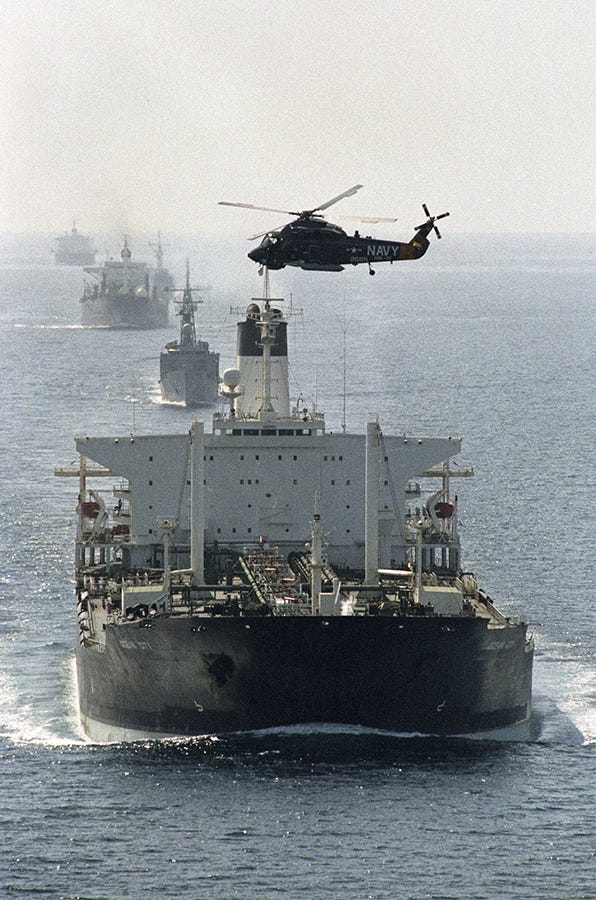
A US navy helicopter flies over a convoy of reflagged tankers consisting of Ocean City and Gas Princess. The USS Ford and USS Elrod are escorting the tankers. Circa 21 Dec. 1987. Photo by Norbert Schiller.
The numbers are staggering. Over the course of the war, 430 ships were attacked. 72 were sunk or damaged beyond repair. Eight million tons of shipping were destroyed, equivalent to a quarter of the tonnage lost in the entire Battle of the Atlantic during World War II. Iran and Iraq together lost over $510 billion in oil revenue. At night, Revolutionary Guard operatives dropped mines from vessels disguised as traditional dhows, the same wooden cargo boats that have carried goods through Gulf waters for centuries. Former Iranian president Rafsanjani called the mines “God’s angels that descend and do what is necessary.” As defense analyst Dave DesRoches put it years later, “Iran’s strategy at sea particularly is based on disruption. They know they can’t dominate. They have to disrupt.”
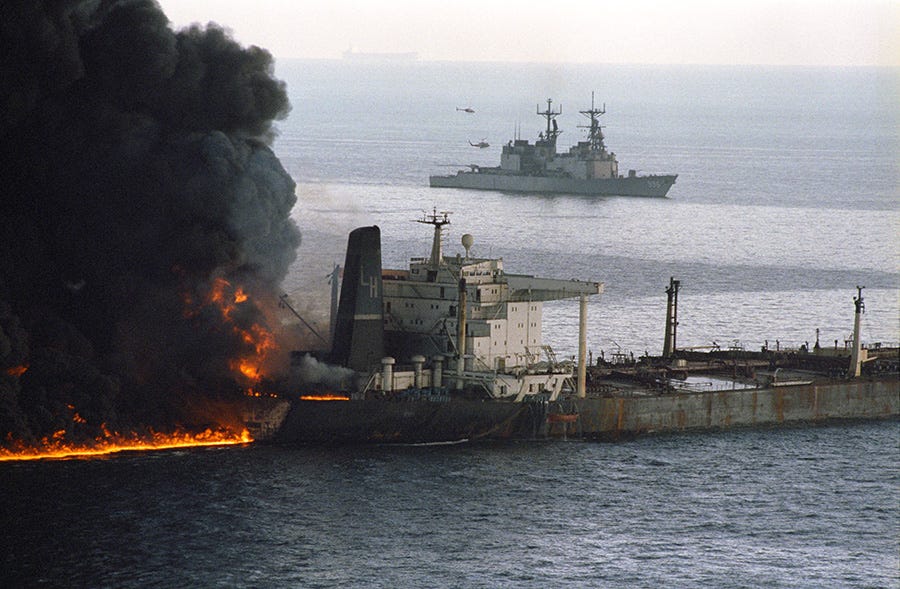
A Helicopter from the USS Chandler helps rescue 40 crew from the 232 thousand ton Cypriot registered oil tanker, Pivot, after it was attacked and set ablaze by an Iranian warship. It was coming from Saudi Arabia with crude oil. Circa 12 Dec. 1987. Photo by Norbert Schiller.
That strategy reached its darkest moment in July 1988, when the USS Vincennes, chasing Guard speedboats into Iranian territorial waters, mistook Iran Air Flight 655 for a military aircraft and shot it down, killing all 290 civilians aboard. In the United States, the incident faded from public memory almost immediately. In Iran, it never faded at all. A billboard erected in Tehran’s Vali-e-Asr Square years later showed American and Israeli ships sinking beneath the waves, captioned in four languages: “We Drowned Them All.” When Ayatollah Khamenei was presented with a portrait of a Guard soldier killed during the Tanker War, he smiled and said, “Excellent, very timely.” Americans forgot. Iranians built it into the national architecture. And now, in 2026, we see the same strait, with the same adversaries, using the same logic. The only thing that has changed is which side is asking the world for help.
V. Where It All Points
Five centuries. Portuguese fortresses, British blockades, American escorts, Iranian mines, Houthi drones. The technology changes every generation. The empires rotate. The 21 miles stay exactly where they are, and the pattern repeats with a regularity that should terrify anyone paying attention.
The structure has never changed because the dependency has never changed. Global civilization runs on fossil fuels extracted from one region and shipped through two narrow waterways. Every decade, a new actor threatens the strait. Every decade, the world economy convulses. And every decade, instead of addressing the structural vulnerability, we send more warships. Right now, 22 nations are negotiating how to reopen a passage that a fifteenth-century ambassador once called the Abode of Security. Bahrain is asking the UN Security Council to authorize force. Twenty-five hundred Marines are heading to the Gulf aboard the USS Boxer. Russia and China, who profit from the disruption, will veto any resolution. The architecture is working exactly as it always has: concentrating power at the narrows and forcing the rest of the world to react.
Walter Rodney taught us that underdevelopment is produced through control of extraction routes. Eric Williams showed us how the Caribbean colonial economy was built on the same logic: narrow passages, captive labor, wealth flowing outward to imperial centers. George Beckford saw the plantation as a total institution that organized entire societies around a single extractive purpose. The Strait of Hormuz is that institution applied to water. It organizes the global economy around a dependency so fundamental that when six miles of shipping lane close, parliaments convene, alliances fracture, and families in Florida, Ohio and every other state pay for it at the pump.
I grew up in St. Croix, where everything arrives by ship through narrow passages controlled by distant powers. Whenever a hurricane knocked out the fragile grid, or whenever boats couldn’t dock, or when a particular supply chain broke, we felt the architecture in our bodies. The world is now feeling what the Caribbean has always known: that when your survival depends on a chokepoint, you are never truly free. As such, the answer for the current geopolitical crisis is not more warships at Hormuz. It is building an energy system that does not route civilization’s survival through a corridor you could cross in a fishing boat. Until then, the pattern holds. Same strait. Different empire. Same crisis. Once again, we see that history doesn’t exactly repeat, but it certainly rhymes.
References
Gambrell, J. (2019, June 14). Oil tanker attacks echo Persian Gulf’s 1980s ‘Tanker War’. Associated Press: Worldstream. Available from NewsBank: America’s News Magazines: https://infoweb-newsbank-com.eu1.proxy.openathens.net/apps/news/document-view?p=AMNP&docref=news/1740E9180F348460.
Hacaga, M. (2020). An easy target? Types of attack on oil tankers by state actors. Security and Defence Quarterly, 28(1), 54–69. https://doi.org/10.35467/sdq/118147
Irish, J. (2026, March 23). Bahrain pushes UN-backed action for Hormuz shipping; France tables rival text. Reuters. https://www.reuters.com/world/china/bahrain-proposes-un-security-council-approve-use-force-protect-hormuz-shipping-2026-03-23/
Nonneman, G. (1999). The Gulf Tanker War: Iran and Iraq’s Maritime Swordplay. International Affairs, 75(1), 179.
Roos, D. (2026, March 13). The Strait of Hormuz: A Timeline of Tensions | HISTORY. HISTORY. https://www.history.com/articles/7-historical-fights-over-strait-of-hormuz
Ulrich, B. (2023). Hormuz. In The Medieval Persian Gulf (pp. 91–102). Chapter, Arc Humanities Press.
Bahrain proposes UN Security Council approve use of force to protect Hormuz shipping
____________________________________________________________________________
Means and Meaning publishes every Tuesday. If you found value in this analysis, I’d be very grateful if you’d consider buying me a coffee — your support helps me dedicate time to this work while keeping all content free and accessible.
You can also support this project by subscribing (it’s free!), sharing with others who might appreciate it, or joining the conversation in the comments. Sometimes the best antidote to anxiety is knowing you’re not alone in seeing what’s happening.
Next week, we’ll examine another piece of the machinery — and another opportunity to resist it.
Until then, keep questioning, keep connecting, and keep believing that another world is possible.
~ Chris