


I. The Spectacle That Should Have Stopped Us Cold
There's a meme circulating that should have ended any remaining debate about where we're headed.
The President of the United States shared an image of himself as Lt. Col. Kilgore from Apocalypse Now, helicopters filling an orange sky behind him, Chicago burning in the distance. "I love the smell of deportations in the morning," it declares. "Chicago about to find out why it's called the Department of WAR."
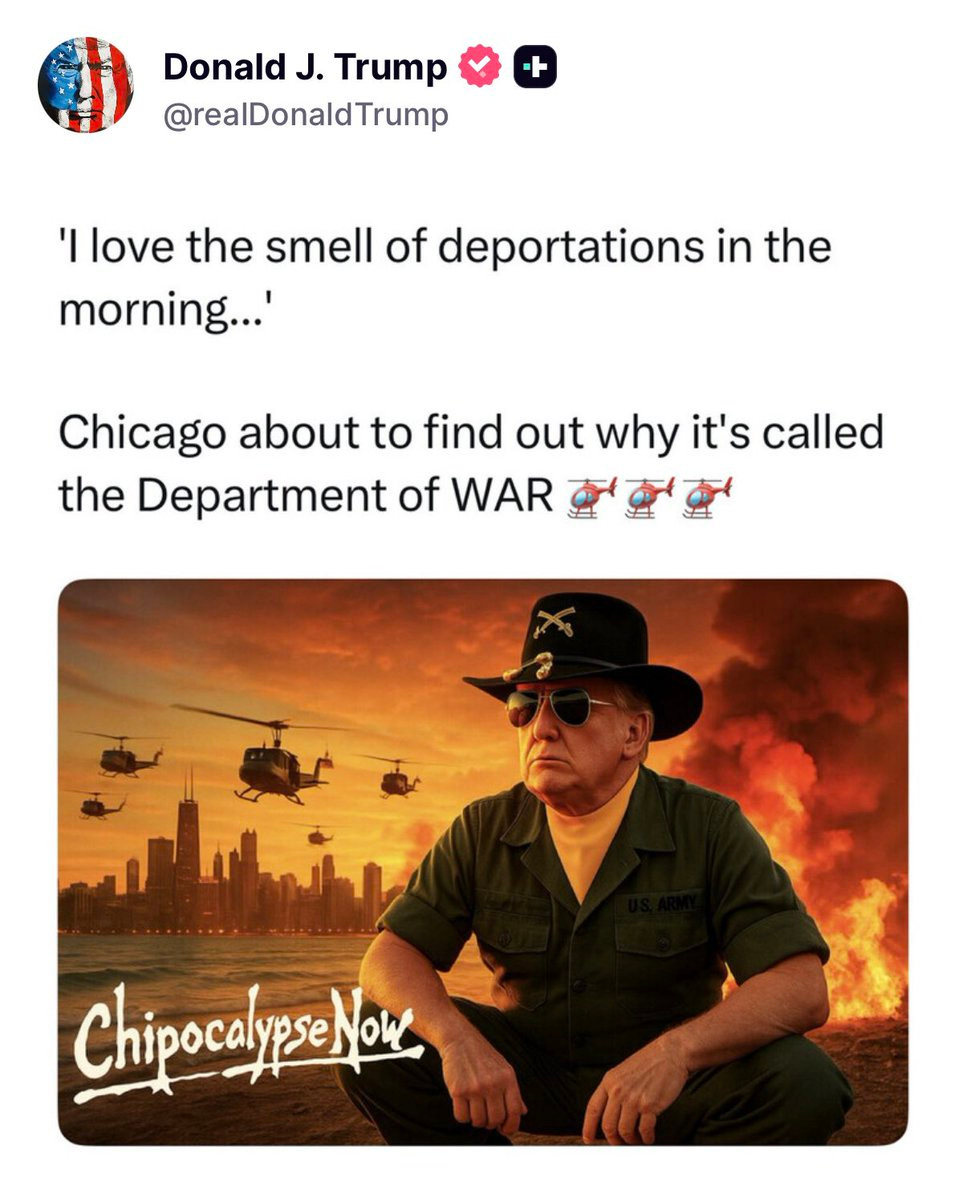
This isn't satire. This isn't hyperbole. This is the sitting president fantasizing about military occupation of an American city, turning mass human suffering into entertainment. Transforming a film about the madness of imperial violence into a cheerful promise of domestic warfare.
In Chicago's Pilsen neighborhood last Saturday, the annual Mexican Independence Day parade went forward, but with far fewer attendees than usual. Those who came carried whistles and code words, distributing "know your rights" cards. Andrea Soria, a Chicago native with a mixed-status family, broke down in tears describing how her undocumented relatives have been too terrified to leave the house all week, relying on her for everything. "It's emotionally draining," she said, "but you know it's not just me or my family, it's a lot of families."
This is what presidential memes do in the real world. They empty celebrations. They trap people in their homes. They turn neighbors into potential targets and cities into imagined war zones.
The distance between fantasy and reality is collapsing. Trump has already renamed the Department of Defense the "Department of War." He's already deployed National Guard troops to DC. He's already announced Chicago, Baltimore, and New Orleans as next. The meme isn't a joke — it's a promise. It's a preview. It's the quiet part screamed out loud through a movie reference that most of his base probably doesn't even understand is about American evil, not American glory.
But here's what's most chilling: we're not nearly shocked enough.
II. Capital Needs Its Enemies (The Economic Function of Domestic Warfare)
To understand why a president dreams of making war on Chicago, we need to understand what Chicago represents — and what it threatens.
Cities have always been where the contradictions of capitalism become impossible to ignore. Where extreme wealth towers over extreme poverty. Where workers organize. Where communities build power. Where different peoples mix and merge and resist together. Cities are where the beautiful lie of American individualism meets the brutal reality of collective struggle.
Chicago, Baltimore, New Orleans — these aren't random targets. They're cities with large Black populations, strong labor histories and Democratic governance. They're sanctuary cities that refuse to turn their police into immigration agents. They're places where multiracial working-class coalitions have fought — and sometimes won — against the machinery of exploitation.
When Trump fantasizes about military occupation, he's not really talking about crime. Crime has been dropping in these cities for years. He's talking about discipline. About reminding workers who's in charge. About breaking solidarity before it can form.
Think about what occupation does to a workforce. When immigration raids become military operations, when neighborhoods become battlegrounds, workers accept whatever conditions they're given. They don't organize. They don't strike. They don't even complain about wage theft or unsafe conditions. They keep their heads down and try to survive.
This is the economic function of terror: it creates the perfect worker. Disposable. Replaceable. Silent. Too frightened to demand dignity, let alone justice.
The meme makes it entertainment, but the logic is older than America itself. Every system of exploitation needs an internal enemy to justify its violence. It needs a threat that makes occupation feel like protection. It needs chaos that makes order — any order, no matter how brutal — seem preferable to freedom.
What we're watching isn't law enforcement. It's the manufacturing of a permanent underclass through spectacular violence. It's capitalism creating the conditions it needs to survive: a workforce too terrorized to resist, a public too frightened to object, and an enemy vivid enough to justify anything.
The war isn't coming. For communities like Pilsen, it's already here. The question is whether the rest of us will recognize it before the helicopters are over our neighborhoods too.
III. The Architecture of Occupation
The escalation has been breathtaking in its speed and brazenness.
First came the unmarked vans — the ones citizens kept calling 911 about, thinking they were witnessing kidnappings. Then the masked agents, the no-knock raids, the detention centers built in weeks. Now we've arrived at presidential memes about military helicopters over American cities, at executive orders renaming Defense to War, at National Guard deployments that would have been unthinkable just years ago.
Washington DC was the testing ground. In August, troops from neighboring states flooded the capital — not to protect it from foreign threats, but to impose order on its own residents. The message was clear: the federal city belongs to the federal government, not to the people who live there. The Constitution's careful balance between state and federal power? Irrelevant when there are enemies to fight.
Now the model is ready for export. Chicago, Baltimore, New Orleans — each selected for maximum symbolic impact. Each a laboratory for normalizing what should be intolerable.
The infrastructure of occupation isn't just physical, though the physical is staggering enough. It's psychological. It's teaching us to see American cities as war zones. It's training us to view military vehicles on our streets as normal, even necessary. It's the slow transformation of fellow citizens into enemy combatants.
Watch how it works: First, you need the rhetoric of crisis. "American carnage." "War zones." "Cities out of control." Never mind that violent crime has been dropping. Reality is irrelevant when you're building mythology.
Next, you need the spectacle. The memes. The movie references. The theatrical deployments. Make it feel exciting, inevitable, even entertaining. Make resistance seem not just futile but ridiculous. Who opposes restoring "order"?
Then comes the infrastructure. The expanded detention facilities. The surveillance networks. The integration of local police with federal forces. The legal frameworks that make the extraordinary permanent.
Finally, the normalization. Media coverage that debates tactics rather than questioning the premise. Democrats who argue they can manage crime better without troops, implicitly accepting that these cities are problems to be managed. A public that grows accustomed to occupation as background noise.
DC showed it could be done. The residents protested, but the troops stayed. The media covered it for a few days, then moved on. The opposition party raised concerns about process, not principle. And now it's just how things are in the nation's capital — a template ready to be stamped onto any city that steps out of line.
This is how democracies die: not in dramatic coups, but in the steady construction of authoritarian infrastructure disguised as emergency response. In the slow teaching of citizens to see each other as threats. In the meme-ification of state violence until we're too numb to notice when the joke becomes reality.
IV. When "War" Means What It Says
"Eight people were killed and over 50 people were wounded last weekend in Chicago," the White House spokesperson said, defending the president's war meme. As if urban violence justified military occupation. As if the solution to American poverty was American warfare.
This is how language prepares the ground for atrocity.
Start with the rename: Department of Defense becomes Department of War. Trump claims it "just sounds better," but the shift is seismic. Defense implies protection, boundaries, response. War implies attack, expansion, conquest. When you're the Department of Defense, you need a threat to defend against. When you're the Department of War, you just need an enemy.
And the enemy is us. American cities. American citizens. Americans who dare to live in places that vote wrong, look wrong, organize wrong.
Watch how the framing works its dark magic. "War on crime" becomes war on cities. "Restoring order" becomes military occupation. "Supporting law enforcement" becomes suspending law itself. Each euphemism builds on the last until we're debating tactics instead of questioning why the president is fantasizing about making war on Chicago.
The media plays along. "Trump threatens Chicago with apocalyptic force," reads the AP headline, as if this were normal political discourse. As if threatening American cities with military violence were just another campaign promise to fact-check. The debate becomes about whether troops would reduce crime statistics, not whether a president declaring war on his own people represents a fundamental break with democracy.
Even the opposition accepts the premise. They argue Chicago doesn't need troops because crime is already declining. They debate jurisdiction and process. They express concern about "rhetoric" and "norms." But by engaging with the logic — by arguing about effectiveness rather than legitimacy — they've already conceded the main point: that American cities are problems to be solved through force.
Joe Lowndes put it perfectly: the authoritarians in power "are in fact openly hostile" to American credal commitments to democracy and equality. They've chosen supremacy over democracy, domination over law. The mask isn't slipping — it's been thrown away.
When 57% of Americans oppose National Guard deployment to DC, when 61% oppose it in their own communities, the administration doesn't moderate. It escalates. It shares memes about the smell of deportations. It promises to show cities "why it's called the Department of WAR." Because this isn't about public safety or public opinion. It's about teaching us to accept the unacceptable. It's about moving the window of possibility until military occupation of American cities seems reasonable, even inevitable.
"Someday this war's gonna end," Martin Sheen's character says in Apocalypse Now, knowing home no longer exists. But this war — the war on American cities, on American people — is just beginning. And home is what they're planning to destroy.
V. The Political Economy of Authoritarian Spectacle
Follow the money, and the spectacle makes sense. Military occupation of American cities isn't just ideological — it's profitable. Every deployment requires contractors, equipment, surveillance technology. The same companies getting rich from border militarization are salivating at the prospect of bringing the war home. When Trump shares memes about Chicago burning, stock prices for military contractors tick upward. The Department of War needs enemies to justify its budget, and if foreign wars are winding down, domestic enemies will do just fine.
But the deeper profit comes from what occupation produces: a compliant workforce stripped of power. When whole communities live under military threat, labor organizing dies. Wage theft goes unreported. Workplace injuries stay hidden. The threat of deportation or arrest becomes the ultimate management tool, more effective than any corporate HR department. This is why capital loves authoritarianism — it delivers the perfect worker: scared, silent, and disposable.
The meme economy and the real economy merge here. Trump's "Chipocalypse Now" isn't just performance — it's marketing. It's teaching us to see state violence as entertainment, to consume images of our own oppression. Every share, every outraged response, every news cycle spent debating the meme instead of resisting the reality helps normalize what's coming. The spectacle isn't separate from the machinery of control — it's the lubrication that helps it run smoothly. When fascism arrives as a movie reference, we're too busy analyzing the reference to stop the fascism.
VI. When the War Comes Home (Historical Echoes and Future Warnings)
We've been here before. Every time American capitalism has faced a crisis of legitimacy, it has turned its war machinery inward. For example, in 1921 at Blair Mountain, federal troops were deployed against 10,000 striking coal miners in the largest armed uprising since the Civil War. The miners wore red bandanas and faced bombing from private planes — the first air assault on American soil. The lesson: when workers organize effectively enough, the state will wage literal war against them.
In 1967, federal troops occupied Detroit after the uprising on 12th Street. Tanks rolled through American neighborhoods. Snipers positioned on rooftops. 43 dead, over 1,000 injured. The occupation didn't address the poverty and police violence that sparked the rebellion — it deepened them. The lesson: military force can destroy communities but never heal them.
In 1970 at Kent State, the Ohio National Guard fired into a crowd of students protesting the Vietnam War. Four dead in Ohio. The war had come home in the most literal sense — American soldiers shooting American students for opposing American empire. The lesson: violence deployed abroad always returns to haunt the homeland.
Each time, the pattern repeats: Crisis. Demonization. Deployment. Normalization. Each time, we tell ourselves it's temporary, exceptional, necessary. Each time, the infrastructure of repression grows stronger.
But this time feels different. This time, the president isn't hiding behind euphemism or national security. He's sharing memes about loving the smell of deportations. He's promising to show cities what "war" means. He's building the legal and physical architecture for permanent occupation while turning it into entertainment.
The Posse Comitatus Act — the law forbidding military deployment for domestic law enforcement — was our guardrail against this exact scenario. Passed in 1878 after the military occupation of the South during Reconstruction, it recognized a simple truth: armies trained for war can't police communities without destroying them. When Trump treats it as an obstacle to overcome rather than a principle to uphold, he's telling us exactly what kind of future he's building.
Chicago won't be the last. Once you normalize military occupation of one American city, every city becomes occupiable. Once you teach the public to see their neighbors as enemies, everyone becomes a target. The infrastructure built to terrorize immigrants will be used against protesters. The surveillance systems deployed against "criminals" will monitor dissidents. The camps constructed for "illegals" will hold whoever opposes the regime.
This is how empires eat themselves — by turning the machinery of conquest inward, by treating their own citizens as conquered peoples, by waging war on the very communities that built them.
The awful meme told us everything: a president fantasizing about American cities burning, about citizens fleeing in terror, about the sweet smell of state violence in the morning. When authoritarians tell you who they are, believe them. When they show you their dreams, prepare for the nightmare.
But here's what they don't want us to remember: every authoritarian system in history has been defeated by people who refused to accept it. Every occupation has ended. Every wall has fallen. The infrastructure of oppression is never as permanent as it seems.
The question isn't whether this system will fall. It's how much damage it will do before we bring it down. It's how many communities will be destroyed, how many families torn apart, how many dreams deferred or destroyed.
The war has come home. The only choice left is whether we'll fight back or simply document the casualties.
References
Kim, J. (2025, September 6). Trump threatens ’Apocalypse Now’-style action against Chicago to boost deportations. NPR. https://www.npr.org/2025/09/06/nx-s1-5532148/national-guard-chicago-baltimore-new-orleans
Lowndes, J. (2025, September 7). When Trump shared the meme of himself as the fictional Lt. Col. Kilgore from Apocalypse Now making war on the denizens of Chicago a few days ago, it was met with shock across liberal and progressive social media. Facebook. Retrieved September 8, 2025, from https://www.facebook.com/share/p/15CTh9s9Ec2/
Stanton, Z. (2025, September 7). Playbook: Trump’s ‘Apocalypse Now’ moment. Politico. https://www.politico.com/newsletters/playbook/2025/09/07/trumps-apocalypse-now-moment-00549289
—
Means and Meaning publishes every Tuesday. If you found value in this analysis, I'd be grateful if you'd consider buying me a coffee — your support helps me dedicate time to this work while keeping all content free and accessible.
You can also support this project by subscribing (it's free!), sharing with others who might appreciate it or joining the conversation in the comments.
Next week, we'll examine another piece of the machinery — and another opportunity to resist it.
Until then, keep questioning, keep connecting and keep believing that another world is possible.
~ Chris
Agree. Thanks for this analysis