


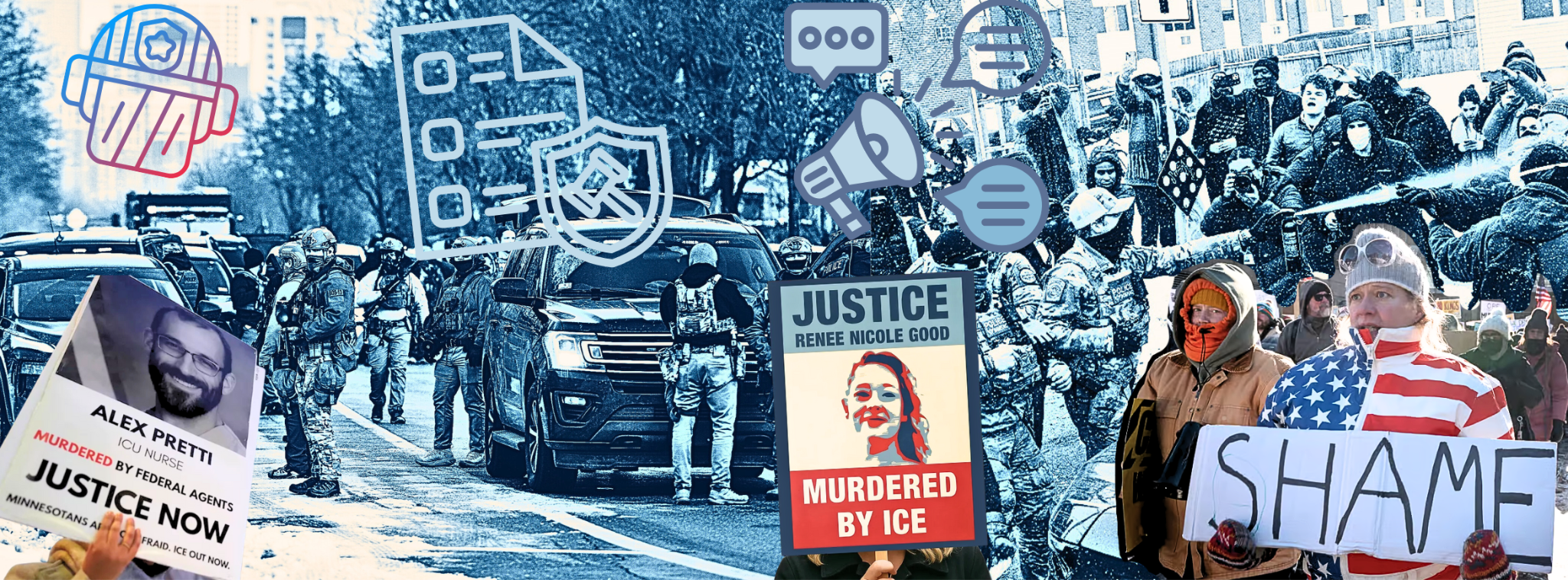
This piece is part of “The Quiet War,” a series tracking how state violence operates in plain sight — from border militarization to urban occupation, examining how authoritarianism arrives not with fanfare but with bureaucracy, memes, and manufactured consent.
I. When a Person Becomes a “Threat”
A week ago, I wrote about Greenland - about what happens when empire stops pretending to follow rules, when sovereignty becomes negotiable and when people are reclassified from citizens to assets. I warned that colonial violence always comes home. That what the United States perfects abroad, it eventually deploys within its own borders. Minneapolis is where that warning became prophecy.
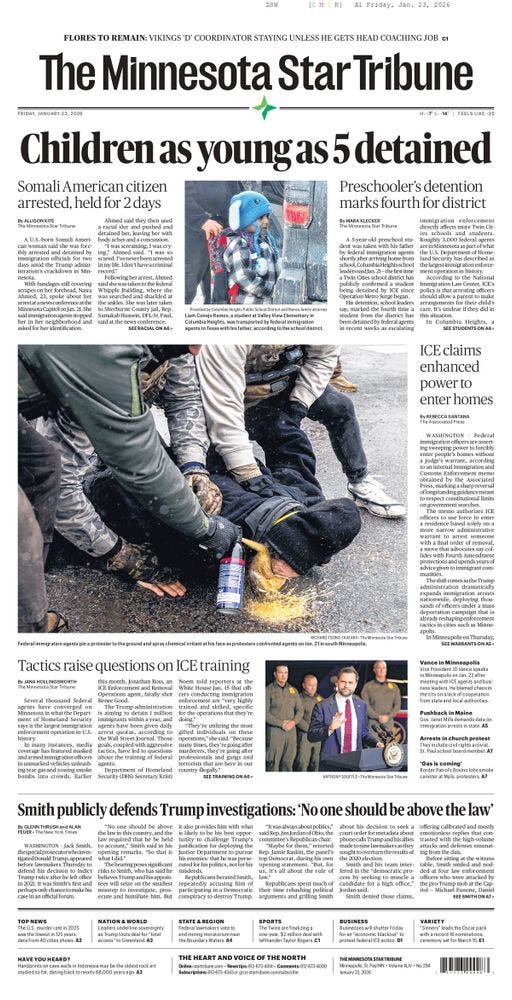
By now everyone has seen some news coverage, but I’m unsure how many truly appreciate the scale of Operation Metro Surge. The Department of Homeland Security calls it “the largest immigration enforcement operation ever carried out.” More than 2,000 ICE agents and 1,000 Customs and Border Patrol officers were deployed to a single metropolitan area. Over 3,000 arrests have occurred in two months. Schools closed. Businesses shuttered. Neighbors afraid to leave their homes. Federal agents patrolling public streets with military-grade weapons, going door to door, detaining U.S. citizens, Native Americans, legal residents, children - anyone whose presence is deemed suspicious.
And then they started killing people.
In the final moments before she was killed, Renée Nicole Good was calm. In a video filmed beside her car, she tells the federal agent approaching her window, “That’s fine, dude. I’m not mad at you.” She is not shouting. She is not threatening. She is not resisting. She is trying to leave.
Seconds later, she is dead.
A week later, also in downtown Minneapolis, Alex Pretti is doing what thousands of people across the country have learned to do: filming. He records masked agents shoving protesters. He steps forward to shield a woman who has been knocked to the ground. He is sprayed, tackled, pinned. His legal firearm is removed. He lies helpless beneath a pile of armed bodies.
Then he is shot multiple times.
Filming. Shielding. Pinned. Disarmed. Shot.
This is how a neighbor becomes a problem. This is how a person becomes a “threat.” Not through violence, but through reclassification. Power does not announce when it withdraws someone’s right to exist. It just does it.
II. How Power Decides Whose Life Counts
One of the great myths of American democracy is that the law applies to everyone equally. That when something goes wrong, institutions will sort it out. That mistakes will be corrected. That innocence will be presumed.
In reality, those protections are unevenly distributed. Some people are treated as citizens first. Their actions are interpreted generously. Their intentions are assumed to be reasonable. Their mistakes are met with patience. They are entitled to explanations, appeals, and second chances.
Others are treated as risks from the start. Their presence is suspicious. Their movements are monitored. Their fear is read as guilt. Their compliance is never quite enough. For them, there is no presumption of innocence, only a presumption of danger.
We know who fills this category. Immigrants. Protesters. Working-class people. Racialized communities. Anyone who moves through public space without institutional protection.
In Minneapolis, ICE agents have detained Target employees during their shifts, arrested restaurant workers in front of customers, pulled people off buses and surrounded families in their homes. Minnesota’s chief U.S. District Judge Patrick Schiltz found that ICE violated at least 96 court orders in Minnesota since January 1 alone - 96 times that federal agents simply ignored judges telling them their actions were illegal. That’s not enforcement. That’s impunity.
When violence happens to these people, it is processed as procedure. Paperwork. Policy. An “incident.”
This is not chaos. It is sorting. Every unequal society draws a line between “people” and “problems.” Minneapolis shows us where ours is.
III. From Colony to City Block: Violence as Message
Every time federal agents kill someone in public, the script is ready before the body hits the ground. Self-defense. An armed threat. A split-second decision. The language arrives faster than the investigation, because it is not meant to describe what happened. It is meant to end the conversation.
Caroline Light, a historian of citizenship and self-defense law whose book Stand Your Ground argues that lethal self-defense protects “security for the few at the expense of the many,” names this for what it is: ritual language. “Self-defense” no longer refers to necessity; it functions as automatic absolution. The victim becomes the aggressor. The killing becomes regrettable but justified. Video evidence doesn’t interrupt this process, it merely tests how much the public is willing to disbelieve its own eyes.
As Light writes in Slate: “What is new today is not the twisted rhetoric of self-defense but its escalation, and its targets. Masked federal agents, many of them poorly trained, now patrol public streets with military-grade weapons and broad discretionary authority. They detain, assault, and, increasingly, kill people based on vague or erroneous claims of public safety. They do so while invoking the same exonerating language that has long enabled state violence.”
We have seen this pattern before, just in different locations. Lynching was framed as community protection. Colonial massacres were justified as “pacification.” Indigenous resistance was labeled savagery. On the frontier, on the plantation, at the border, violence was narrated as restraint rather than domination.
But the techniques didn’t stay at the periphery. They migrated inward.
The counterinsurgency tactics developed in Iraq and Afghanistan (separating populations, controlling movement through checkpoints, treating entire communities as potential threats and punishing those who document abuses) are now standard practice in American cities. The surveillance technologies tested on Mexico’s border track immigrants in Minnesota. The military equipment deployed in Fallujah now patrols Minneapolis streets. The legal doctrines that justified drone strikes abroad now authorize federal agents to kill witnesses at home.
From colony to border. From border to city block. From military occupation to domestic policing. This violence is not primarily about punishment. It is about instruction. It teaches who may intervene and who must remain still. It teaches which lives require explanation and which can be erased with a press release. It teaches silence, compliance, and fear.
Light continues: “For generations, public state violence has been normalized precisely because it was disproportionately inflicted on nonwhite people, immigrants, low-income and other marginalized individuals. Many learned to look away or to justify this violence as the necessary price of ‘law and order.’ Part of race and class privilege was the capacity to see such violence as a regrettable but necessary byproduct of maintaining order and keeping ‘us’ safe.”
This is violence as public pedagogy - spectacular enough to teach the lesson, but deniable enough to seem justified. It works only if people keep looking away, keep telling themselves that those killed must have done something wrong, that the agents must have felt threatened, that surely there’s more to the story.
But we are learning, as Light warns, “what happens when a society confuses authority with innocence and violence with virtue. We have built legal doctrines that reward escalation. We have granted weapons to institutions without demanding restraint. We have taught ourselves that ‘good guys’ with guns will keep us safe from ‘bad guys.’ Maybe now we are learning that the boundary separating the two was never clear in the first place.”
Violence, as it turns out, is never just force. It is pedagogy.
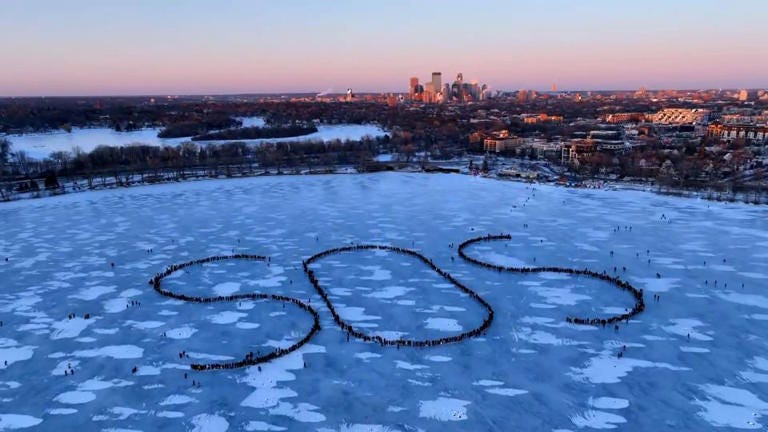
People gather to form a human distress signal on Bde Maka Ska in Minneapolis on January 31st. - WCCO
IV. Fear Is a Business Model
It’s worth noting that ICE is no longer a marginal agency. Under the One Big Beautiful Bill Act, its budget has exploded into the tens of billions of dollars, with funding that rivals or exceeds the FBI’s entire budget. Tens of billions more are earmarked for deportations and detention beds capable of holding up to 100,000 people at once. Its ranks have more than doubled in a single year.
As such, this isn’t solely about law enforcement. It’s also about infrastructure. That’s why it’s always worth asking the revealing question: who actually profits from this expansion? In this case, it’s private prison corporations like CoreCivic and GEO Group, which operate immigrant detention facilities under lucrative federal contracts. It’s also other defense contractors selling surveillance drones, facial recognition systems and military-grade equipment to immigration enforcement. It’s also the tech companies building databases to track, categorize and predict immigrant movement. It’s the transportation companies paid to fly detainees across the country. And it’s the construction firms building detention centers in rural communities desperate for any economic activity.
The business model here is simple: produce insecurity, and then monetize it. The result? Exploding budgets. Private contracts for detention and surveillance. Militarized vehicles in our cities. Coercive technologies that track, apprehend, and confine without accountability. Insecurity is not a byproduct; it is carefully produced and deployed.
Walter Rodney, whose scholarship traced how global capitalism requires poverty in some places to generate wealth in others, taught us to see clearly that poverty and fear are not accidents. They are managed outcomes, produced by systems that profit from them. We can apply his theory to immigration enforcement. For example, the threat of deportability suppresses wages - when workers know ICE can disappear them, they accept lower pay, unsafe conditions and no union organizing. Policing undermines collective power. Precarity ultimately teaches obedience.
The message is clear: Don’t look. Don’t intervene. Don’t organize.
Therefore, one can argue that repression isn’t a failure of the system. It’s a revenue stream, a funded, bureaucratic industry whose profit is obedience and whose product is fear.
V. The People Who Refuse Disappearance
But here is what threatens power more than anything: people who refuse to look away.
Across Minneapolis, thousands have organized into networks of documenters, mutual aid groups and rapid response teams. They film raids. They surround ICE vehicles. They shield neighbors. They share information through encrypted Signal groups, warning others when federal agents are in the area. They provide food, legal support and solidarity to those targeted.
This is not symbolic resistance. This is material intervention in the machinery of state violence. Every camera raised creates evidence that might prevent the next killing from being dismissed as “self-defense.” Every neighbor defended disrupts the smooth operation of mass detention. Every lie exposed makes it harder for power to narrate its violence as necessity.
Adam Serwer, writing in The Atlantic, documents how Minnesota communities have proven that coordinated resistance can limit ICE’s capacity: “When federal agents arrived expecting compliance, they found instead a population that refused to be accomplices to their neighbors’ disappearance.” This is what organized refusal looks like. Not speeches. Not elections alone. Organized care and collective action.
But we cannot romanticize this work. The costs are real and rising. For example, ICE agents photograph license plates of people who document raids. They film bystanders with personal cell phones, which is footage that doesn’t immediately become agency property and can be used for retaliation. Jobs are threatened. People are followed. Organizers wake up to ICE vehicles parked outside their homes. Charlie Warzel reports in The Atlantic that witnesses to federal violence have been surveilled, threatened with arrest, beaten with batons, sprayed with chemical irritants, and subjected to flashbangs and LRADs (sonic weapons that cause pain and disorientation). Alex Pretti was killed for documenting. Renée Good was killed for being present. This is the price of refusing to look away.
And yet people keep showing up. Keep blowing their whistles. Keep filming. Keep shielding. Keep organizing. Because they understand something fundamental: authoritarianism depends on isolation. It requires bystanders to remain bystanders. It needs witnesses to become silent. It demands that we treat violence against our neighbors as someone else’s problem.
The people refusing that script in Minneapolis are not heroes performing exceptional acts. They are ordinary people doing what solidarity requires: treating each other’s survival as a collective responsibility.
They can manage bodies, but they cannot yet manage conscience. Every camera raised, every neighbor defended and every lie exposed is a reminder that power is not omnipotent - it is contested, fragile, uneven and dependent on our compliance.
The question is not whether resistance is possible. Minneapolis proves it is. The question is whether the rest of us will join it.
References
Kristof, N. (2026, January 31). We Don’t Have to Be Like This. The New York Times. https://www.nytimes.com/2026/01/31/opinion/minneapolis-pretti-bovino.html
Light, C. E. (2026, January 25). Don’t let them tell you that was Self-Defense. Slate Magazine. https://slate.com/news-and-politics/2026/01/alex-pretti-execution-lie-self-defense-myths.html
Rahman, B. (2026, January 28). Minneapolis is proving ICE’s undoing. Newsweek. https://www.newsweek.com/minneapolis-proving-ice-undoing-11423859
Serwer, A. (2026, January 29). Minnesota proved MAGA wrong. The Atlantic. https://www.theatlantic.com/ideas/2026/01/the-neighbors-defending-minnesota-from-ice/685769/?gift=j9r7avb6p-KY8zdjhsiSZ8H3lUwN6ZgkAO9HNshlhsY
Warzel, C. (2026, January 27). Believe your eyes. The Atlantic. https://www.theatlantic.com/technology/2026/01/minneapolis-protests-footage/685753/
____________________________________________________________________________
Means and Meaning publishes every Tuesday. If you found value in this analysis, I’d be very grateful if you’d consider buying me a coffee — your support helps me dedicate time to this work while keeping all content free and accessible.
You can also support this project by subscribing (it’s free!), sharing with others who might appreciate it, or joining the conversation in the comments. Sometimes the best antidote to anxiety is knowing you’re not alone in seeing what’s happening.
Next week, we’ll examine another piece of the machinery — and another opportunity to resist it.
Until then, keep questioning, keep connecting, and keep believing that another world is possible.
~ Chris