


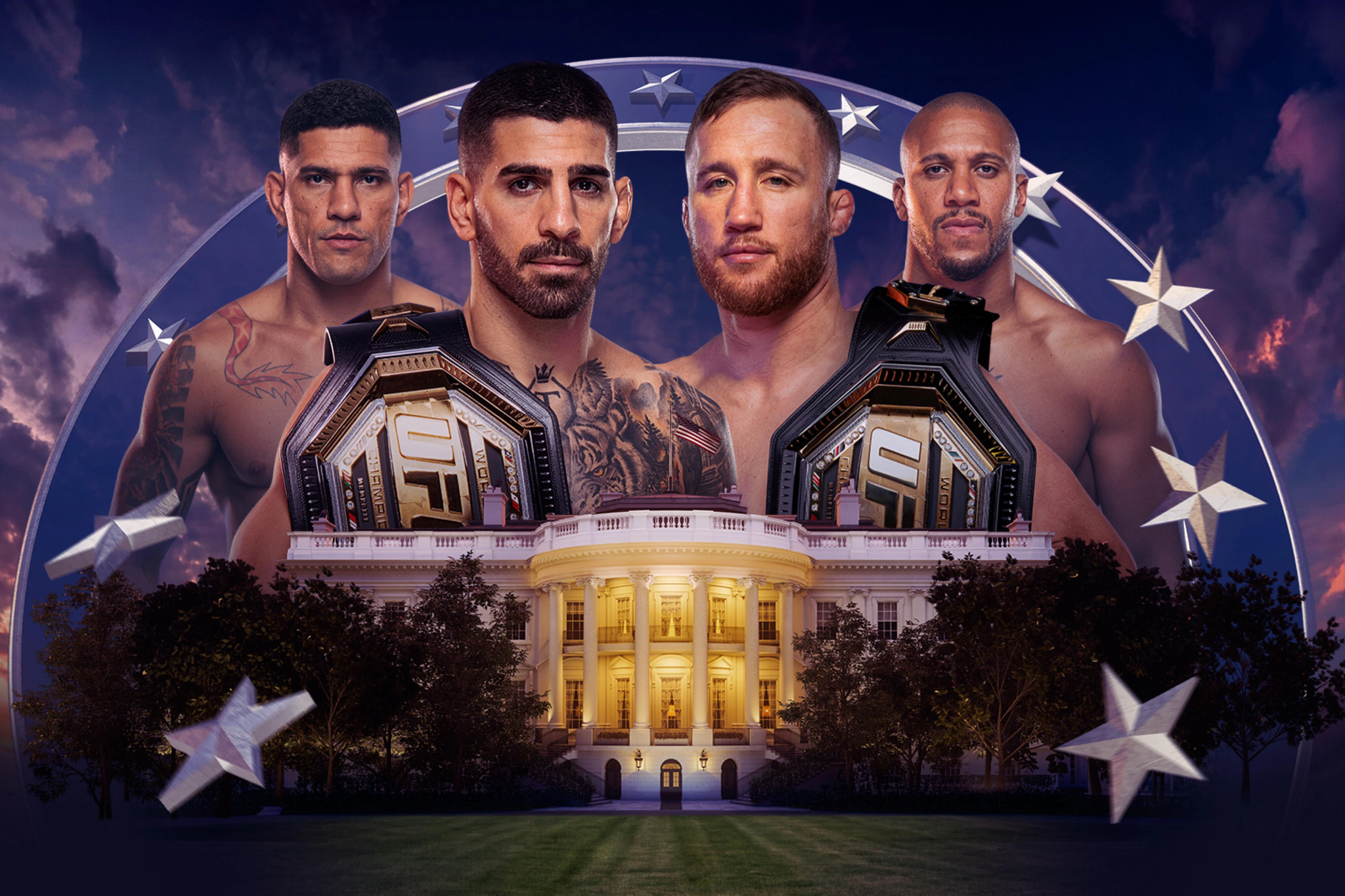
Signal/Noise is an ongoing series that cuts through the spectacle to find the structure underneath. Each installment takes a breaking moment (either political, cultural or economic) and traces the power dynamics most coverage misses. The signal is always there. You just have to know what to listen for.
I. The Lawn
On Sunday, June 14, Flag Day, the President of the United States will celebrate his 80th birthday by watching men beat each other unconscious in a cage on the White House South Lawn.
The event is called UFC Freedom 250. A 5,000-seat temporary arena is being assembled on the same grounds where state dinners used to happen, where Easter egg rolls were held for children, where foreign leaders walked with presidents under the elms. Three hundred and fifty truckloads of equipment. Cranes visible over the roofline of the People’s House. A custom broadcast structure called “The Claw” engineered for television visuals. Extensive regrading because the lawn isn’t flat enough to hold a professional fighting arena. The South Lawn is also, as of last October, adjacent to the demolished East Wing, which is being rebuilt as a 90,000-square-foot ballroom with underground bunkers. The president is staging a cage fight on a construction site next to the monument he’s building to himself.
The event is sponsored by Crypto.com and Ram. The Semiquincentennial of American independence, brought to you by a cryptocurrency exchange and a truck brand. Jefferson would be thrilled.
It hasn’t gone smoothly. Multiple fighters have pulled out. UFC officials have reportedly expressed concerns about the mid-June D.C. heat, the suffocating humidity, and the insects attracted to all the lights. Trump threw what appeared to be a tantrum on Truth Social last weekend, threatening to cancel the whole thing. The spectacle can’t even manage its own logistics.
Outside the White House perimeter on Sunday, the No Kings movement is staging a First Amendment concert. Inside the perimeter, a cage fight. Citizens singing about freedom on one side of the fence. Men bleeding for it on the other. On the president’s birthday. On Flag Day. During a war.
II. Bread and Circuses
The Roman poet Juvenal coined the phrase “panem et circenses” to describe how emperors kept the public pacified: give them bread and give them games, and they’ll forget that the republic is rotting from the inside. As such, the Colosseum wasn’t just entertainment. It was political technology, a machine for converting spectacle into the appearance of power while the actual power structure decayed behind the marble.
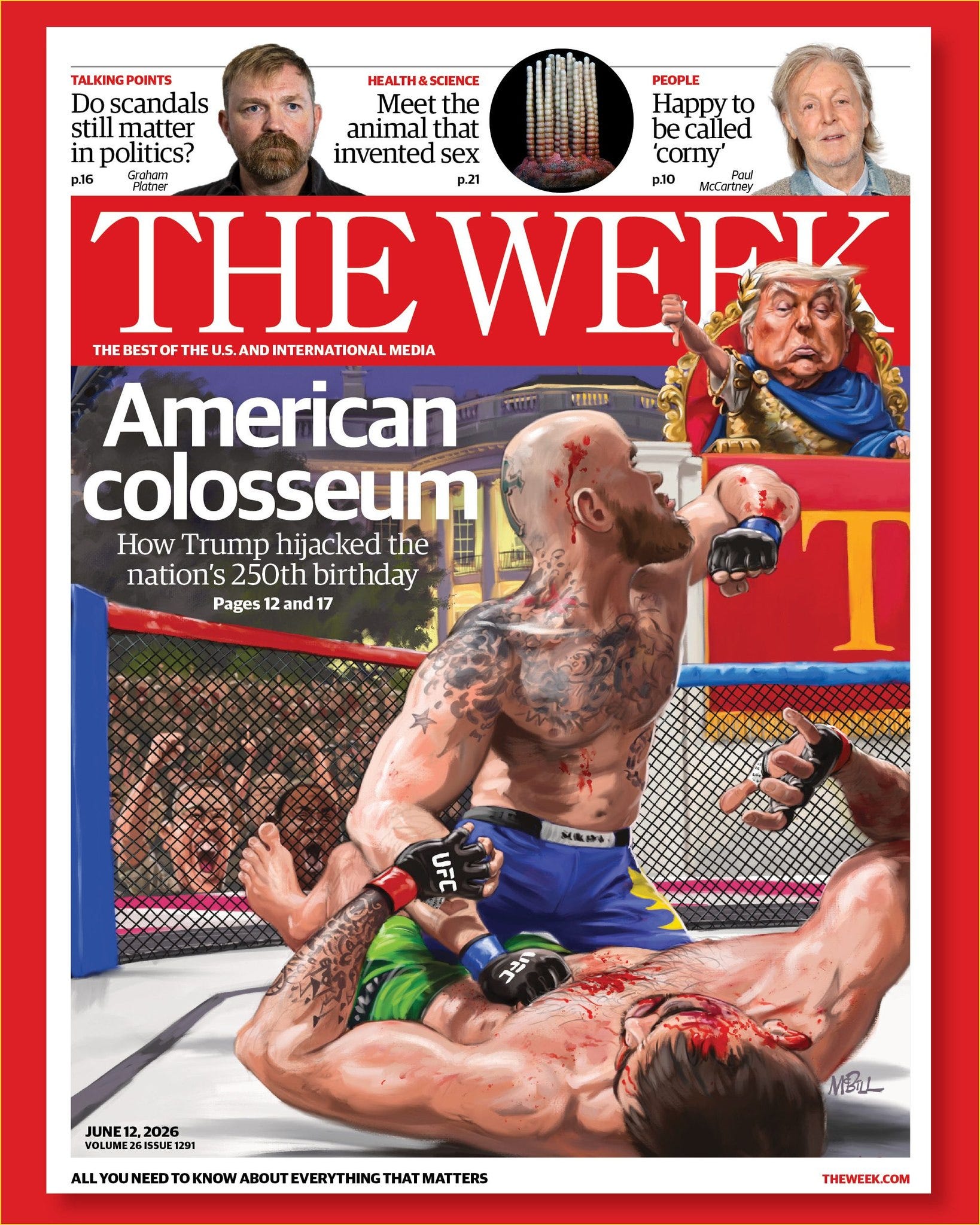
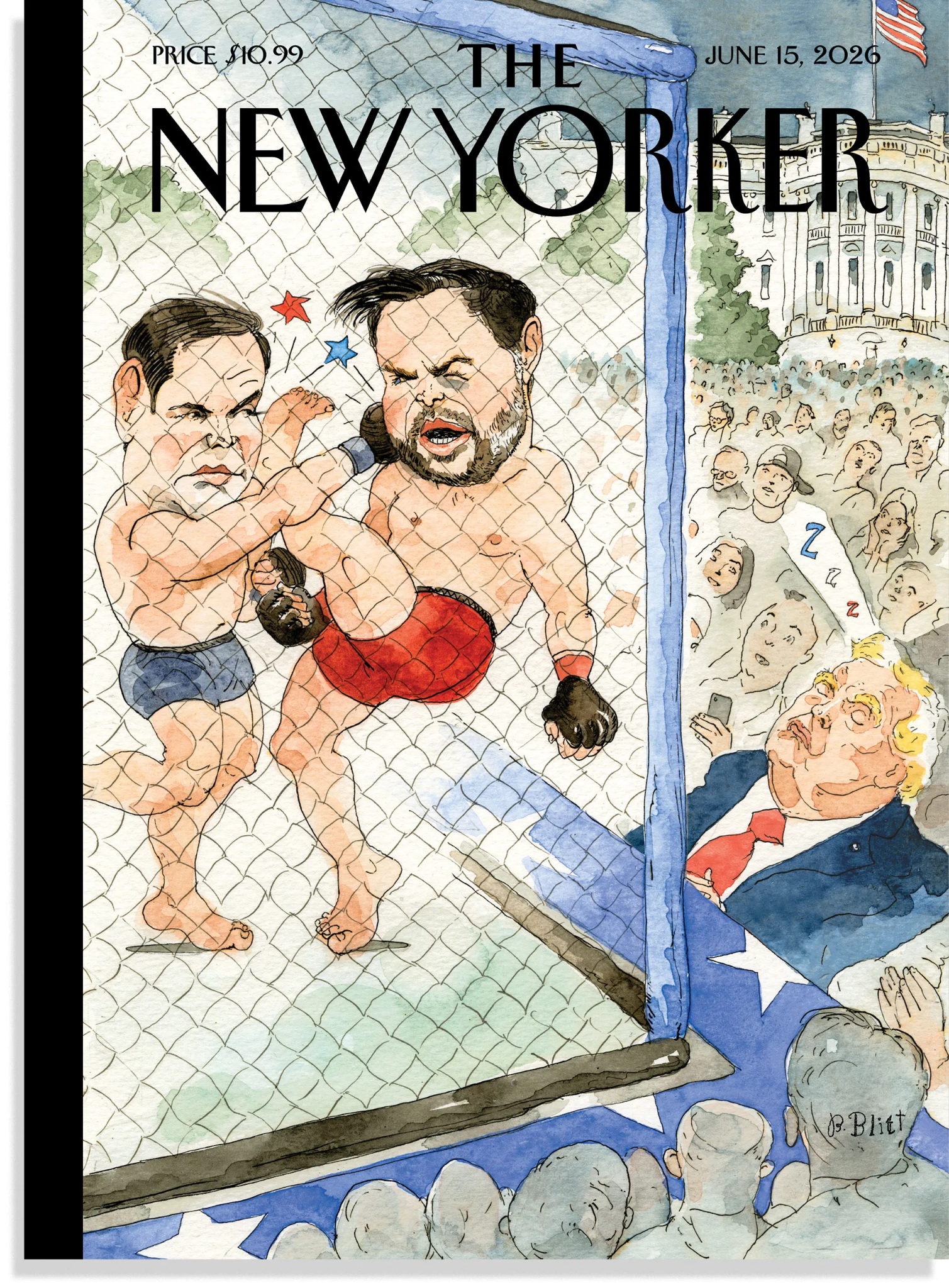
The cover of this week’s issue of The Week captures the parallel with an image that barely qualifies as satire: Trump in imperial Roman garb, presiding over bloodied fighters in a cage, the White House visible through the fence behind him. The headline: “American Colosseum.” The subheadline: “How Trump hijacked the nation’s 250th birthday.” A mainstream magazine put the bread-and-circuses argument on newsstands across the country, because the argument is no longer a reach. It’s a rendering of what’s actually happening on Sunday.
But there’s a more recent prophecy worth naming. In 2006, Mike Judge released Idiocracy, a comedy set 500 years in the future where the President of the United States is a former professional wrestler named Dwayne Elizondo Mountain Dew Camacho, the most popular television show is called “Ow! My Balls!,” and the entire country has been dumbed into submission by an endless feed of spectacle and consumption. Despite the film’s thoughtful opening monologue about how human evolution could play out, it was ultimately treated as absurdist satire, and played in theaters as a joke about a future that could never actually arrive.
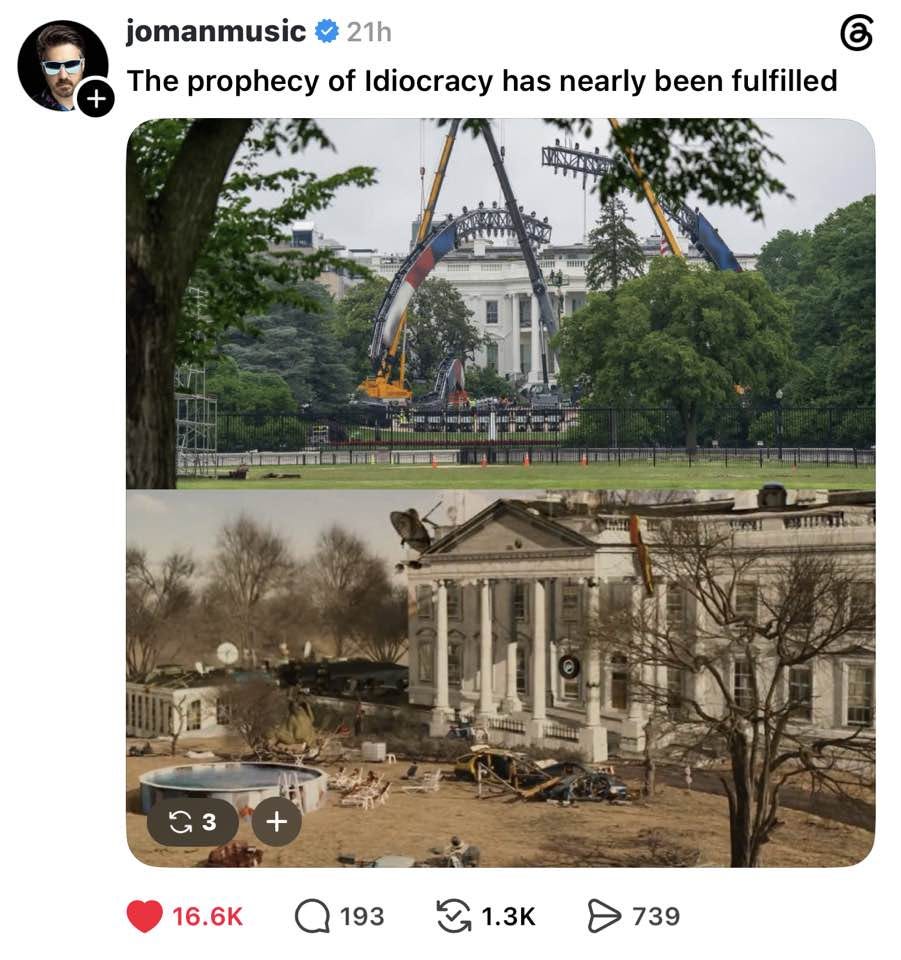
Twenty years later, the President of the United States is staging a cage fight on the White House lawn on his 80th birthday during a war. The event is sponsored by a cryptocurrency exchange. His family is selling $12,000 commemorative gold coins with his face on them. A pre-fight press conference is scheduled at the Lincoln Memorial. And the professional satirists saw it coming. “I’m no prophet,” Judge told TIME back in 2016, when Trump was merely running for office. “I was off by 490 years.” His co-writer Etan Cohen put it more bluntly: “Writing Idiocracy was just following your id. Now unfortunately our id has become our candidate for President.” That was before the war. Before the ballroom. Before the golden statue. Before Freedom 250.
The id didn’t just become the candidate. It became the presidency. And on Sunday, it’s hosting fights in an arena on the lawn of the People’s House, charging admission, and calling it patriotism.
III. The Freedom in Freedom 250
The name is worth sitting with. Freedom 250. A celebration of American liberty, staged by a company that two separate law review articles have identified as one of the most exploitative labor structures in professional sports.
The UFC operates as a monopsony, a market in which a single buyer dominates the purchase of labor. If you are an elite mixed martial arts fighter, the UFC is effectively the only employer. There is no meaningful alternative. The Iowa Law Review published an analysis last year arguing that the FTC should take enforcement action against the UFC for acquiring its dominance through anticompetitive mergers and maintaining it through exclusionary contracts that prevent fighters from seeking competitive offers. The University of Toledo Law Review went further, describing UFC fighter contracts as “unconscionable,” a legal term meaning so one-sided that no fair person would offer them and no reasonable person would accept them absent coercion.
The numbers tell the rest. UFC fighters receive roughly 16 to 20 percent of the revenue they generate. In the NFL, NBA, and MLB, athletes receive approximately 50 percent. The gap isn’t a negotiation outcome. It’s a structural feature of a market with one buyer and no exit. The FTC investigated the UFC twice in the 2010s for antitrust violations. Both investigations ended without action. Now the company is hosting a birthday party for the president on public land, and selling $12,000 gold coins with his face on them in partnership with his sons’ business. The coins are billed as commemorating a “defining patriotic moment.” The fighters whose labor makes the moment possible will take home less than a fifth of what it generates.
Terry Crews, who played President Camacho in Idiocracy, saw where this was heading a decade ago. “The cult of masculinity has gone amok,” he said in 2016. “What he is saying is, I will beat you down and take your women.” The UFC spectacle is that cult made architectural: masculinity as product, combat as content and patriotism as brand. The fighters are the raw material. The president is the logo. And the freedom on display at Freedom 250 is the freedom of a structure that pays its athletes less than a fifth of what they earn while wrapping the exploitation in a flag and staging it on the lawn of the People’s House.
The event’s own tagline says it plainly, though not in the way they intended: “Freedom isn’t a spectator sport.” For UFC fighters, it isn’t a sport at all. It’s a contract they can’t leave.
IV. The Architecture of Distraction
Guy Debord wrote that the spectacle is not a collection of images but a social relation among people, mediated by images. The UFC Freedom 250 is that thesis made flesh and broadcast on a streaming platform owned by a Trump-aligned CEO. The presidency has been reduced to content production, and Sunday’s programming is a cage fight with a flag motif.
Here is what is happening while 350 truckloads of equipment are assembled on the South Lawn.
The Iran war is in its fourth month. The Strait of Hormuz still remains effectively closed. The national average for gas today is $4.16, and California has the highest of any state at $5.89. Diesel inventories are at historic lows. Spirit Airlines no longer exists. The energy crisis that analysts warned about in the spring is arriving on schedule, and it will get worse before it gets better. Fifty-six people have died in immigration detention this year. Detainees at Delaney Hall have been documented eating food with worms in it. The $1.5 trillion defense budget continues to fund a war that 71% of Americans oppose while the administration simultaneously spends $60 million on UFC event infrastructure and pushes a $400 million ballroom expansion at the White House.
One Reddit user put it as cleanly as anyone could: “So glad we are getting this instead of healthcare.”
The spectacle doesn’t just distract from the crisis. It announces that the people in power have decided the crisis is not their problem. The cage fight is not a failure of governance. It is the governance. Entertain the base. Perform strength. Sell the coins. Stream the content. And let the architecture collapse behind the stage set while the cameras point the other way.
A lawsuit filed by the Public Integrity Project is seeking to block the event entirely. Its founder, Brendan Ballou, called it “a profoundly corrupt scheme to enrich the President and his friends,” warning that if the fight proceeds, “our national monuments will become little more than branding opportunities for the rich and well-connected.” The administration’s response to the legal challenge was three words: “obstructionist, baseless, and dilatory.” They didn’t address the merits. They attacked the people who filed.
That, too, is the architecture.
V. Where It All Points
While the cage fight happens inside the perimeter on Sunday, the No Kings movement will be outside it, staging a First Amendment concert they’re calling Rise Up, Sing Out. Citizens singing about freedom on one side of the fence, men bleeding for money on the other. The juxtaposition is almost too neat, and I want to be honest about my ambivalence: I’ve written before about my skepticism toward traditional protest, about how marches and concerts and petitions tend to make participants feel like they’ve done something without actually threatening the structures that produce the crisis in the first place. The powerful don’t lose sleep over people singing outside the gate. They lose sleep over people who stop showing up to work, stop paying the bills, and stop participating in the machinery that keeps the whole thing running.
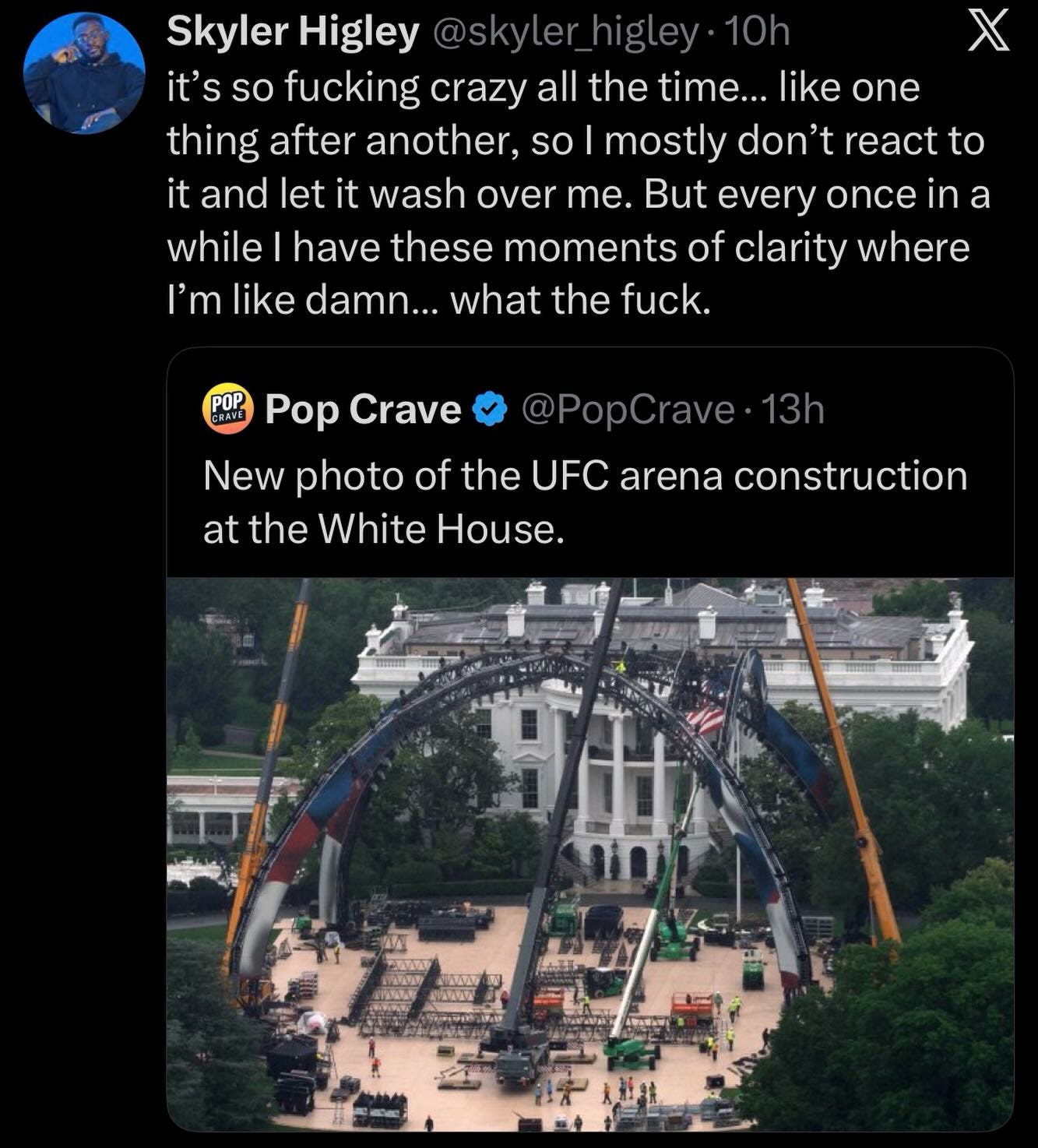
But I also know that something is shifting. Eight million Americans marched on No Kings Day earlier this year, the largest single day of nonviolent direct action in the country’s history, and even if marching alone doesn’t dismantle the architecture, it does something that the spectacle is specifically designed to prevent: it reminds people that they are not alone in seeing what they see, that the exhaustion is shared, that the pattern recognition is not paranoia but clarity. One viral tweet captured that feeling perfectly this week, a man looking at photos of the arena construction behind the White House and writing: “It’s so fucking crazy all the time... like one thing after another, so I mostly don’t react to it and let it wash over me. But every once in a while I have these moments of clarity where I’m like damn... what the fuck.” That moment of clarity is what the spectacle is designed to prevent, and the fact that millions of people are still having it, still showing up, still refusing to let the absurdity become the new normal, is the only thing that separates a declining republic from a fallen one.
The Colosseum is still standing in Rome. You can buy a ticket and walk through the tunnels where the gladiators waited. The Roman Empire, of course, is not standing. It fell, slowly and then all at once, while the games kept playing and the emperors kept building and the bread kept flowing until it didn’t. The arena always outlasts the empire that built it, because stone endures longer than legitimacy and spectacle survives longer than the state that staged it.
On Sunday the president will sit in the front row of a cage fight on the lawn of the People’s House, on his 80th birthday, on Flag Day, during a war, next to a half-built ballroom, while citizens sing about freedom outside the fence and fighters bleed for a fraction of what they’re worth inside it, and the country will watch it all on a screen and decide what it means. The only question worth asking is the one the spectacle is designed to make you forget: who exactly is in the cage, and which side of the fence are you on?
References
Blanchet, B. (2026, June 8). Trump Family, UFC selling $12,000 ’Freedom 250’-Themed coins ahead of White House fight night. HuffPost. https://www.huffpost.com/entry/trump-organization-ufc-selling-freedom-250-coins_n_6a26db25e4b0626f4fe031e5
Garner, D. (2022). Unconscionable: Fighters, Contracts, And A Hardcore Cash-Money Sport. University of Toledo Law Review.
Powel, J. (2026, June 8). Federal lawsuit aims to stop UFC Freedom 250 fight at White House. USA TODAY. https://www.usatoday.com/story/sports/ufc/2026/06/07/lawsuit-stop-ufc-freedom-250/90451204007/
Stein, J. (2026, February 22). We have become an idiocracy. TIME. https://time.com/4327424/idiocracy/
Varandani, S. (2026, May 27). From Politics to Pay-Per-View: The White House’s Entertainment Era. International Business Times, Singapore Edition. https://www.ibtimes.sg/politics-pay-per-view-white-house-entertainment-era-ufc-freedom-250-86992
Williams, T. (2025). Hipster Antitrust and Labor Monopsony: Why the Federal Trade Commission Should Throw a Punch at the UFC. Iowa Law Review.
____________________________________________________________________________
Means and Meaning publishes every Tuesday. If you found value in this analysis, I’d be very grateful if you’d consider buying me a coffee — your support helps me dedicate time to this work while keeping all content free and accessible.
You can also support this project by subscribing (it’s free!), sharing with others who might appreciate it, or joining the conversation in the comments. Sometimes the best antidote to anxiety is knowing you’re not alone in seeing what’s happening.
Next week, we’ll examine another piece of the machinery — and what it tells us about how the rest of it works.
Until then, keep questioning, keep connecting, and keep believing that another world is possible.
~ Chris