


This piece is part of “The Big Squeeze,” a series examining how capital extracts value from every aspect of daily life — from subscription traps to housing crises, revealing how systematic wealth transfer is disguised as innovation and convenience.
I. What Would Christmas Cost Without the Credit Card?
Every December, the same quiet pressure returns: Be generous. Be festive. Be normal.
Most people aren’t trying to keep up with the Joneses. They’re trying to keep up with expectations, to show care, to create memories and to make a hard year feel a little lighter for the people they love. In a country where so much of life already feels precarious, Christmas becomes one of the few moments where we’re told it’s okay to pause and be generous.
The problem is that generosity has been outsourced to the marketplace.
Americans now spend close to a trillion dollars during the holiday season, and a significant share of that spending is financed with debt. Not because people are reckless, but because wages haven’t kept pace with the cost of living, and because our culture quietly equates love with buying power.
For many families, Christmas isn’t indulgence. It’s triage. A careful balancing act between rent, groceries, credit cards and the hope of giving their kids something to hold onto.
If the season feels heavier than it used to, that’s not a personal failure. It’s what happens when an economy built on extraction asks people to prove care with money they don’t have.
II. When Celebration Becomes an Obligation
No one sits down in January and decides, “This year I’d like to feel financially panicked by December.” And yet, year after year, that’s exactly where many people end up.
Holiday spending doesn’t just “happen.” It’s orchestrated. Months of advertising, countdowns, limited-time offers, and emotional cues train us to experience buying as participation, as proof that we showed up, that we did Christmas correctly. Even restraint is marketed back to us, neatly packaged and for sale.
The message is subtle but relentless: if you love people, you’ll spend. If you don’t spend, you’re opting out - out of joy, out of belonging or out of the season itself.
What makes this especially cruel is the timing. December arrives after a year of rising rents, higher grocery bills, costlier utilities, medical debt and stagnant paychecks. Families are already stretched thin when the economy turns generosity into a performance with a price tag.
Groups like Reverend Billy and the Church of Stop Shopping understand this well. Their street theater isn’t about scolding consumers. It’s about breaking the spell: using humor and spectacle to expose how absurd it is that celebration has been reduced to a transaction.
The pressure isn’t coming from within us. It’s coming from an economy that depends on constant spending, even (and especially) when people can least afford it.
And Christmas, for all its warmth, has become one of its most reliable tools.
III. An Economy That Needs Us to Keep Buying
The strange thing about all this isn’t that Americans spend so much during the holidays. It’s that the economy needs them to.
By December, the pressure is no longer just cultural - it’s structural. Retailers, advertisers, credit card companies and logistics giants all depend on a massive end-of-year surge to make the numbers work. Holiday shopping isn’t a bonus; it’s a pillar. When spending slows, panic sets in, not about human well-being, but about quarterly earnings and growth targets.
That’s why every year feels louder. Earlier sales. Bigger discounts. More urgency. The system has to extract more, faster, from households already carrying debt and anxiety. Even “record-breaking” holiday sales often coexist with record levels of financial stress. Those two facts are not in tension. They are connected.
What gets lost in the celebration is that this kind of consumption isn’t about abundance. It’s about compensation. Buying often fills gaps created elsewhere, like by long work hours, or by distance, by exhaustion and by the quiet knowledge that time and security are in short supply.
This is why restraint alone never fixes the problem. You can skip a purchase, reuse decorations, or set a budget (and those choices certainly matter) but they don’t change the underlying reality.
We’re living inside an economy that confuses motion with health, spending with care, and growth with joy. And once a year, it asks us to prove our belonging by keeping the whole machine running.
IV. The Church of Stop Shopping
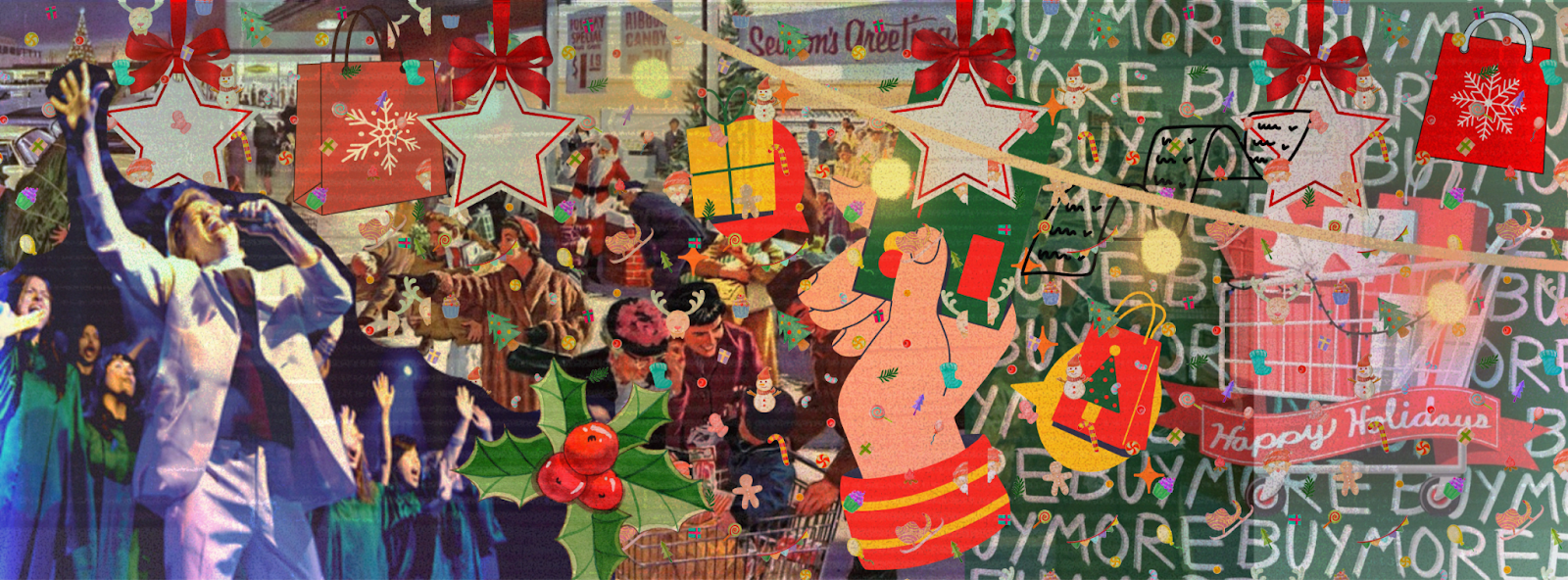
Every December, Reverend Billy and the Church of Stop Shopping show up where the pressure is thickest: malls, big-box stores, glowing retail cathedrals. Dressed like a preacher, backed by a full gospel choir, he shouts and sings against overconsumption, not with spreadsheets or scolding, but with spectacle. It’s easy to laugh at first. That’s part of the point.
The performances are exaggerated, joyful, disruptive. They borrow the language of religion and turn it sideways, exposing how shopping has taken on the rituals once reserved for faith: confession (“I couldn’t help myself”), absolution (“It was on sale”), and salvation (“They’ll love this”). By making it absurd, the Church of Stop Shopping makes it visible.
What they’re really interrupting isn’t buying, but normalcy. The idea that this is just how things are. That maxed-out credit cards, stressed parents, and frantic December schedules are personal failures rather than predictable outcomes of a system built on constant growth.
The humor matters. Laughter opens a crack where guilt usually sits. Instead of blaming shoppers, the performances aim at the machinery around them: the ads, the music, the artificial urgency and the way desire is engineered and recycled year after year.
It’s not about purity or withdrawal. It’s about asking, in the middle of the noise, a forbidden question: What if we didn’t have to do this to prove we care? That question lingers long after the choir leaves the store.
V. What Would Care Look Like Without a Price Tag?
The problem isn’t that Americans shop too much at Christmas. It’s that we live in an economy that asks us to prove care, joy and belonging by spending money we often don’t have.
Most people feel this contradiction intuitively. The stress. The quiet panic behind “just one more gift.” The sense that love has somehow been outsourced to receipts and shipping confirmations. None of this comes from greed. It comes from wanting to show up for the people we love in a system that monetizes that impulse at every turn.
An economy built on endless growth can’t afford for us to pause. So it turns holidays into pressure valves. Buy now. Buy enough. Buy before it’s too late. And when the bills come due in January, the system shrugs - that part is private, individual, your responsibility.
But what if care didn’t require consumption? What if generosity wasn’t measured by price? What if belonging didn’t hinge on keeping the retail machine humming at full speed?
These aren’t abstract questions. They’re already being answered in small ways, like in shared meals, in hand-me-down traditions, in mutual aid and in time spent rather than money exchanged. In moments when people quietly refuse the script.
The Church of Stop Shopping isn’t really asking us to stop buying things. It’s asking us to imagine something bigger: a society where meeting human needs comes before extracting profit, and where love isn’t something you have to put on a credit card.
That may sound radical. But so is the idea that this is the best we can do. And in a season built around hope (however you understand it), that feels like a very good place to start.
References
Collins, S. (2024, November 2). The Church of Stop Shopping and Religious
Activism: Combatting Consumerism and Climate Change Through Performance.
WebOnlyReviewsLJ, 149(11), 1.
Cooper, T. (2008). Carnivalesque as Comic Corrective: The Rhetorical Project of
Reverend Billy and the Church of Stop Shopping. Conference Papers -- National
Communication Association, 1.
Counselor, C. (2025, December 19). How much do Americans spend on Christmas? Capital
Counselor. https://capitalcounselor.com/blog/christmas-spending-statistics/
Sandlin, J. A. (2010). Learning to Survive the “Shopocalypse”: Reverend Billy’s
Anti-Consumption “Pedagogy of the Unknown.” Critical Studies in Education, 51(3),
295–311. https://doi.org/10.1080/17508487.2010.508809
____________________________________________________________________________
Means and Meaning publishes every Tuesday. If you found value in this analysis, I’d be very grateful if you’d consider buying me a coffee — your support helps me dedicate time to this work while keeping all content free and accessible.
You can also support this project by subscribing (it’s free!), sharing with others who might appreciate it, or joining the conversation in the comments. Sometimes the best antidote to anxiety is knowing you’re not alone in seeing what’s happening.
Next week, we’ll examine another piece of the machinery — and another opportunity to resist it.
Until then, keep questioning, keep connecting, and keep believing that another world is possible.
~ Chris