


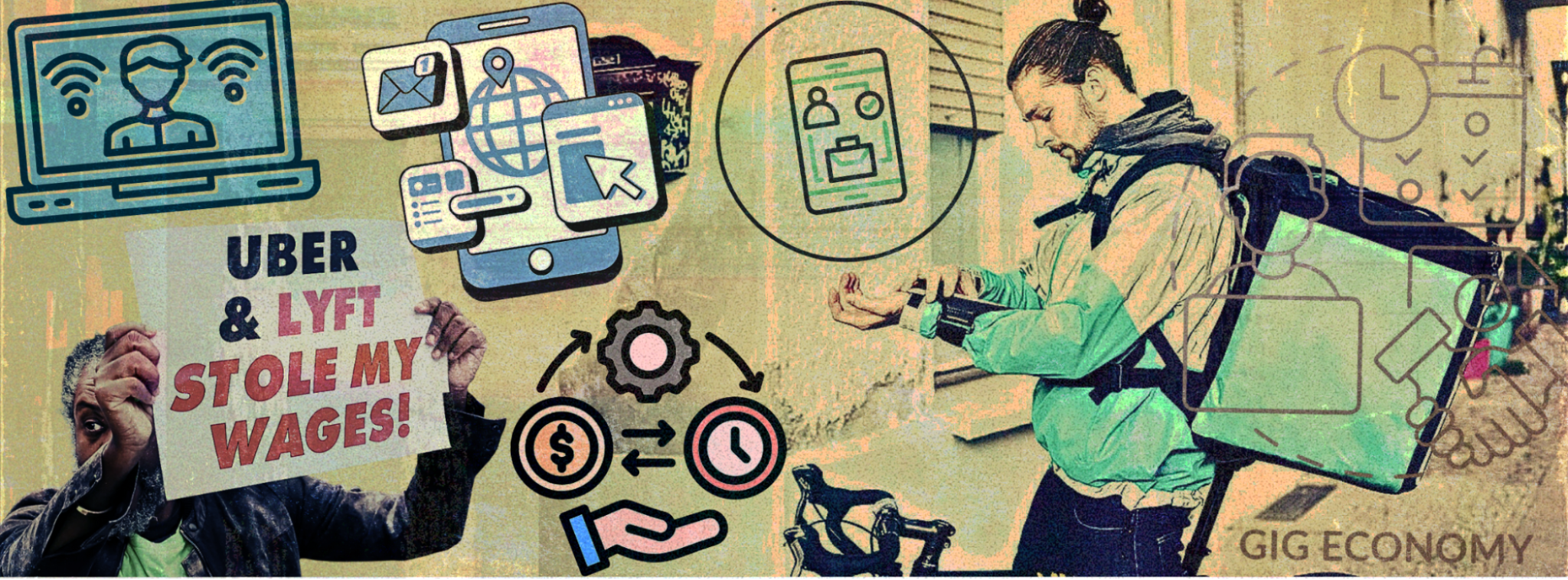
This piece is part of “Workers Rising,” a series celebrating and analyzing labor struggles past and present — from shop floors to app-based gigs, exploring how workers build power against increasingly creative forms of exploitation.
I. The Promise That Curled Inward
By the time Gen Z entered the workforce, the script was already worn thin. Work hard, specialize, be flexible and, ultimately, build a career. What they encountered instead was an economy where stability had become a luxury good and “success” meant juggling debt, uncertainty and three different income apps at once. Not because they wanted to, but because the floor had quietly dropped out beneath them.
What some economists are now calling “disillusionomics” isn’t rebellion for rebellion’s sake. It’s adaptation. When wages lag, rents surge and long-term planning feels almost fictional, people stop treating work as a path and start treating it as a patchwork. Side hustles multiply. Spare rooms turn into revenue streams. Even leisure becomes monetizable. Life itself gets sliced into sellable pieces.
This is often framed as a cultural shift: Gen Z as risk-loving, commitment-averse, allergic to the nine-to-five. But that explanation gets it backward. These behaviors aren’t driven by excess confidence in the market. They’re driven by a deep recognition that the old promises no longer hold. When conventional routes close, improvisation takes their place.
The gig economy didn’t just meet this moment - it helped shape it. Marketed as freedom, it offered a way to survive without security, and a way to stay afloat without standing still. And over time, what began as flexibility hardened into expectation.
II. When Flexibility Becomes a One-Way Street
At its core, the gig economy is often described as a neutral marketplace: various platforms simply connect workers to customers, take a small cut, and everyone benefits. But that story obscures what’s really happening. These platforms don’t just match labor to demand, they reorganize work so that risk flows downward while control flows up.
Gig companies rarely own cars, bikes, tools or even offices. What they own instead is the system: the app, the algorithm and the data. Workers supply the labor, absorb the downtime, pay for their own equipment and shoulder the uncertainty. The platform skims value from every transaction while avoiding the obligations that traditionally came with being an employer.
This is why gig work scales so quickly and so profitably. Growth doesn’t require hiring more managers or building factories. It requires enrolling more workers into a system where pay fluctuates, schedules are unstable, and decisions are made by software no one can appeal. Labor becomes just another input, one that is infinitely adjustable and easily replaceable.
Over time, this arrangement reshapes expectations. Workers are told they’re independent, entrepreneurial and “their own boss.” But independence without power is just isolation. What looks like freedom on the surface often functions as a stripped-down form of employment, one where the worker carries the costs, and the platform captures the upside.
III. The Architecture of the Trap
The gig economy doesn’t rely on foremen or factory whistles. Its discipline is quieter, and often more effective. Control is built directly into the architecture of the platforms themselves: ratings systems, opaque algorithms, dynamic pricing and constant surveillance dressed up as “optimization.”
Workers are nudged, sorted, and punished without ever being formally managed. A low rating can mean fewer jobs. Declining too many gigs can quietly throttle visibility. Sudden “deactivations” arrive without explanation or appeal. As one critical study of platform labor put it, algorithmic management allows firms to “extract value while minimizing accountability,” replacing human supervision with automated enforcement.
This isn’t incidental - it’s foundational. Platforms like Uber have openly acknowledged that reclassifying workers as employees, with minimum wages and benefits, would “adversely affect” their business model. In other words, the profitability of gig work depends on keeping workers just outside the boundary of protection.
By 2025, roughly 12% of the global workforce was engaged in some form of platform-based labor, generating more than $600 billion annually. Yet most of those workers still lack predictable income, benefits, or job security. The system scales precisely because instability is built in. What emerges is a trap disguised as choice. Workers are free to log on, but not free from the consequences engineered into the system once they do.
IV. When Everyone’s a “Founder,” No One Has a Floor
If the gig economy has a masterstroke, it’s not technological - it’s linguistic. Workers aren’t called workers. They’re partners, creators, independent contractors, or, most seductively, entrepreneurs. Everyone is framed as a CEO in miniature, even when they control nothing but their own exhaustion.
This language matters because it shifts responsibility. If income is unstable, that’s not a structural problem - it’s a personal branding failure. If demand dries up, the answer isn’t collective protection but another hustle, another platform or another reinvention. Risk is individualized, while profits remain pooled at the top.
Fortune recently described Gen Z’s economic life as a “giant list of income streams.” But what sounds like diversification is often desperation. Turning spare time, spare space, and even spare attention into money isn’t empowerment when it’s done to survive. It’s the monetization of insecurity.
The rhetoric of flexibility also obscures dependence. Gig workers may choose when to log on, but they don’t choose how pay is calculated, how algorithms rank them, or when access is revoked. That’s not entrepreneurship—it’s labor without leverage.
By convincing people they’re solo operators in a crowded market, this language dissolves solidarity before it can form. And when workers see themselves as isolated brands instead of a shared class, the system wins the argument before the fight even begins.
V. The Fight That Keeps Breaking Through
For all its sophistication, platform capitalism has a basic flaw: it still depends on living labor. Algorithms may discipline work, fragment it, and obscure its value, but they cannot eliminate workers’ shared interests. This is where the system’s confidence begins to crack.
In The Fight Against Platform Capitalism, Jamie Woodcock documents something platforms work tirelessly to deny: gig workers are not isolated. From Deliveroo riders in London to Uber, Lyft and other rideshare drivers coordinating through WhatsApp and Telegram, workers repeatedly find ways to communicate, compare conditions and act together, even across borders. As Woodcock notes, platform labor has produced “new forms of collective subjectivity,” precisely because workers experience the same opaque pay cuts, sudden deactivations and algorithmic discipline.
This matters because it reframes resistance. The gig economy’s problem isn’t that workers lack power, it’s that power is systematically suppressed and individualized. Yet strikes, coordinated log-offs, legal challenges and data leaks keep surfacing anyway. Not despite platform design, but because of it.
Taken together, the barbell economy, disillusionomics, algorithmic control and linguistic sleight-of-hand all point to a system straining to hold contradictions in place. The question is no longer whether gig work is sustainable as-is. It’s whether we continue treating precarity as innovation, or recognize that every “flexible” platform is quietly rebuilding the conditions for collective struggle.
So the real question in turn is this: when workers keep finding each other inside a system built to keep them apart, what kind of economy are they already preparing to replace it with?
References
Munis, J. (2026, January 14). Gen Z is rebelling against the economy with ‘disillusionomics,’ tackling near 6-figure debt by turning life into a giant list of income streams | Fortune. Fortune. https://fortune.com/2026/01/10/gen-z-disillusionomics-rebelling-against-economy-life-hacking-income-streams-debt-dupe-culture/
Roy, K. (2026, January 14). Forget the K-Shape: We have a barbell economy—and the middle class is buckling under the weight | Fortune. Fortune. https://fortune.com/2026/01/14/when-will-us-enter-recession-middle-class-barbell-k-shaped-economy/
Sarkar, S. (2025). Platform Capitalism and the Gig Economy: Surplus ValuevExtraction in the Age of Algorithmic Labor. Socialism & Democracy, 39(1/2), 227–249. https://doi.org/10.1080/08854300.2025.2520478
Thorogood, J. (2025, July 16). Gig Economy in 2025: Regulatory Shifts and Tech-Driven opportunities. Forbes. https://www.forbes.com/councils/forbesbusinesscouncil/2025/07/16/gig-economy-in-2025-regulatory-shifts-and-tech-driven-opportunities/
Towers-Clark, C. (2021, January 11). The Uberization of Work: Pros and Cons of the gig economy. Forbes. https://www.forbes.com/sites/charlestowersclark/2019/07/08/the-uberization-of-work-pros-and-cons-of-the-gig-economy/?sh=19e21b941cc7
Woodcock, J. (2021). In The Fight Against Platform Capitalism: An Inquiry into the Global Struggles of the Gig Economy (pp. i–vi). University of Westminster Press. https://doi.org/10.2307/j.ctv1ktbdrm.1
____________________________________________________________________________
Means and Meaning publishes every Tuesday. If you found value in this analysis, I’d be very grateful if you’d consider buying me a coffee — your support helps me dedicate time to this work while keeping all content free and accessible.
You can also support this project by subscribing (it’s free!), sharing with others who might appreciate it, or joining the conversation in the comments. Sometimes the best antidote to anxiety is knowing you’re not alone in seeing what’s happening.
Next week, we’ll examine another piece of the machinery — and another opportunity to resist it.
Until then, keep questioning, keep connecting, and keep believing that another world is possible.
~ Chris