


Precarity Diaries is an ongoing series connecting personal economic experience to structural conditions. Each installment starts where most of us actually live - in the gap between what the system promises and what it delivers, between the credential and the paycheck, between the ceremony and what comes after - and follows those threads back to the architecture that produced them. These aren’t just personal stories. They’re the transcripts of a system grading on a curve that was never designed in our favor.
I. The Ceremony
I cried at my students’ graduation this past Friday afternoon. Our virtual public charter school held its inaugural graduating senior class ceremony, and watching those names scroll across the screen, students I had taught and graded and worried about and encouraged through the past few years of pandemic recovery and political chaos and the slow unraveling of every institutional promise their education was built on, I lost it. I typed into the staff Teams chat afterward: “Ugh, every year I tell myself I’m not gonna cry, and every year I fail. Such a moving and fitting tribute to all of our deserving seniors. SO PROUD!!!” I meant every word.
The next day, I put on my own cap and gown, as well as a graduation hood with a light sky blue velvet lining, indicating the degree level achieved. Master of Education, Curriculum and Instruction, from Southern New Hampshire University. Magna cum laude. Perfect score on my capstone. I watched the virtual commencement livestreamed on YouTube, wearing my graduation regalia, including honor society cords, in my office, and when my name appeared I felt a flood of emotions including pride, relief, and deep contentment. I posted about it on Facebook and received a broad outpouring of support and well wishes from not only many family and friends, but also many former grade school teachers, Hampshire professors, and students I had taught over the years everywhere from St. Croix to Maine to Grenada. The kid from the small island did alright.
And a week before that, Hampshire College held its final spring commencement, conferring degrees to 192 graduates under a tent on a campus that will close at the end of this year. President Chrisler held back tears. The keynote speaker, Dr. J Finley, a friend from the class ahead of mine, called her address her “Div IV” and told the graduates that no one is coming to save them. The library quad was brimming with people who came to applaud the new alumni and to say goodbye to the institution that made them.
Three ceremonies in eight days. I wept viewing all of them from a computer screen. And the question I could not stop asking, through the tears and the pride and the caps sailing into the air, is the question this piece is built around: graduation into what?
II. What They’re Walking Into
Students graduating at all academic levels this month are stepping into a world experiencing seismic economic shifts, political turmoil compounded by a war in the Middle East, and a labor market that has quietly turned hostile to the very people it was supposed to absorb. Only 13% of young Americans between 18 and 29 believe the country is headed in the right direction, according to the Harvard Youth Poll. 57% percent say it is on the wrong track. 43% describe themselves as struggling or getting by with limited financial security, a figure that rises to 50% among Black youth and 51% among Hispanic youth. And only 30% believe they will be better off financially than their parents, which means seven in ten members of this generation have already abandoned the foundational promise of American economic life before their careers have even begun.
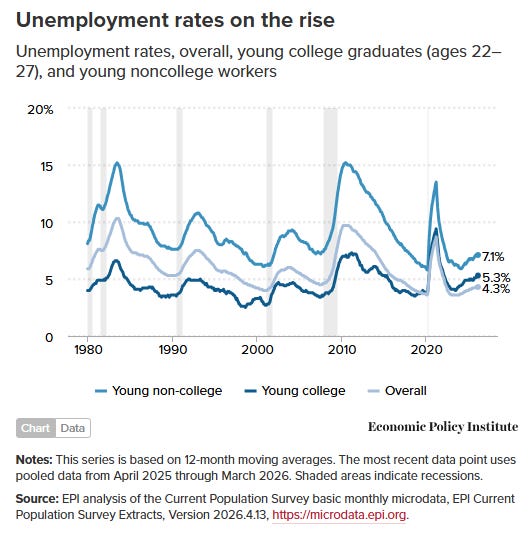
The job market they are entering confirms their pessimism. More than half of 183 employers surveyed by the National Association of Colleges and Employers rate the 2026 job market for college graduates as poor or fair, the most pessimistic outlook since the first year of the pandemic. Handshake, one of the largest early-career job platforms, reports a 16% year-over-year decline in full-time job postings alongside a 26% increase in applications per job. Three in five rising seniors say they are pessimistic about starting their careers. One product design major told Inside Higher Ed, “The political climate has made me lose a lot of hope for not only the job market, but my future as a whole. Everything feels very divided and unstable.” The unemployment rate for young college graduates has risen to 5.3%, now exceeding the overall national rate of 4.3%, a complete reversal of the historic pattern in which a degree once guaranteed a labor market advantage. The Economic Policy Institute notes that the hires rate, one of the most reliable indicators of labor market health, has fallen to levels not seen since 2013 and 2014, when unemployment was three percentage points higher than it is today.
And it’s not just college graduates facing this contraction. The Wall Street Journal reported this week that summer teen hiring is on track to be the worst in decades, with camp counselor listings on Indeed down nearly 30% from last year, and New York City’s Summer Youth Employment Program receiving over 200,000 applications for 100,000 openings. Challenger, Gray and Christmas projects that only 790,000 jobs will go to teen workers this summer, which would set a new record low, falling below last year’s already historic low of 801,000. Rising fuel costs are squeezing the small businesses that typically hire young people for seasonal work. The labor market is not merely difficult at one level. It is contracting at every level simultaneously, from the entry-level corporate positions that college graduates are competing for to the summer jobs that high school students depend on for their first paychecks.
Artificial intelligence is also accelerating this contraction in ways that graduates can feel even if economists are still debating the data. Nearly nine in ten graduates now worry that AI will replace entry-level roles, up from 64% just one year ago. By a three-to-one margin, young Americans believe AI will take away more opportunities than it creates. 59% see it as a direct threat to their job security, making it one of the few issues on which young Democrats and Republicans agree. Companies are not necessarily eliminating positions outright, but they are, as one career expert described it, “hitting the brakes” on hiring as they assess how much human labor they still need. The result is a labor market characterized by what multiple analysts now call a “low-hire, low-fire” environment: companies aren’t laying people off in large numbers, but they aren’t bringing anyone new in either. Additionally, turnover has stalled, as 75% of current employees plan to stay in their positions through 2027, nearly half of them out of fear and economic uncertainty rather than satisfaction. Positions that would normally open through natural attrition are locked up. And the graduates standing outside the door, diplomas in hand, are discovering that up to 20% of the job listings they are applying to may not even be real, posted by companies to build talent pipelines or signal growth to investors rather than to actually fill a position.
The commencement speeches told them the future is theirs. Here is what “theirs” looks like in the data.
III. The Credential Trap
The system’s answer to all of this has always been the same: get more education. Work harder. Earn the credential. The degree will open the door.
I believed that. I still believe in the liberatory power of education itself, with a conviction rooted in watching it transform my own life and the lives of my students across nearly two decades. But despite completing my master’s degree this spring, I was offered a contract for next year that amounts to a pay cut after inflation. Fifteen years of classroom experience, a new graduate degree, and I will earn less in real terms next year than I did this year. The system’s response to four years of graduate work was a number calculated on a scale they won’t even share with me.
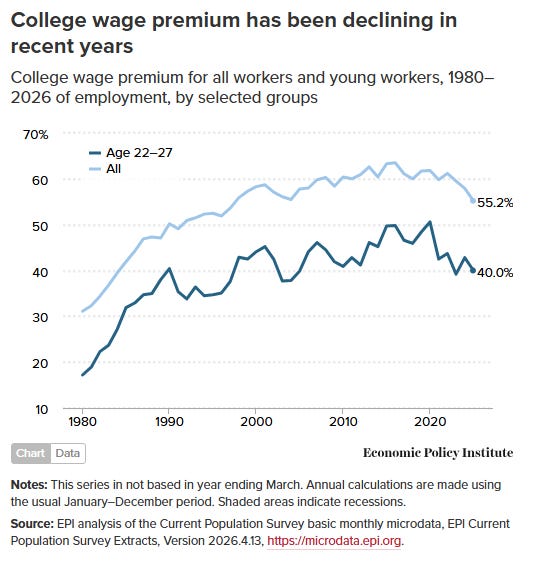
Sadly, I am not an exception. I am the pattern. The Economic Policy Institute’s data shows that the college wage premium, the earnings advantage a degree provides over a high school diploma, peaked around 2015 and has been declining since, now sitting roughly where it was in the late 1990s. The credential costs more and delivers less than it did a decade ago. Meanwhile, the Institute for Women’s Policy Research reports that the gender wage gap is widening for the second consecutive year, with women earning 82.1 cents on the dollar in 2025, down from 83.6 cents just two years prior. Women graduating this month walk into a labor market that is actively moving backward on pay equity, regardless of their qualifications. For Black and Hispanic graduates, the picture is even starker: the EPI documents annual earnings gaps exceeding $10,000 compared to their white and Asian American peers, even among workers with identical credentials and limited experience.
And here is the structural absurdity that ties it all together: more than 80% of hiring managers now say AI fluency is important for entry-level hires, but only one in three graduates say their college prepared them to use AI professionally. The system charges $50,000 to $200,000 for a credential, the credential often doesn’t teach the skills employers now require, and the wage premium it once guaranteed is shrinking. The door the degree was supposed to open is closing while the cost of the key keeps rising.
IV. The Speech and the Architecture
Most commencement speeches say some version of the same thing: work hard, believe in yourself, and the future belongs to you. It is optimism delivered in academic regalia with inspirational music underneath, and it is, in a way, one of the most sophisticated performances of ideology in American life. The speeches assume a world that rewards credentials, absorbs talent, and distributes opportunity to those who earn it. The data in the previous two sections describes the world that actually exists. The gap between the two is the architecture this generation is graduating into, and this year, that generation is making its displeasure heard.
At the University of Central Florida earlier this month, a commencement speaker began telling arts and humanities graduates that artificial intelligence represents “the next Industrial Revolution.” The graduates booed. Not murmured. Not shifted uncomfortably. They booed loudly enough that the speaker stopped mid-sentence and asked, “What happened?” The moment went viral, and similar disruptions have followed at ceremonies across the country. Palliative care researchers have a clinical term for what happens when a patient’s anticipated future suddenly vanishes. They call it the “existential slap.” What that auditorium in Orlando captured on video was an entire generation experiencing something structurally similar, refusing, collectively, to sit quietly through one more performance of a future they no longer believe in.
At Hampshire’s final commencement, Assistant Professor Noah Romero offered a different framing entirely. Hampshire, he told the graduates, did not keep them safe from the world. It kept “an irredeemable world” safe from the graduates. And now the college was about to “unleash 192 miniature Hampshire Colleges on the world.” That is not the language of a normal commencement speech. It is the language of a counter-narrative, one that treats the graduates not as products to be absorbed by the economy but as forces capable of challenging it. The difference between telling graduates “the future is yours” and telling them the world should be worried about what they’re capable of is the difference between training workers and educating citizens. One of those institutions just closed, while the other has never been more profitable.
V. Where It All Points
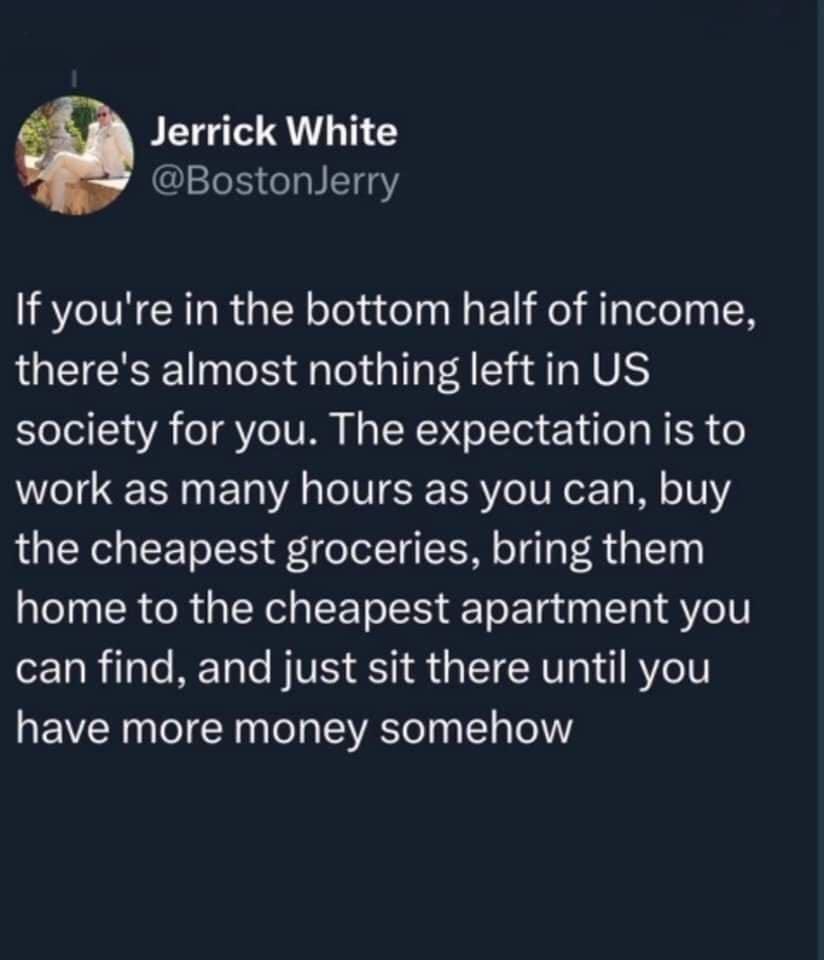
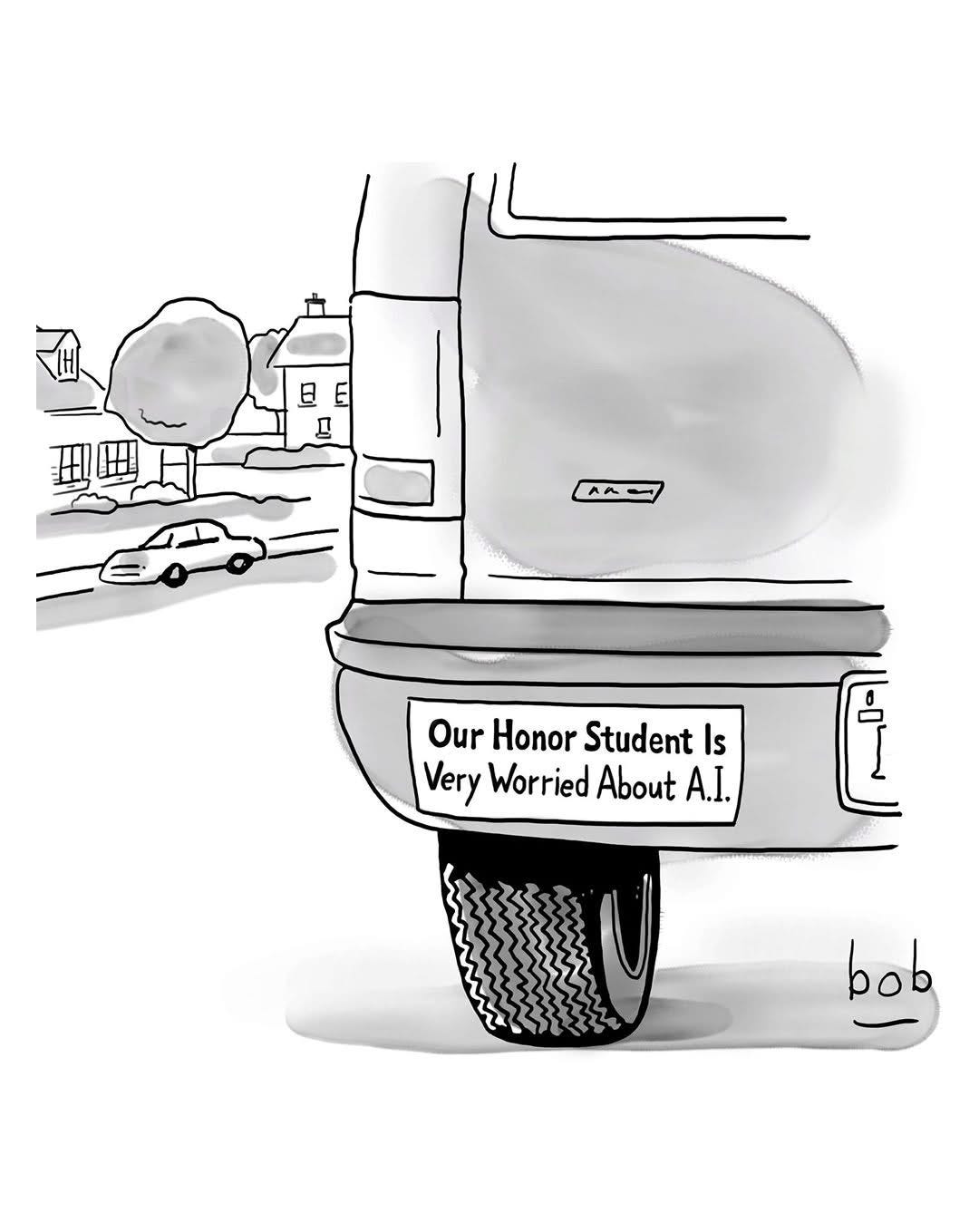
The post above has been circulating on social media this spring, and every time I see it I think about my students. Not because they are destined for that life, but because the architecture they are graduating into was not designed to prevent it. The systems that were supposed to catch them, educate them, employ them, house them, and give them a foothold in a functioning democracy are fraying simultaneously, and the fact that commencement speakers keep telling them to believe in themselves is not reassurance. It is a substitution of individual optimism for structural responsibility, and this generation is clear-eyed enough to know the difference.
I am not cynical about any of this. I refuse to be. I watched my students’ names scroll across that screen on Friday afternoon and saw young people who studied through a pandemic, adapted to a political landscape that shifted beneath them semester by semester, and still showed up. They wrote essays and took exams and asked questions and pushed back and grew. They did their part. And a republic that still calls itself an experiment in self-governance owes them an economy and a democracy worthy of the energy they’re bringing to it.
At Hampshire’s final commencement, Dr. J Finley told the graduating class something I have not been able to stop thinking about. She quoted a line from her own book, forged, she said, in the work she did at Hampshire nearly a quarter century ago: “There cannot be liberation without a deep subjective, and collective, consciousness of what one desires out of the condition of being free.” Then she added, in her own voice: “No one’s coming to save us.”
Both of those statements are true, and holding them together is the work of this moment. The graduates of 2026, at every level, possess something the architecture they are entering cannot take from them: the capacity to see clearly what is happening and to refuse to accept it as inevitable. The labor market is hostile. The credential is devalued. The debt is crushing. The housing is unaffordable. The safety net is being shredded. AI is rewriting the rules of employment in real time. The energy crisis is restructuring the global economy beneath their feet. All of that is true.
And what is also true is that they are capable, and creative, and more structurally literate than any generation before them. They are not naive about what awaits them. The Harvard data proves it. The booing at UCF proves it. The quiet, determined faces I saw on my screen Friday afternoon prove it. They know. And knowing, as Hampshire’s motto insists, is not enough. But it is where everything begins.
I cried at three graduations in eight days. I cried because the pride is real, and the love is real, and the ceremonies are beautiful, and the music swells and for one brief moment everything feels like a promise. I also cried because I teach for a living, and I know what promises are worth in this economy. These graduates deserve a world that matches the faith their education asked them to have. Building that world is not their burden alone. It is ours. All of ours. And we are running out of time to start.
References
Cammalleri, A., & Cammalleri, A. (2026, May 19). ‘Let this day be all about joy’: Hampshire College’s final spring commencement honors Class of 2026. Amherst Bulletin. https://amherstbulletin.com/2026/05/19/let-this-day-be-all-about-joy-hampshire-colleges-final-spring-commencement-honors-class-of-2026/
Connor, S. (2026, April 23). The Planet is Dying but You’ve Got Work on Monday. Collapse 2050.

Ellis, L. (2025, November 13). Companies Predict 2026 Will Be the Worst College Grad Job Market in Five Years. The Wall Street Journal. https://www.wsj.com/lifestyle/careers/2026-graduates-job-market-7928bcd7?msockid=2b8fdbfd306665fc0a73c89a311d6461
Fast, J. & Gould E. Young college graduates face a weaker labor market—but a more mixed picture than the headlines suggest. Economic Policy Institute. https://www.epi.org/blog/class-of-2026-young-college-graduates-face-a-weaker-labor-market-but-a-more-mixed-picture-than-the-headlines-suggest/
Harvard Public Opinion Project. (2025, December 4). Harvard Youth Poll Reveals Mounting Strain on Young Americans — Financial, Institutional, and Social. Harvard Kennedy School Institute of Politics. https://iop.harvard.edu/press-releases/harvard-youth-poll-reveals-mounting-strain-young-americans-financial-institutional
Indy, A., & Indy, A. (2026, May 22). Hampshire College celebrates its final spring commencement - Amherst Indy. Amherst Indy - Critical, Progressive, Independent. https://www.amherstindy.org/2026/05/22/hampshire-college-celebrates-its-final-spring-commencement/
Liebergen, S. (2026, May 13). Class of 2026 faces tough job market and AI concerns as graduation season approaches. Scripps News. https://www.scrippsnews.com/politics/economy/class-of-2026-faces-tough-job-market-and-ai-concerns-as-graduation-season-approaches
Mowreader, A. (2025, August 29). Class of 2026 worries about jobs after college. Inside Higher Ed | Higher Education News, Events and Jobs. https://www.insidehighered.com/news/student-success/life-after-college/2025/08/29/class-2026-worries-about-jobs-after-college
Pahwa, N. (2026, May 20). Something strange is happening at college graduations across the country. It’s causing shocking outbursts—and for good reasons. Slate Magazine. https://slate.com/technology/2026/05/ai-college-graduation-speakers-eric-schmidt.html?pay=1779738975426&support_journalism=please
Peterson, M. & Sampong, C. The numbers don’t add up: women continue to earn less, regardless of occupation. In IWPR (Report No. C539). https://iwpr.org/wp-content/uploads/2026/03/2026-IWPR-Occupational-Gap-fact-sheet.pdf
Robinson, B., PhD. (2026, May 7). 10 Trends driving the job market 2026 Graduates need to know. Forbes. https://www.forbes.com/sites/bryanrobinson/2026/05/07/10-trends-driving-the-job-market-2026-graduates-need-to-know/
Smith, R. (2026, May 24). This Summer’s Teen Job Market Is the Toughest in Decades. The Wall Street Journal. https://www.wsj.com/economy/teen-summer-jobs-f3ffdbfa?msockid=2b8fdbfd306665fc0a73c89a311d6461
Wallace, A. (2026, May 20). This summer could be the worst on record for teen hiring. Tell us your experience. CNN. https://www.cnn.com/2026/05/20/economy/teen-hiring-jobs-callout
____________________________________________________________________________
Means and Meaning publishes every Tuesday. If you found value in this analysis, I’d be very grateful if you’d consider buying me a coffee — your support helps me dedicate time to this work while keeping all content free and accessible.
You can also support this project by subscribing (it’s free!), sharing with others who might appreciate it, or joining the conversation in the comments. Sometimes the best antidote to anxiety is knowing you’re not alone in seeing what’s happening.
Next week, we’ll examine another piece of the machinery — and what it tells us about how the rest of it works.
Until then, keep questioning, keep connecting, and keep believing that another world is possible.
~ Chris