


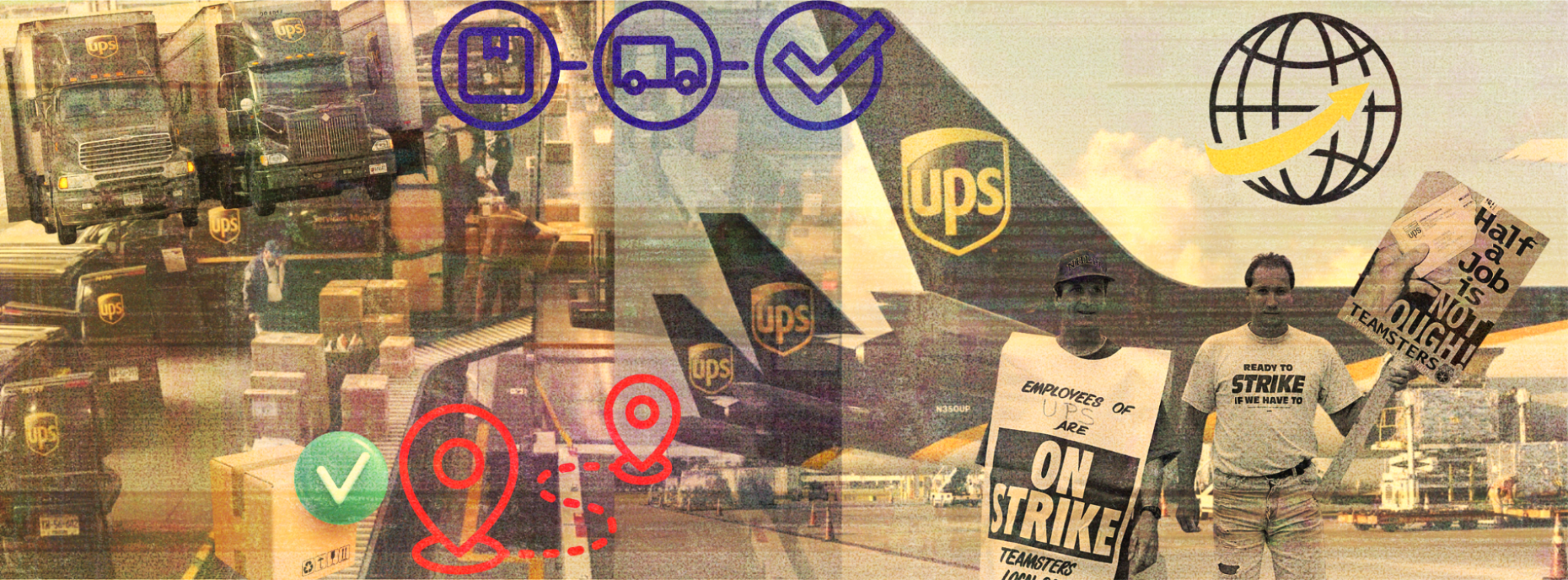
History Rhymes is an ongoing series tracing the echoes between past struggles and present crises. Each installment revisits a moment of resistance - from labor uprisings to political repression - to reveal the patterns that persist, the forces that evolve, and the lessons we can use now. History doesn’t repeat, but power does. And so does the courage to challenge it.
I. When the Brown Trucks Stopped Moving
On an August morning in 1997, something impossible happened: the brown trucks stopped.
Across the country, UPS package cars sat parked in long, silent rows - an industrial heartbeat gone still. Conveyor belts that usually screamed with motion fell quiet. Sorting hubs emptied. And in their place came a different sound entirely: the sharp, high-pitched shriek of whistles, thousands of them, blowing in unison as workers “blew the whistle” on the company that had pushed them to the breaking point.
More than 185,000 UPS workers - drivers, sorters, clerks, pilots and mechanics - walked off the job and into the streets. They carried hand-painted signs. They marched in the scorching August heat. They blocked gates with their bodies. Some walked their delivery routes, knocking on doors not to drop off packages but to deliver leaflets, window signs, and an explanation: we’re fighting for the future of full-time work, and we need you with us.
Within hours, the shockwaves were everywhere. Rivals like USPS and FedEx buckled under the weight of 11 million diverted parcels a day. Small businesses panicked. News anchors looked stunned. A $40-million-a-day hole opened in the U.S. economy. But ordinary people - teachers, retirees, parents waiting on school supplies, neighbors stepping out onto front porches - kept saying the same thing: Good. It’s about time somebody stood up to them.
What looked like a labor dispute was really a referendum on the direction of American work. For years, UPS had been quietly transforming itself into the employer of the future: fewer full-time jobs, more part-time “flexibility”; heavier packages, faster routes, more surveillance; record profits for shareholders, exhaustion for the workers holding the system together. The company doubled the maximum package weight from 70 to 150 pounds. It slashed part-time wages to $8 an hour. By 1990, half the workforce was part-time, and UPS wanted even more. Management insisted that this was what efficiency required. Workers knew it was how a corporation turns bodies into margins.
So they did something that felt impossible in the post-Reagan era: they fought back - and they won.
For fifteen days, the strike became a national crossroads. “Part-Time America Won’t Work” wasn’t just a slogan; it was a diagnosis. And for a brief moment, Americans could see the circulatory system of the modern economy - and the people who kept it alive - with crystal clarity. When those workers stopped moving, everything else did too.
Nearly three decades later, the rhyme is unmistakable. Today’s logistics workers - whether wearing brown, purple or Amazon blue - are trapped in a system moving even faster, squeezing even harder and depending even more on their exhaustion to keep the gears turning. The trucks are sleeker now, the scanners smarter and the routes algorithmically optimized down to the second. But the core truth of 1997 hasn’t changed: The economy only works because workers do, and when they withdraw their labor, the whole country feels the tremor.
The rest of this story is about what created that rupture, how it reverberates through today’s labor fights, and why the lessons of 1997 matter more now than ever.
II. The Machinery Behind the Moment
The UPS strike didn’t come out of nowhere. It erupted from a set of structural pressures that had been building for decades - pressures that now define the entire logistics economy. By 1997, UPS was already perfecting the model that Amazon, FedEx and countless gig-economy employers would later scale into an industry standard: fast delivery built on slow erosion of the workforce.
The shift began quietly. In the 1960s, UPS won permission to use part-time labor. In the 1980s, the company slashed those wages to $8 an hour. By 1990, half the workforce was part-time - and management made clear it wanted a majority. The logic was simple: part-timers were cheaper, easier to churn through and less likely to resist. Meanwhile, UPS doubled the maximum package weight to 150 pounds, stretching bodies to their limit in the name of “efficiency.”
This is the core principle of the logistics economy: speed is profit, and the cost is extracted from human beings. Just-in-time delivery requires a just-in-time workforce, which is often very fragmented, overworked and permanently replaceable.
At the same time, logistics became the circulatory system of a globalized economy running thinner every year. By the mid-1990s, UPS wasn’t just a delivery company; it was a central artery of commerce, moving millions of packages daily through a network calibrated down to the minute. Any disruption - weather, machinery or worker revolt - would jam the entire system.
Management knew this. Workers knew it too. That’s why the 1997 contract fight was fundamentally about more than wages. It was about who controlled the future of work in an economy that couldn’t function without them. UPS wanted to seize worker pensions, expand subcontracting and harden a two-tier system that pushed workers into permanent precarity. Workers wanted full-time jobs, stability and a chance to earn a living without breaking their backs.
Nearly thirty years later, nothing about this architecture has disappeared. It has only become more efficient, more global and definitely more ruthless. The stresses that led to the 1997 walkout are the same forces driving today’s burnout, heat deaths, algorithmic surveillance and near-strikes.
The machinery didn’t malfunction. It evolved.
III. The Architecture of Control
Corporations don’t rely on luck to maintain power. They rely on architecture: policies, technologies, legal strategies and old-fashioned intimidation designed to make resistance feel impossible.
In 1997, that architecture was already taking shape. UPS pushed a two-tier workforce that trapped half of its employees in permanent part-time status, with low wages and no path upward. It demanded control of worker pensions - a bid to govern not just labor, but workers’ futures. It expanded subcontracting to splinter solidarity. And it ramped up harassment, speed-up and discipline until the work felt less like a job and more like a test of endurance.
When negotiations neared the breaking point, management deployed its most familiar tool: the ultimatum. It issued a “final offer,” demanded an immediate vote, and leaned on the clock like a weapon. Deadlines became leverage. Delay became strategy. And when the union refused to bow, UPS tried to win in the press what it was losing at the table - portraying workers as reckless, disruptive and a threat to the “national interest.”
But workers understood the deeper truth: architecture is only strong until people stop obeying it.
The parallels to today are unmistakable. UPS in 2025 is using the same blueprint, upgraded with 21st-century tools. Forced overtime. “Optional” buyouts that read like threats. Tens of millions paid in penalty wages because drivers are routinely pushed past legal limits. Subcontracting disguised as “network streamlining.” And in the hottest year on record, the company managed to deliver only 10% of the air-conditioned vans it promised.
Amazon takes this architecture even further - algorithmic surveillance, GPS heat maps and AI-driven route optimization that schedules bathroom breaks out of existence. FedEx relies on contractors to insulate itself from responsibility. Everywhere you look, the same design principles repeat: fragment, pressure, extract, profit.
The 1997 strike didn’t just confront a company. It confronted an architecture of control that now spans an entire industry - and that workers are once again beginning to push against.
IV. The War Over Words
One thing I learned from the US Labor History course I took at Hampshire College (taught by the brilliant Laurie Nisonoff) is that every labor struggle is also a language struggle. Before corporations fight workers on the picket line, they fight them in the public imagination. UPS in 1997 also understood this well. Its “last, best, and final offer” wasn’t just a bargaining stance; it was a narrative device meant to frame workers as unreasonable if they dared to reject it. Management insisted part-time jobs were “flexible opportunities,” that subcontracting was “efficiency,” and that pension takeover was “modernization.” The goal was simple: recast extraction as progress.
Workers countered with a different kind of clarity. “Part-Time America Won’t Work” wasn’t just a slogan - it was a diagnosis of an economy being hollowed out from within. Drivers walking their routes to hand out leaflets reframed the strike not as an inconvenience, but as a fight for the future of work. And when UPS executives claimed $8 an hour was “more than enough,” Teamsters broadcast the tape widely, letting the company’s own contempt speak for itself.
Language didn’t just describe the conflict. It shifted it. Public support swung firmly behind the workers (two-to-one in some polls) because the workers told the more honest story: that a company posting record profits had no excuse for turning full-time jobs into precarious ones.
Fast forward to today, and the vocabulary has evolved but the function remains the same. UPS calls forced overtime “operational needs.” Buyouts are “voluntary separation programs.” Delayed safety improvements are “supply chain challenges.” Amazon refers to surveillance as “performance monitoring” and algorithmic quotas as “productivity tools.” Corporations sanitize exploitation with phrases engineered to dissolve responsibility.
Workers still counter with plain truth. Heat is heat, not “weather-related strain.” A 70-hour week is not “flexibility.” A missed AC installation is not “logistical delay” - it’s a hazard.
In every era, the side that names reality most clearly gains power. In 1997, workers won that battle. Today, they’re starting to win it again.
V. Where It All Points
The story of 1997 isn’t a relic. It’s a map. And if you trace its lines forward, they lead directly into the present moment, into every near-strike at UPS, every Amazon warehouse walkout and every FedEx driver pushed past exhaustion by a system that always demands more. The pressures that once cracked the UPS workforce have only intensified as logistics has grown into the hidden infrastructure of everyday life. Faster delivery. Thinner margins. More surveillance. Less stability. The promise of “full-time work” shrinking again into a part-time nation.
If anything, workers today hold even more leverage than their counterparts in 1997. The economy is more dependent on constant motion, every retail business more tethered to the next-day supply chain, every household more reliant on doorstep deliveries. A strike in 1997 shook the country. A strike of similar scale today could shake the world.
But leverage alone isn’t enough. What made 1997 historic wasn’t just the walkout - it was the organizing that made the walkout possible. Rank-and-file democracy. Member-to-member networks. Public engagement that turned a labor dispute into a moral argument about the future of work. The courage to reject a weak contract, even when management and the media insisted it was the best workers could get.
Those lessons matter now more than ever. The Teamsters’ renewed militancy, the rising tide of union support, the cross-union solidarity emerging in logistics and rail - these are not isolated sparks. They’re signs that workers are rediscovering their collective power in the very sectors that capitalism depends on most.
And this is where history truly rhymes. The same forces that tried to shrink work in the 1990s are still at it today. The same tactics (speed-up, subcontracting and intimidation) still wear new names but do the same damage. And the same path to victory remains: workers who understand their own power, organize beyond the shop floor and refuse to accept a future built on permanent precarity.
1997 showed what happens when workers stop the trucks and make the country look directly at the cost of convenience. 2025 may yet ask the same question.
History doesn’t exactly repeat - but when the stakes are this high, we shouldn’t be surprised when, once again, history rhymes.
References
Independent Socialist Group. (2023, July 6). Lessons from the 1997 UPS Teamster Strike. https://independentsocialistgroup.org/2023/07/06/lessons-from-the-1997-ups-teamster-strike/
Kulisch, E. (2025, August 12). UPS settles Teamster grievances, averts strikes in multiple states. FreightWaves.com. https://www.freightwaves.com/news/ups-settles-teamster-grievances-averts-strikes-in-multiple-states
Lessons from the 1997 UPS Strike. (n.d.). Teamsters for a Democratic Union. https://www.tdu.org/lessons_from_the_1997_ups_strike
____________________________________________________________________________
Means and Meaning publishes every Tuesday. If you found value in this analysis, I’d be very grateful if you’d consider buying me a coffee — your support helps me dedicate time to this work while keeping all content free and accessible.
You can also support this project by subscribing (it’s free!), sharing with others who might appreciate it, or joining the conversation in the comments. Sometimes the best antidote to anxiety is knowing you’re not alone in seeing what’s happening.
Next week, we’ll examine another piece of the machinery — and another opportunity to resist it.
Until then, keep questioning, keep connecting, and keep believing that another world is possible.
~ Chris