


Signal/Noise is an ongoing series that cuts through the spectacle to find the structure underneath. Each installment takes a breaking moment (either political, cultural or economic) and traces the power dynamics most coverage misses. The signal is always there. You just have to know what to listen for.
I. The Model in the Bunker
There is a scene in Downfall, a compelling 2004 German film about Hitler’s final days, that stopped me cold when I finally watched it one day this past week after work. It is April 1945. Berlin is being bombed to rubble. Soviet artillery shakes the walls of the Führerbunker. And Adolf Hitler is standing over a detailed architectural model of “Welthauptstadt Germania,” Albert Speer’s fantasy redesign of Berlin as the eternal capital of the thousand-year Reich. Grand boulevards. Triumphal arches. A domed hall that would hold 180,000 people.
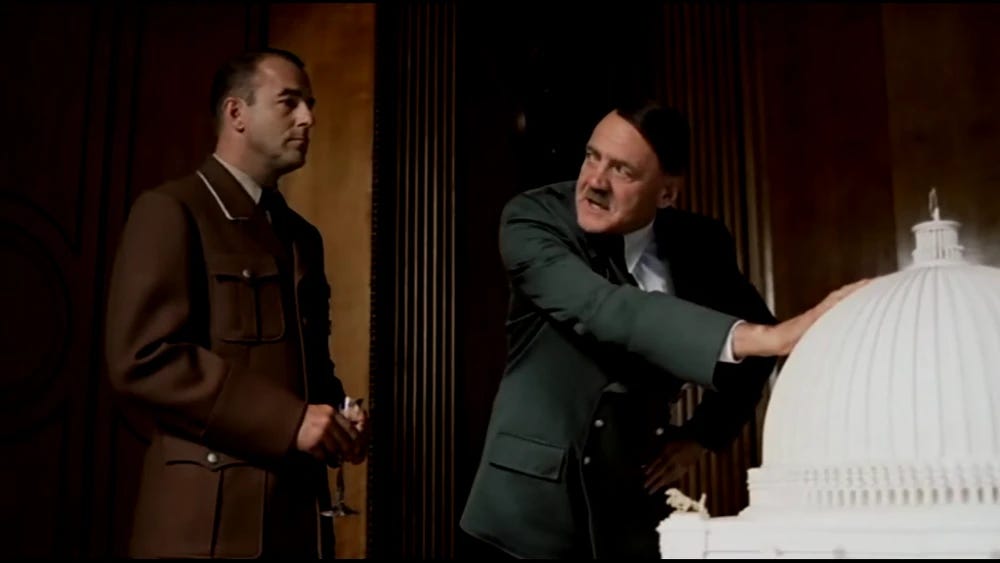
Hitler tells Speer the Allied bombing will actually help the construction by clearing the old buildings. He praises their shared vision of a “treasure house for arts and culture” that would “last the millennia.” When an aide urges him to flee Berlin, Hitler refuses. He says he’d feel like a “lama priest spinning an empty prayer-wheel.” He must force an outcome in Berlin, or face his downfall. Speer’s response: “I’ll be on stage when the curtain falls.”
A man staring at a model of a city he will never build, in a bunker beneath a city that is being destroyed, convinced that the architecture proves his permanence even as the ceiling shakes. The denial is total. The model is the last thing the mind holds onto when reality has become unacceptable.
I watched that scene and thought immediately of the President of the United States. Last October, Donald Trump began tearing down sections of the White House to build a massive ballroom, with underground bunkers and data centers beneath it. During an ongoing affordability crisis, and also now a new, unpopular war that is bleeding a billion dollars a day. With oil at $114. With majority support for impeachment. With mounting evidence of cognitive decline so visible that even Fox News hosts are asking questions.
The model in the bunker is not a personality quirk. It is a pattern. It recurs across civilizations. And it always signals the same thing.
II. Look on My Works
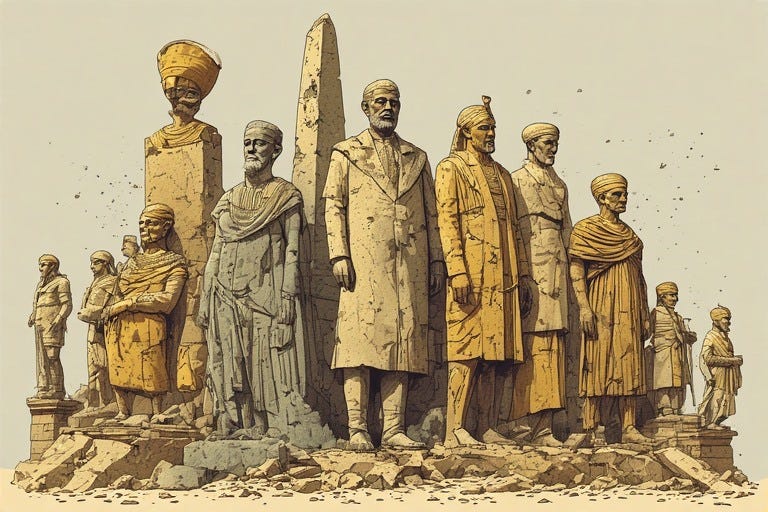
The pattern is quite old. Ramesses carved himself into cliff faces. The pharaohs built pyramids to outrun death. Louis XIV built Versailles to make the French aristocracy orbit him like planets around a sun. But Versailles consumed so much of France’s wealth that it helped create the conditions for the revolution that eventually destroyed the monarchy. The monument ate the kingdom. But the history teacher in me can’t help but notice that the pattern accelerates in the 20th century, when the monuments get bigger and the regimes get shorter.
Nicolae Ceaușescu demolished a quarter of Bucharest’s historic center to build the Palace of the Parliament, the largest administrative building in the world. Twenty thousand workers around the clock. Forty thousand people displaced. The building was completed after his execution by firing squad. It outlived the regime by decades. Today Romania charges tourists admission to visit it.
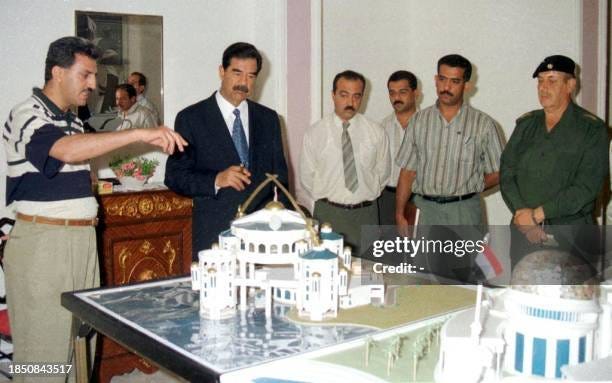
Saddam Hussein built dozens of enormous palaces while UN sanctions starved his population. I remember watching during the Iraq War, my second year at Hampshire, as US forces occupied those palaces and used the marble halls as military bases. The monuments that were supposed to project his permanence became the occupier’s furniture. His statue in Baghdad was pulled down on live television. In Basra, a giant poster of Saddam had its mouth shot out.
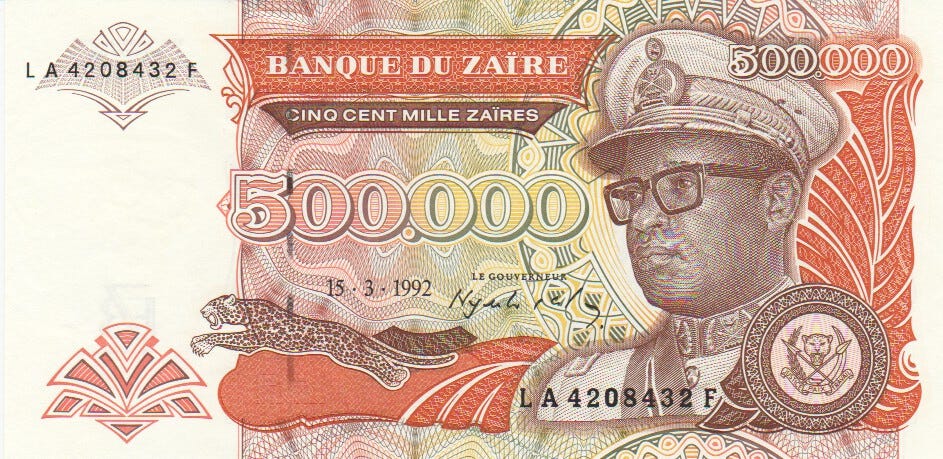
And the pattern kept repeating. Ferdinand Marcos carved into a Philippine mountainside, later blown up with dynamite. Mobutu’s face printed on every banknote in Zaire, later carved out by the citizens who’d been forced to carry them. Assad statues across Syria reduced to rubble after the 2024 revolution. Daniel arap Moi’s fist sculpture bursting through Mount Kenya, his face on every coin and even a national holiday named after himself.
Richburg’s observation here is telling: “Leaders come and eventually go, and many of their garish tributes to themselves end up on history’s junk pile, or become lasting monuments to their ridiculousness.” The grandeur is always inversely proportional to the stability. You could say that the bigger the statue, the closer the fall.
III. The Ballroom, the Arch, and the Golden Statue
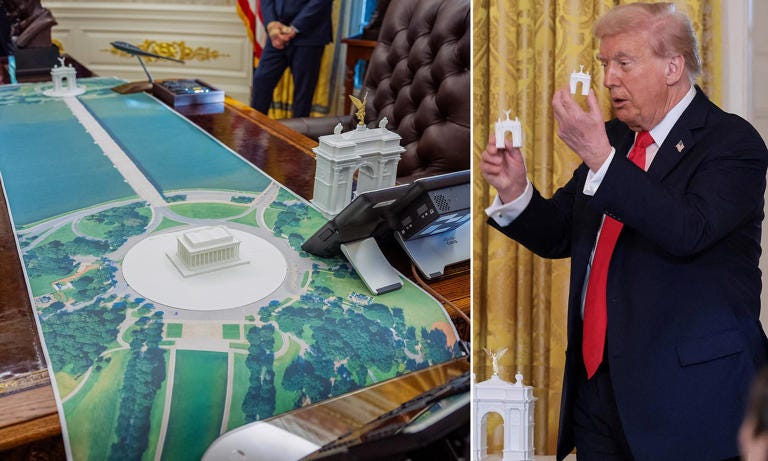
Last October, with his approval ratings steadily dropping, the President of the United States began demolishing the East Wing of the White House in order to eventually build a 90,000-square-foot ballroom with underground bunkers and data centers beneath it. He also bulldozed the Rose Garden, and gilded the interiors. And then he turned his attention to the National Mall, where he proposed a 250-foot triumphal arch, taller than the White House, the Lincoln Memorial and the Capitol building, modeled after Napoleon’s Arc de Triomphe but bigger, because of course bigger. He wants it to be the biggest arch in the world. A 60-foot gilt bronze Lady Liberty perched on top like a hood ornament on history’s most expensive car.
The Commission of Fine Arts, stacked with his loyalists, received nearly 1,000 public comments on the project. One hundred percent were negative, but they voted to move forward anyway. The commission chairman explained: “This is personal for the president.” A Vietnam veterans’ group actually filed a legal challenge because the arch would block the sightline between the Lincoln Memorial and Arlington National Cemetery. So we basically have the president inserting himself, architecturally, between Lincoln and the war dead. Between the nation’s ideals and the nation’s sacrifices.
And the arch is just the centerpiece. Let’s not forget the Kennedy Center, renamed. The Institute of Peace, renamed. Palm Beach airport, renamed. A proposed new class of guided-missile destroyers, named after himself. His signature will soon be stamped on US paper currency. Trump RX. Trump Gold Card visas (although, apparently, only a single one issued so far). Cabinet members wearing shoes he gives them like offerings to a man who has confused the presidency with a shoe store loyalty program.
Art historian Erin Thompson put it precisely: “The aesthetic is a way to make the political physically present. It’s a way to make it seem like things are changing and like Trump is keeping his promises when he’s actually not.”
The gold statue at his golf resort, nicknamed “Don Colossus,” was widely compared to North Korean propaganda statuary. The comparison is apt not because Trump runs a hermit kingdom, but because the psychological function is identical: the oversized, gilded likeness performing power for an audience that is required to witness it. Leaders who are building real power don’t need gold statues. Leaders who are losing it build nothing else.
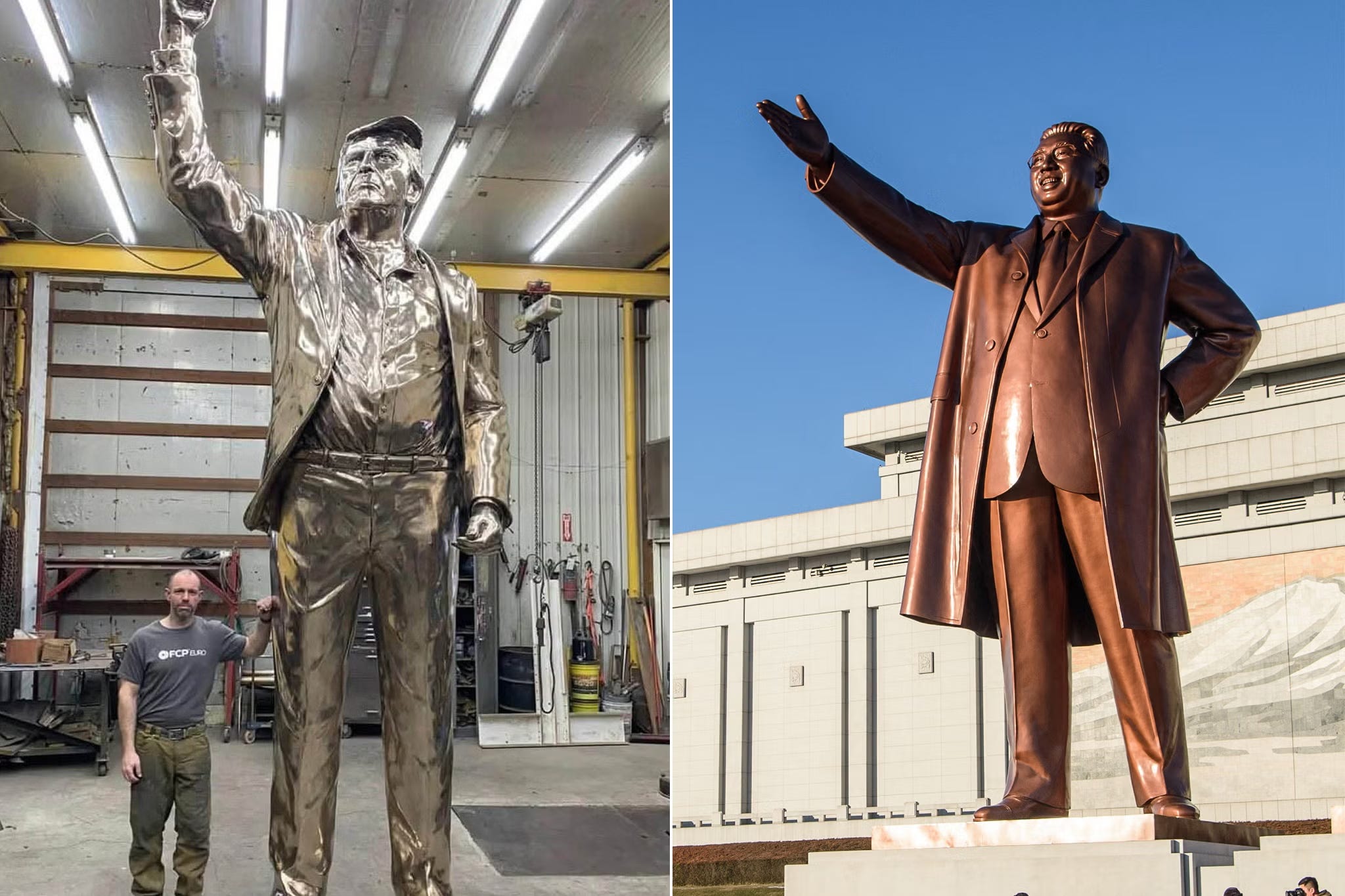
Left: the 15-foot ‘Don Colossus’ statue before gilding. Right: Statue in Pyongyang.
IV. The Architecture of Denial
Guy Debord wrote that the spectacle is not a collection of images but a social relation among people, mediated by images. The arch, the statue, the ballroom, the gilded interiors, the renamed buildings: these are images of power substituting for the exercise of actual governance. When you can’t build consensus, you build a ballroom. When you can’t win a war, you build a victory arch. When the approval ratings collapse and the economy buckles and the impeachment polling crosses 50%, you stamp your name on the currency and hand your Cabinet members matching shoes and call it leadership.
Gramsci would also recognize this instantly. When hegemony fails, when consent can no longer be manufactured through legitimacy, the ruler turns to spectacle to perform the authority he can no longer command. The gold statue is what you build when you can’t build a coalition.
But there’s a darker layer here too. Beneath the ballroom: bunkers. Data centers. Survival infrastructure. The spectacle is on the surface. The contingency plan is underneath. That combination, grandiosity above and escape routes below, is the architecture of a regime that knows, on some level it will never publicly admit, that the curtain is falling.
Hitler had the model and the bunker. Trump has the ballroom and the bunker. The parallel isn’t rhetorical. It’s architectural.
V. The Curtain Falls
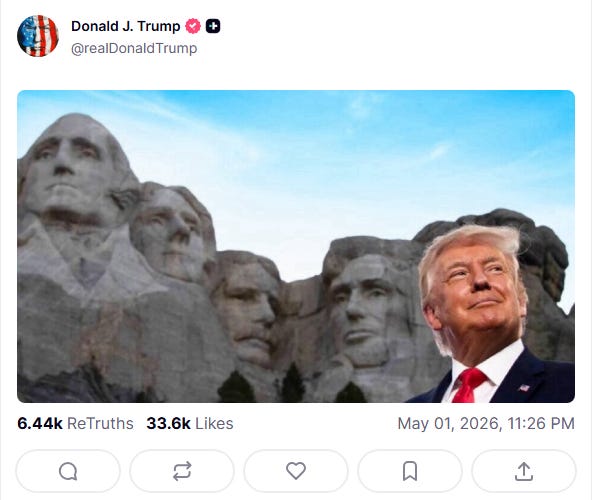
Four days ago, the President of the United States posted a photo of himself beside Mount Rushmore on Truth Social, grinning, as if the granite were already making room. I sincerely hope he doesn’t take the next step and commission his own likeness on that mountain, but with this president, hoping feels like a weak verb. And it’s worth remembering what Mount Rushmore already is before we worry about what it might become. The Lakota called that granite formation Tunkasila Sakpe Paha, Six Grandfathers Mountain, a sacred place of prayer for the Native peoples of the Great Plains. It was carved into stolen land, in violation of the 1868 Treaty of Fort Laramie, by a sculptor named Gutzon Borglum who had documented ties to the Ku Klux Klan. Rushmore isn’t the exception to the pattern of monumental erasure. It is the template.
Speer said he’d be on stage when the curtain falls. He wasn’t on stage. He was at Nuremberg, on trial. The model was ash. The thousand-year Reich lasted twelve years. Ceaușescu’s palace was finished after his firing squad. Saddam’s palaces became the occupier’s furniture. Marcos was blown off his own mountainside. Mobutu’s face was carved out of the money by the people who’d been forced to carry it.
The arch may not be built. The ballroom may not be finished. The gold statue may one day be removed, or defaced, or displayed in a museum with a plaque explaining what it was and what it cost and who paid for it while their schools crumbled and their grocery bills doubled and their sons and daughters came home from the Gulf in flag-draped coffins.
The question is not whether the monuments will outlast the regime. They almost never do. The question is how much of the country gets demolished in the construction.
References
Chapman, M. (2026, March 23). Trump gets stark history lesson over monument obsession from expert. Raw Story. https://www.rawstory.com/trump-monuments-2676580103/
Klein, B. (2026, April 16). Trump’s arch gets overwhelmingly negative public feedback but appears poised to move forward. CNN. https://www.cnn.com/2026/04/16/politics/trump-arch-feedback-commission
Sonnenfeld, J., & Tian, S. (2026, April 13). The futility of Trump’s grandiose personal branding of public assets, from ballrooms and bills to ships and planes | Fortune. Fortune. https://fortune.com/2026/04/13/trumps-personal-branding-obsession-history-leadership/
Reveal. (2025, December 10). Trump’s gilded White House makeover is all about power. Mother Jones. https://www.motherjones.com/politics/2025/12/trump-white-house-statues-monuments-east-wing-ballroom/
Richburg, K. (2026, March 24). Only a certain type of leader wants his face everywhere. Mercury. https://themercury.co.za/ios/opinion/2026-03-24-only-a-certain-type-of-leader-wants-his-face-everywhere/
Scott, O. (2026, April 29). Trump’s 15-foot gold statue of himself at his Florida golf course compared to North Korea’s Dear Leader. The Independent. https://www.independent.co.uk/news/world/americas/us-politics/donald-trump-north-korea-gold-statue-b2966982.html
____________________________________________________________________________
Means and Meaning publishes every Tuesday. If you found value in this analysis, I’d be very grateful if you’d consider buying me a coffee — your support helps me dedicate time to this work while keeping all content free and accessible.
You can also support this project by subscribing (it’s free!), sharing with others who might appreciate it, or joining the conversation in the comments. Sometimes the best antidote to anxiety is knowing you’re not alone in seeing what’s happening.
Next week, we’ll examine another piece of the machinery — and another opportunity to resist it.
Until then, keep questioning, keep connecting, and keep believing that another world is possible.
~ Chris