


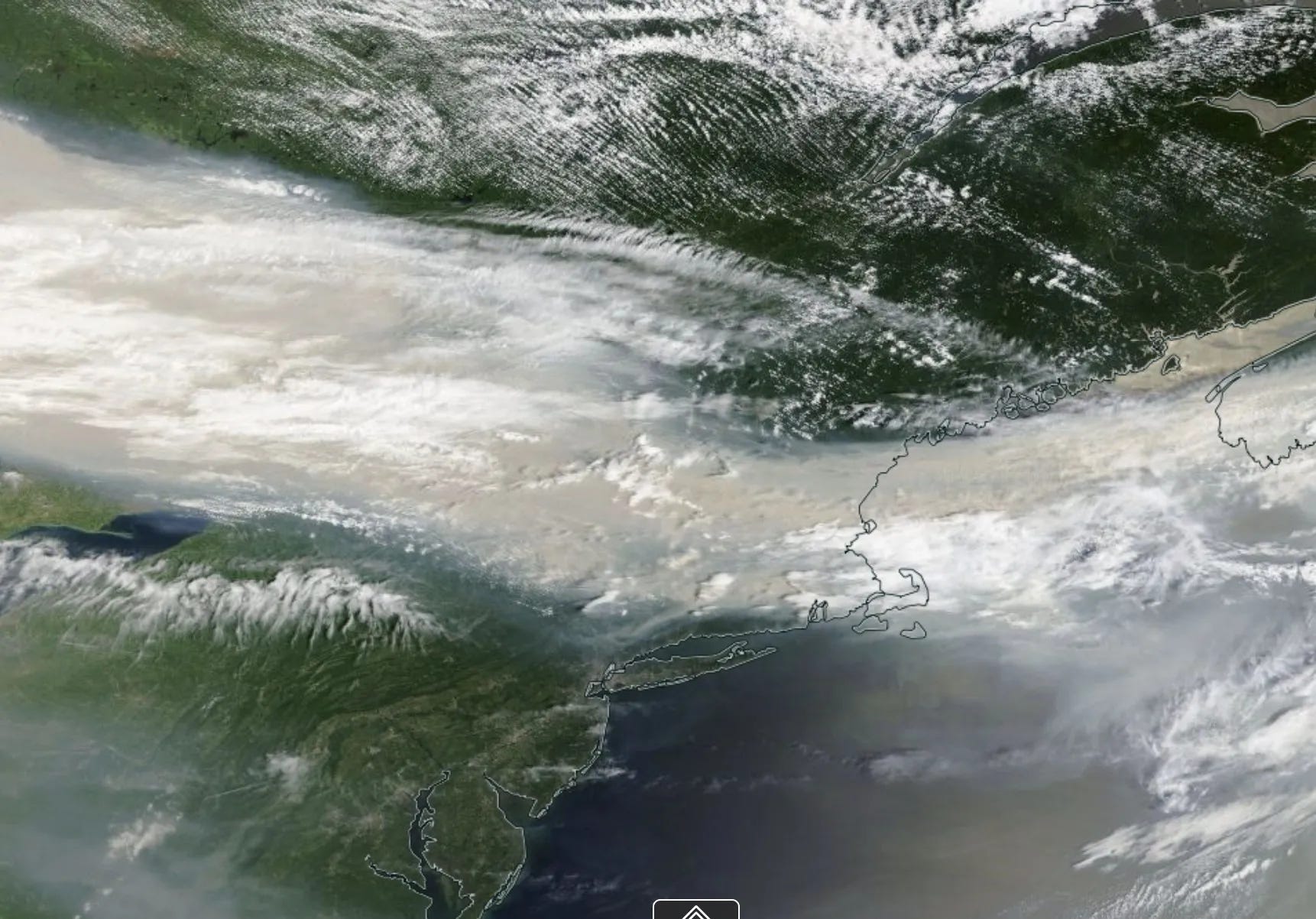
Satellite imagery shows wildfire smoke over southern Maine on Wednesday, July 15th. (Image by Keith Carson)
Precarity Diaries is an ongoing series connecting personal economic experience to structural conditions. Each installment starts where most of us actually live, in the places we love and the seasons we count on, and follows the threads back to the systems remaking them. These aren’t just personal stories. They’re field notes from inside a transformation most of us can feel but few have the language to name.
I. The Smoke Over Casco Bay
The ocean waters off mid-coast Maine have been warm this summer. Warmer than it should be. By mid-June I was swimming off the rocks on Orr’s Island and exclaiming to family and friends that it already felt like August temps, with the initial brisk shock wearing off in seconds instead of the usual minutes of full-body negotiation with the North Atlantic. My mom’s cottage sits on the backshore, and from the porch you can watch lobster boats cross Casco Bay in the early morning light, the distant peninsulas, islands and ledges layered in shades of blue, grey and green that shift with the fog and the tide. It is, by any honest measure, one of the most beautiful places I have ever lived. I came back to Maine this summer because Maine is where I’m originally from, the majority of my family is still here, because the coast has always been the place where I can think most clearly, and because after the year I’ve had, I needed the kind of calm and quiet that only salt air and cold water can provide.
But some mornings this July, the air hasn’t smelled like salt at all. Instead, it smelled like smoke.
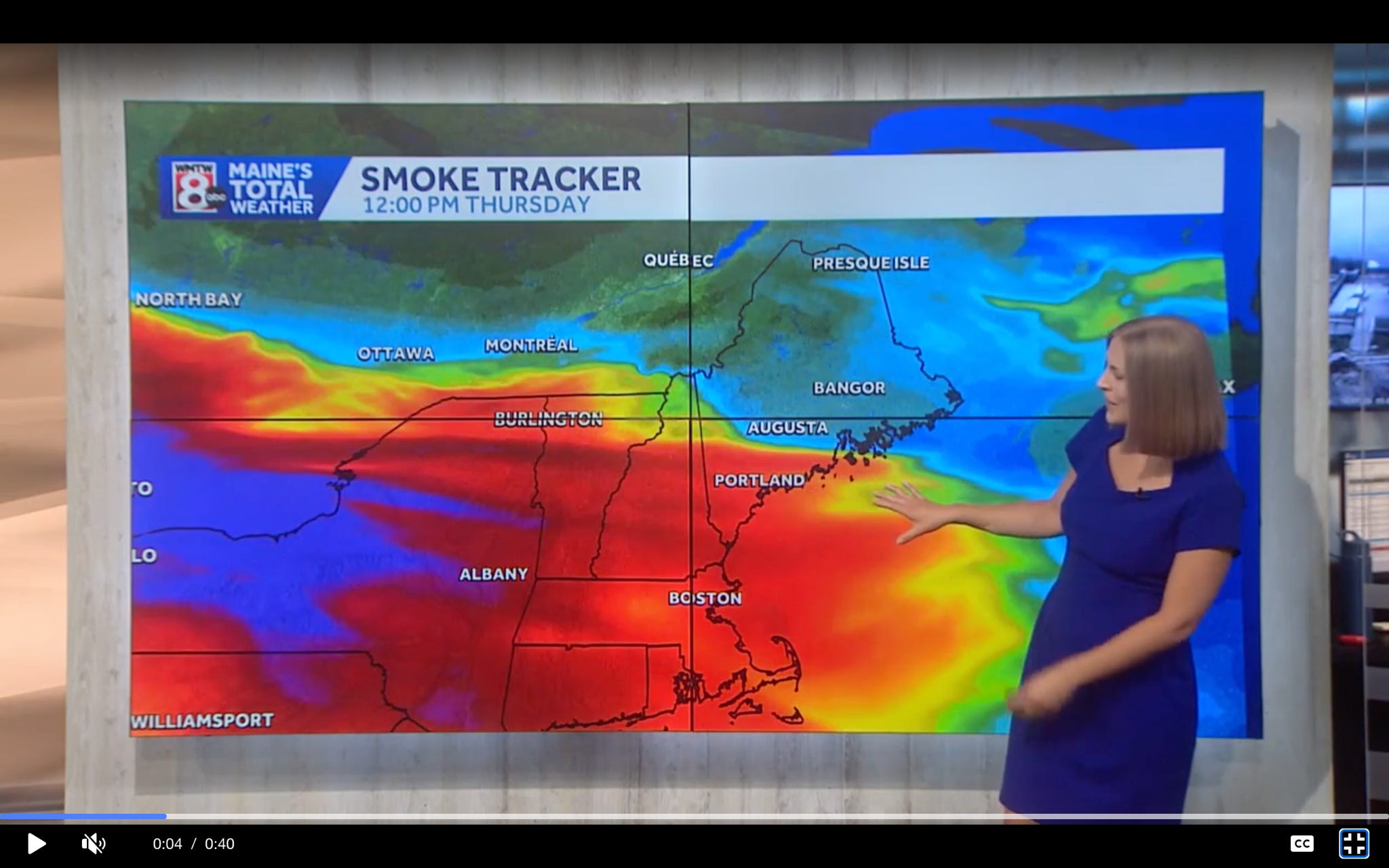
Canadian wildfires burning through thick forests in Ontario have been sending smoke plumes across the border and into New England for weeks. At least 17 states have been placed under air quality alerts. Detroit and Minneapolis briefly had the worst air quality of any major cities in the world. In Maine, the smoke has remained mostly moderate, the densest portion of the plume staying aloft rather than settling to the surface, but you can still see the haze, and you can taste it. On the worst days, the familiar blue of Casco Bay takes on a flat, yellowish quality that doesn’t belong here, and the sunsets, while spectacular, are spectacular for the wrong reasons.
During the impressive Fourth of July heat wave, half the guests who had RSVP’d to my cousin’s annual party in Bowdoinham didn’t show up because of fears over the heat. In Maine. In July. We have already decided to hold next year’s gathering at the cottage on Orr’s Island instead, because the coast consistently runs five to ten degrees cooler than inland. We didn’t call it climate adaptation. We just moved the party.
II. What Summer Looks Like From Above
What I am experiencing on Orr’s Island is a mild version of what much of the country is enduring. This summer, more than 70 million Americans have been placed under excessive heat advisories at a single time, as three major heat domes have rolled across the country in the span of a single month. Temperatures reached 105 degrees across the Gulf Coast and Great Plains, 108 in western Nebraska, and 115 in Montana, a state most Americans associate with snow. Philadelphia canceled its 250th anniversary Fourth of July parade, the celebration of the nation’s founding in the city where the Declaration of Independence was signed, because it was too dangerous to stand outside. At least 44 people in the United States have died from heat-related causes in July alone. In Europe, the numbers are worse: heatwaves killed more than 10,000 people in June, and 250,000 have been evacuated from wildfires in Spain and France.
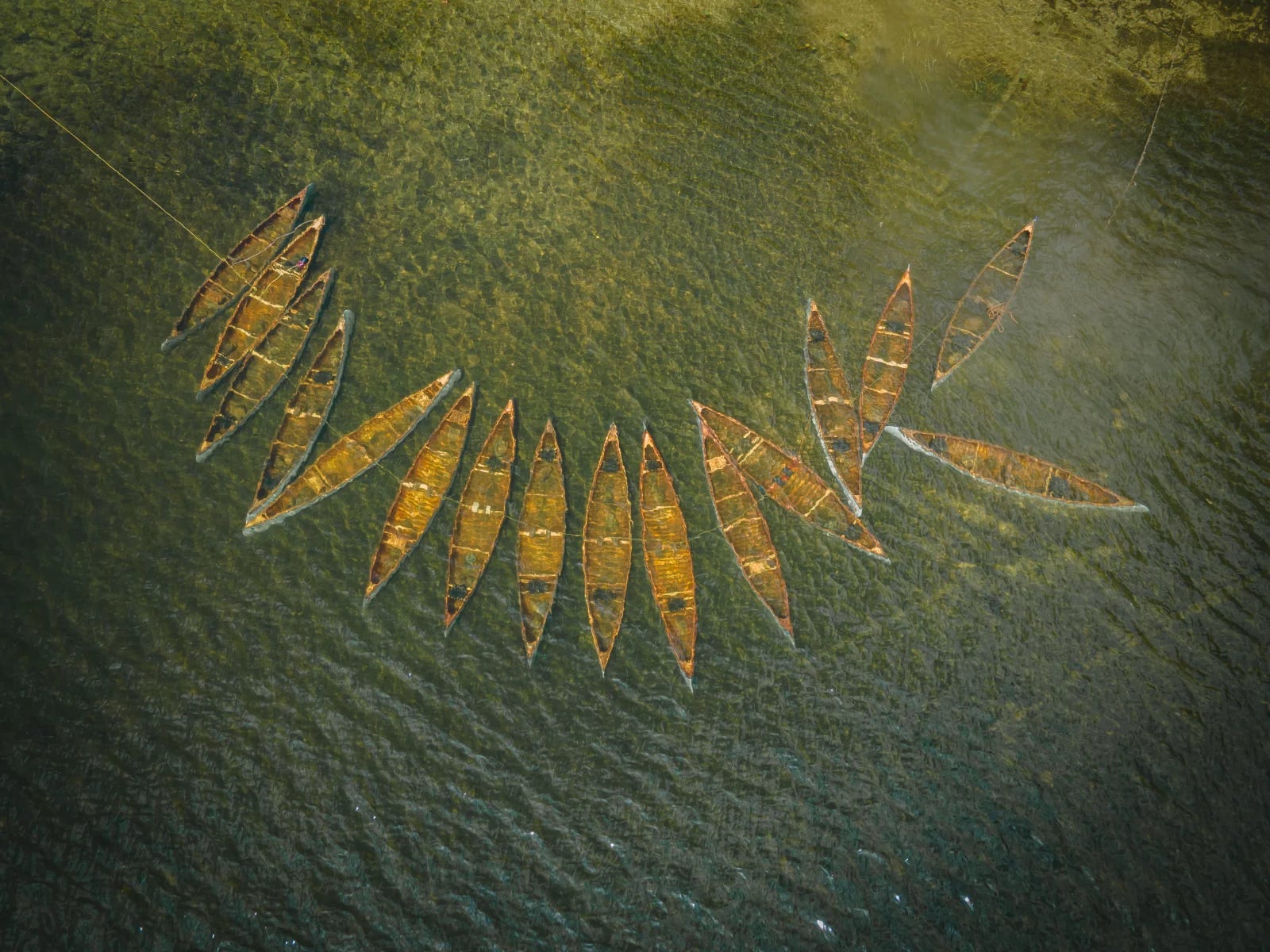
Camp Widjiwagan in Ely, Minn., submerged some of their canoes in lake waters to protect them from the wildfires. Photo by YMCA of the North
The fires are part of the same pattern. The United States has recorded 41,779 wildfires so far this season, the most in a decade, and the country is currently at its highest wildfire preparedness level, meaning federal resources are fully committed and new fires may simply go unanswered. Forest fires now burn ten times as much acreage annually as they did in 1985. Fire season itself has expanded from roughly four months to six or eight. In Canada, where the fires producing the smoke over my porch originated, wildfire acreage has increased sixfold over the historical average. That smoke has traveled a thousand miles south, placing at least 120 million Americans under air quality warnings at various points this summer. Across the country, wildfire smoke of all origins now contributes to an estimated 10,000 premature deaths annually in the United States, a figure researchers say is likely an undercount.
And then there is the water, or lack thereof. Across the western states, drought conditions are intensifying under the sustained heat. Reservoirs are dropping. Rivers that feed cities and farmland are running low. The heat dries the land, and then the dry land burns. And the burning land sends smoke across the continent. And underneath all of it, the same engine: a planet warming faster than at any point in its geological history, driven by the combustion of the same fossil fuels this publication has spent the spring tracing from the Strait of Hormuz to your gas pump to your grocery store to the air above Casco Bay.
“We are experiencing exactly what the climate models in the 1990s said we should experience now,” said Andy Pershing, chief program officer at Climate Central. “More frequent, more severe heatwaves, bigger temperature anomalies, more humidity, higher overnight temperatures. These are all part and parcel of the climate story.”
None of this is a surprise. All of it was predicted. The models were right. The response was absent.
III. Not A Bad Summer
It would be comforting to treat all of this as an unusually rough stretch of weather, a bad summer that will pass and give way to a more familiar one. Unfortunately, that doesn’t appear likely to occur. Last year was the hottest one in recorded history, with global temperatures reaching 1.34 degrees Celsius above pre-industrial levels and breaching the threshold set by the Paris Agreement for the first time. In the United States alone, 197 all-time high temperature records were set in 2025. Heat-related emergency room visits surged 28 percent. And scientists studying the geological record have confirmed that the planet is not merely warm but warming faster than at any point in Earth’s known history, a rate of change that is overwhelming the capacity of ecosystems, infrastructure and human bodies to adapt. Nighttime temperatures, which once allowed the body and the land to recover from daytime heat, are now staying elevated through the night, compounding the stress with every passing day.
“What we used to consider extreme is becoming routine,” said David Easterling, an atmospheric scientist at NOAA. That single sentence may be the most important climate statement of the summer, because it reframes what we are living through not as an anomaly but as a new baseline, one that will itself be exceeded in the years to come.
Zachary Labe, a climate scientist at Climate Central, put it even more directly: “Climate change is a present threat. We do not have to wait until 2050 or 2100 to see the consequences.”
We are not waiting. The consequences are on the porch, and they smell like smoke.
IV. The Same Pipe
Three-quarters of all global greenhouse gas emissions come from the burning of fossil fuels. The same combustion that powers the global economy, that moves the diesel trucks I traced from the Strait of Hormuz to your grocery store, that heats the homes and fuels the industry and runs the supply chains I have spent this spring documenting in piece after piece, is also what is heating the atmosphere, drying the forests, and filling the sky above Casco Bay with smoke from a thousand miles away. This is not a metaphor. It is chemistry. The same pipe that delivers the fuel delivers the carbon. The economic crisis and the climate crisis are not parallel emergencies. They are the same combustion, experienced on different timescales.
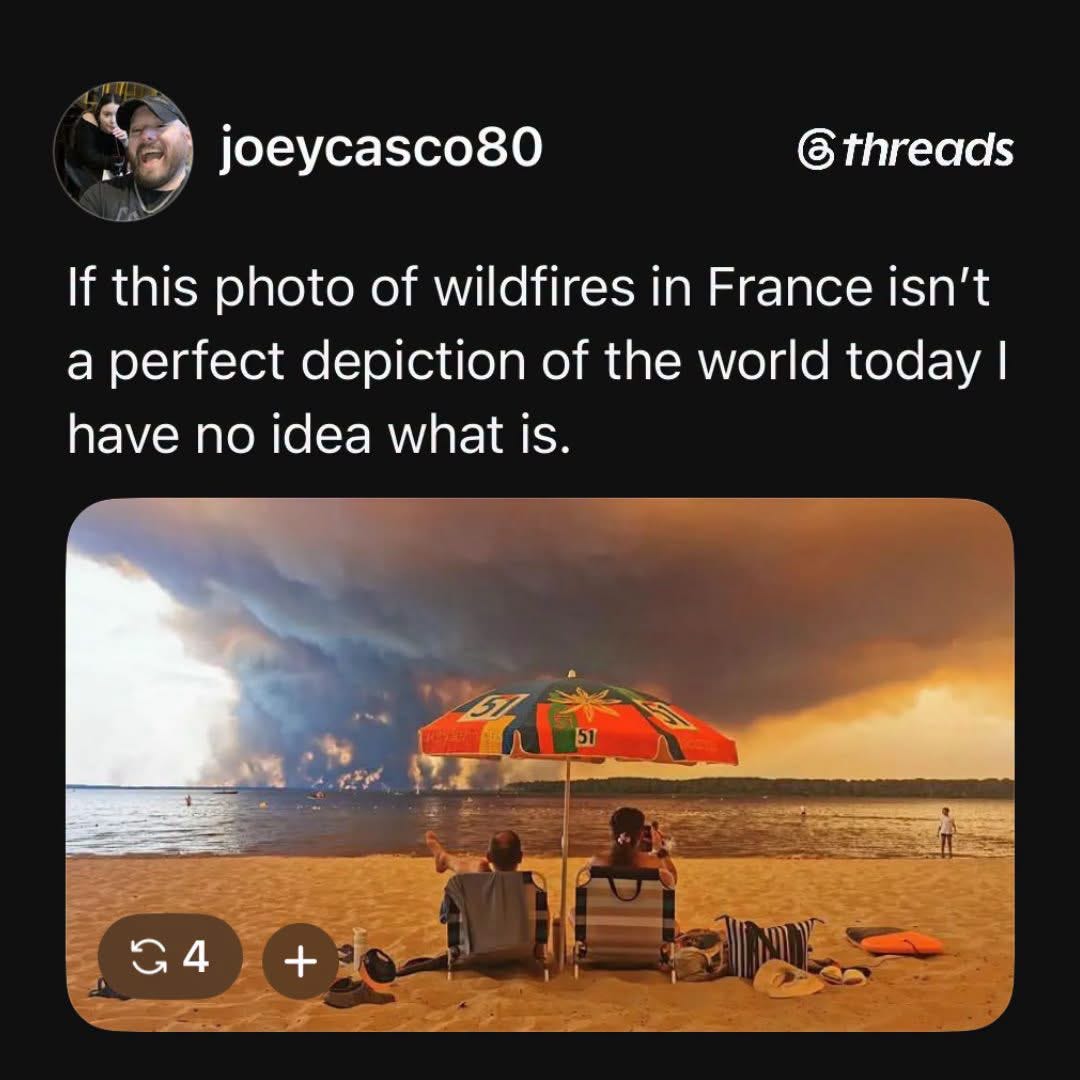
“On America’s 250th birthday, our study gives a clear reality check,” said Theodore Keeping, a climate scientist at Imperial College London, after the World Weather Attribution team concluded that this summer’s heat would have been virtually impossible without human-caused warming. “The climate the country has today is fundamentally different to the one it had when the founding fathers signed the Declaration of Independence.”
And the country’s response to this transformation has been to defund the people tasked with managing it. The United States currently spends roughly 70 times more on fossil fuel subsidies than on wildfire preparedness. The Forest Service has been gutted. The national defense budget crossed $1.5 trillion this year while $73 billion was cut from everything else. And at the peak of the worst fire season in a decade, with the country at its highest preparedness level, a federal fire management coordinator told TIME that when new fires arise, “we just can’t help with that new fire.”
The country subsidizes the combustion, defunds the firefighters, and calls the result an act of God.
V. Where It All Points
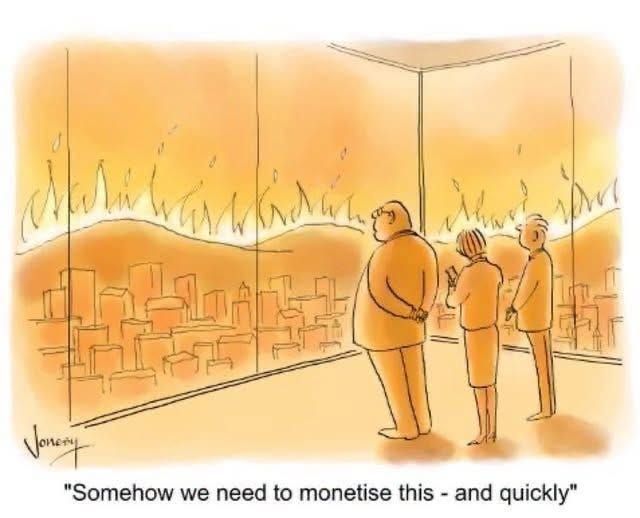
I am writing this from my family’s house, Homeport, on the western side of Orr’s Island, looking out over Beal’s Cove on a foggy afternoon. The bay is indeed still beautiful. The lobster boats still cross in the morning, rain or shine. The water is still fairly clear and cold to swim in, even if the shock doesn’t last as long as it used to. My dogs still run across the rocks at low tide. The lupines bloomed in June and the wild roses are blooming now, and on a clear evening the sunset over Harpswell Sound can still take your breath away.
I am not writing this piece to tell you that summer is over. I am writing it because summer is changing, structurally and measurably, in ways that the people who study it have been predicting for decades and that the rest of us are only now beginning to feel in a regular way. The smoke that drifted over this bay came from the same combustion cycle that built the economy, that heated the planet, that dried the forests, that later helped spread the fires. It is all one system, and the system is producing consequences faster than our institutions, our infrastructure or our imaginations can absorb them.
This spring, I traced the architecture of fossil fuel dependency from a 21-mile strait to a teacher’s pantry in Florida. This summer, I’m watching that same architecture arrive as haze over one of the places I love the most. The connection is not poetic, it is molecular. Every gallon of diesel that moved a truck, heated a home or powered an economy also added carbon to the atmosphere that is now making Maine summers feel like something they never used to be.
I will swim again this weekend off the rocks with my cousins, and I will sit on the cottage porch with my dark roast coffee and watch the bay and be grateful for all of it. But I will also note that I have now checked the air quality index on my phone several times this year, something I never once did before 2026, first during wildfires near my house in Florida this spring and again during the Ontario smoke a couple of weeks ago, and the fact that this is becoming a habit rather than an anomaly is itself the point. If the refuge is no longer safe, what exactly are we preserving by refusing to change the system that made it this way?
References
Berger, A. (2026, July 26). Climate change is now threatening a pillar of childhood: summer break. NPR. https://www.npr.org/2026/07/26/nx-s1-5900911/wildfire-smoke-fires-camp-minnesota
Borenstein, S. (2026, May 28). Think it’s hot now? The next five years will smash records, UN says. PBS News. https://www.pbs.org/newshour/science/think-its-hot-now-the-next-five-years-will-smash-records-un-says
Brandt, J. (2026, July 3). Philadelphia cancels 4th of July parade due to extreme heat, organizers say. CBS News. https://www.cbsnews.com/philadelphia/news/philadelphia-4th-of-july-parade-canceled-heat/
Deben, L. (2026, July 26). Military bosses say climate change is now a national security threat – ministers must not ignore them. The Independent. https://www.independent.co.uk/voices/climate-change-military-national-security-threat-b3020097.html?fbclid=IwdGRjcATUWLFwZG9mBWZkaWQWULWzgl3DATSzMwbUTk8LXCYNNSLVWWV4dG4DYWVtAjExAHNydGMGYXBwX2lkCjY2Mjg1NjgzNzkAAR6TTJnjDoTNVBaEQIFZZSZvMXbDE-AZ770SO1d_20CBPkIctxnkPpEAERckng_aem_aXMDYyX9Sgck4etMiJ73KQ
Flisiuk, F. (2026, July 16). Smoke may increase but the worst avoids Maine. WMTW. https://www.wmtw.com/article/wildfire-smoke-from-canada-continues-to-make-maine-skies-hazy/71941580
Freedman, A. (2026, July 20). Fires, floods and record heat: This is the summer of compounding disasters. CNN. https://www.cnn.com/2026/07/20/climate/climate-compounding-disasters-summer
It’s not just you: summer heat is getting worse. (2026, July 7). The Climate Reality Project. https://www.climaterealityproject.org/blog/its-not-just-you-summer-heat-getting-worse
McGuire, B. (2026, July 24). Earth is heating up faster than at any time in its history. New Scientist. https://www.newscientist.com/article/2581280-earth-is-heating-up-faster-than-at-any-time-in-its-history/?utm_id=97758_v0_s00_e0_tv4_a1demo0ecg7rma&fbclid=IwY2xjawTUWuFleHRuA2FlbQIxMABicmlkETB6VXpIY3BVZjMxVU9zT3Vyc3J0YwZhcHBfaWQQMjIyMDM5MTc4ODIwMDg5MgABHr12NVZWyjV9D4R0MFiYnfOSZbwHFknkJsRB5FUZy9u53Y2opKVazH1w2i54_aem_S7IhJk0IRiictOHmRX9xGQ
Milman, O. (2026, July 27). Scorching US heatwave to hit 70 million people with third ‘heat dome’ in month. The Guardian. https://www.theguardian.com/us-news/2026/jul/25/scorching-us-heat-wave
NPR. (2026, July 23). Climate: Fighting extreme heat in 2026. NPR. https://www.npr.org/2026/07/23/nx-s1-5904513/climate-fighting-extreme-heat-in-2026
Shah, S. (2026, June 29). Will this summer be a record hot one? TIME. https://time.com/article/2026/06/29/what-are-the-three-hottest-years-on-record-and-how-will-this-summer-compare-/
Shah, S. (2026, July 27). The U.S. is now at its worst level of wildfire preparedness. What does that mean? TIME. https://time.com/article/2026/07/27/us-wildfire-preparedness-level-5-what-that-means/
Zhong, H. (2026, July 3). Without Climate Change, U.S. Heat Wave Called ‘Virtually Impossible’. The New York Times. https://www.nytimes.com/2026/07/03/climate/heat-wave-us-canada-climate-change.html
____________________________________________________________________________
Means and Meaning publishes every Tuesday. If you found value in this analysis, I’d be very grateful if you’d consider buying me a coffee — your support helps me dedicate time to this work while keeping all content free and accessible.
You can also support this project by subscribing (it’s free!), sharing with others who might appreciate it, or joining the conversation in the comments. Sometimes the best antidote to anxiety is knowing you’re not alone in seeing what’s happening.
Next week, we’ll examine another piece of the machinery — and what it tells us about how the rest of it works.
Until then, keep questioning, keep connecting, and keep believing that another world is possible.
~ Chris