


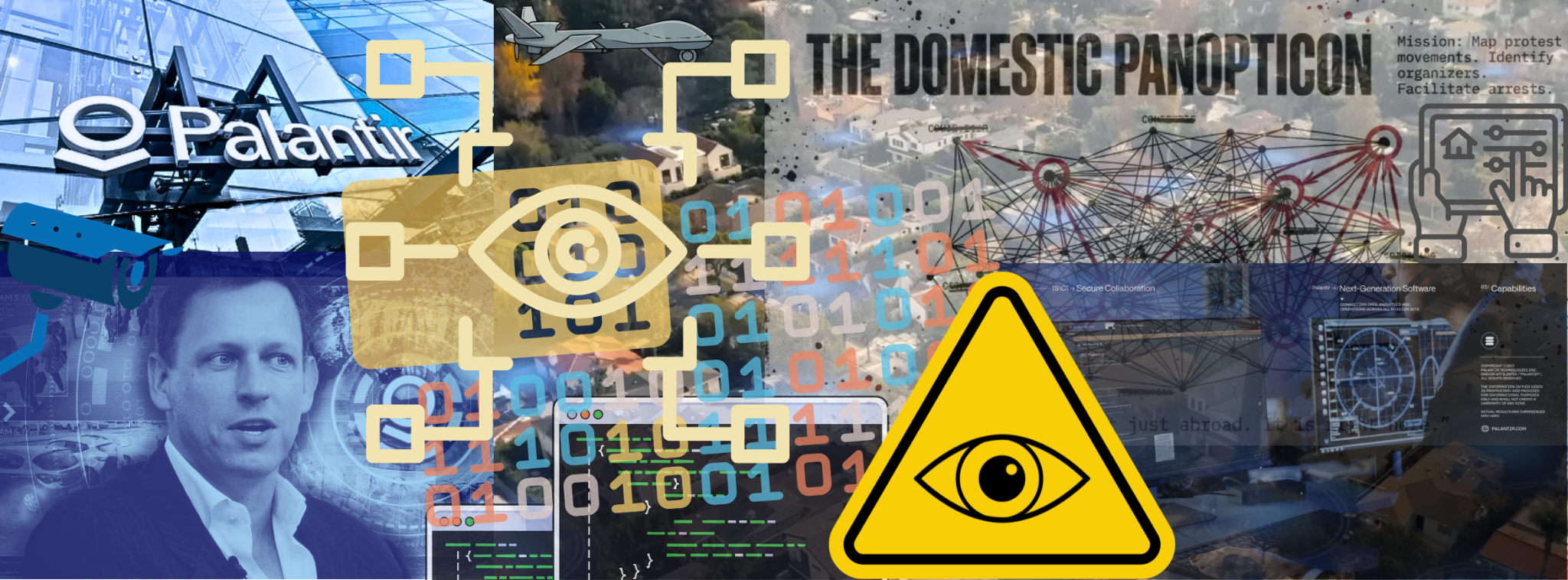
The Quiet War is an ongoing series about the war that doesn’t make the front page. Each installment traces the infrastructure of repression being built while most people’s attention is elsewhere: the surveillance systems, the detention machinery, the erosion of rights that happens not in dramatic confrontation but in contracts, policies and code. This war is quiet by design. Naming it is the first act of resistance.
I. The Seeing Stone
Millions of people have seen Peter Jackson’s films about The Lord of the Rings. Fewer, though still many, have read the books. But J.R.R. Tolkien built something more than a fantasy world. He built a mythology that keeps warning us about things we haven’t stopped doing. One of those warnings involves a set of ancient seeing stones called the palantíri, and a technology company that named itself after them.

I’ve been reading Tolkien since I was five years old, starting with a picture book and one of those thick plastic records that narrated The Hobbit in fifteen breathless minutes. I read The Lord of the Rings in seventh grade, studied Tolkien for a year-long author project in eleventh, and I’ve revisited Peter Jackson’s films more times than I’d care to admit. So I know what the palantíri actually were, and more importantly, what Tolkien was warning about.
The palantíri were not weapons. They were seeing stones, crafted by the Elves, used for centuries as tools of communication and foresight. They were not evil by design. They became dangerous when they were concentrated in the wrong hands. And they didn’t lie. That was the real danger. As Genny Harrison recently wrote, they “offered truth without context and certainty without understanding. They did not force action. They made action feel inevitable.” Denethor, Steward of Gondor, looked into his palantír and saw Sauron’s armies with perfect clarity. What he couldn’t see was everything the stone chose not to show him. His field of vision narrowed until despair felt like the only rational response. He burned alive on a pyre of his own certainty.
In 2003, a company co-founded by Peter Thiel with seed funding from the CIA’s venture capital arm, In-Q-Tel, chose to name itself Palantir. It took the name and ignored the warning. Today, Palantir is one of the most powerful surveillance companies on earth. It builds the software that lets ICE track immigrants in real time, helps the Pentagon select strike targets in an active war, and is quietly embedding itself inside the Department of Education. Its stock has surged over 200% since the last election. Its contracts span the federal government.
Most people have never heard of it. That’s not a failure of the architecture. It’s a feature. The quiet war depends on remaining quiet.
II. The Architecture of Watching
Palantir’s flagship immigration product is called ImmigrationOS. An operating system, like the software that runs your phone, except this one runs deportations. It gives ICE what the company calls “near-real-time visibility” by cross-referencing FBI records, customs databases, tax filings, social media activity, cell-phone metadata, travel logs and student visa records into a single searchable intelligence web.
But Palantir doesn’t just collect its own data. It integrates everyone else’s. Amazon’s Ring cameras now feed into Flock Safety’s law enforcement platform, which connects over 6,000 police departments nationwide. ICE accesses that network through inter-agency sharing agreements, no warrant required. Between June 2024 and May 2025, law enforcement ran more than 4,000 immigration-related searches through Flock’s systems, including in states with sanctuary laws that were supposed to prevent exactly this. A homeowner buys a doorbell camera to watch their porch. The state gets a surveillance node.

If you’ve seen the film The Lives of Others, you know the image: a Stasi agent in an attic, headphones on, manually listening to one apartment at a time. East Germany employed 90,000 full-time agents and hundreds of thousands of informants to surveil 16 million people. They still couldn’t achieve total coverage. Palantir does in milliseconds what the Stasi tried to do with file cabinets and human ears. And we install the listening devices ourselves.
Palantir’s defenders say the software doesn’t make decisions, it only supports them. As Harrison wrote, this distinction is “comforting and meaningless.” When a system shapes what agents see, prioritizes who gets flagged, and makes action feel like the logical next step, the fiction of human control is just that. In New Orleans, a secret Palantir program ran from 2012 to 2018, building risk-assessment databases on 3,900 residents. The City Council didn’t know it existed until reporters called them for comment.
That was the prototype. Since then, the architecture has scaled.
III. Colonialism Comes Home
Every tool Palantir sells to ICE was built for counterinsurgency. The data integration, the pattern analysis, the cross-referencing of movement and communication and association into targeting profiles: all of it was developed for Iraq and Afghanistan. Palantir’s first major contracts were with the CIA and the Pentagon, helping military intelligence fuse signals from occupied populations into actionable strikes. When those wars wound down, the company didn’t retire the technology. It pointed it inward. At immigrant communities. At activists. At students. At anyone the state designates as a population to be managed.
Aimé Césaire warned us about this. Writing in 1955, the Martinican poet and theorist argued that fascism was not an aberration in European civilization but colonialism brought home. The techniques of dehumanization, surveillance and control that empires deployed against colonized peoples would inevitably be turned against domestic populations. The logic doesn’t stay overseas. It never has. The plantation was the original surveillance state: total knowledge of the enslaved population’s movements, labor, relationships, and especially any potential resistance. The colonial census was the original data integration. Palantir is the digital update. The technology is new. The architecture of control is centuries old.
At the New York Times DealBook Summit, Palantir CEO Alex Karp said he cared about “reestablishing the deterrent capacity of America without being a colonialist neocon.” A man running surveillance platforms for ICE, powering Pentagon targeting in an active war, and embedding his software in the Department of Education, disavowing the colonial label while building the colonial infrastructure. Césaire’s point exactly: the metropole never recognizes its own logic.

I vividly remember back in 2003, when the Pentagon’s Total Information Awareness program proposed doing what Palantir now does. Its logo was an all-seeing eye casting its gaze across the globe. The public backlash was so fierce that Congress defunded it. But as journalist Shane Harris documented, every component was quietly renamed and shifted to the NSA. The surveillance state learned something from that failure. Not that mass surveillance was wrong, but that the branding was too honest. Two decades later, the same capability operates at vastly greater scale, run by a publicly traded company with a market cap exceeding $70 billion. The all-seeing eye got a stock ticker and an earnings call. Nobody flinched.
IV. The Genie and the Bottle
In February, Anthropic refused to let the Pentagon use its AI for mass domestic surveillance or fully autonomous weapons. The Trump administration’s response was immediate and total. Every federal agency was ordered to cease using Anthropic’s technology. Defense Secretary Hegseth designated the company a national security risk and blacklisted it from all military contracting, accusing it of trying to “seize veto power over the operational decisions of the United States military.” A company that said “our AI should not be used for mass surveillance of Americans” was framed as a threat to the republic.
Hours later, OpenAI signed a Pentagon deal under the same “all lawful purposes” language that Anthropic had rejected. Sam Altman claimed he’d secured identical ethical safeguards. But “all lawful purposes” is a boundary that moves wherever power needs it to move. Warrantless data purchases are lawful. ICE operations are lawful. FISA 702 collection is lawful. The government defines what’s lawful and then promises to stay within the limits it sets for itself.
But here’s what matters most: the AI provider is interchangeable. Anthropic gets expelled, OpenAI steps in, and the architecture doesn’t blink. Palantir is the constant. It is the integration layer between whatever AI capability exists and the operational power of the state. It takes the intelligence and makes it actionable: for ICE raids in Minneapolis, for strike targeting in Tehran, for monitoring which universities receive foreign funding. Karp himself has acknowledged what his company does. “Our product is used on occasion to kill people,” he told Business Insider in 2020. He wasn’t confessing. He was advertising.
The genie isn’t out of the bottle. The bottle was designed to break. Palantir doesn’t want distance, like Anthropic. It doesn’t want a deal, like OpenAI. It wants permanence. And it’s getting it.
V. The War That Watches Back
Palantir runs ImmigrationOS for ICE in Minneapolis. It powers targeting systems for the Pentagon in Tehran. The same company. The same technology. The same architecture of seeing without understanding. The quiet war you’ve been reading about in this series and the loud war I wrote about in “Prayers Count Double When It Rains” are not separate conflicts. They are two functions of a single system: an empire that surveys, sorts, and strikes, abroad and at home, through the servers of one company most people have never heard of.
In 2009, Peter Thiel wrote an essay for the Cato Institute containing a sentence that should follow him for the rest of his public life: “I no longer believe that freedom and democracy are compatible.” He then co-founded the surveillance architecture to ensure they wouldn’t be. Stephen Miller, architect of the most aggressive immigration crackdowns in modern American history, holds up to $250,000 in Palantir stock, routed through a child’s brokerage account. The man who writes the policy profits from the technology that enforces it. This is not a conflict of interest discovered by accident. It is the structure working as designed.
Last week, in Spring Cleaning Your Class Consciousness, I asked you to examine the assumptions you carry without questioning. Here is one worth pulling from the junk drawer: “If you have nothing to hide, you have nothing to fear.” That is the quiet war’s most effective piece of propaganda. It asks you to accept surveillance as the price of innocence, when the entire history of this infrastructure proves that innocence was never the point. The system does not watch because you might be guilty. It watches because watching is what the architecture was built to do.
Harrison’s closing words are the ones I keep returning to: “We are rebuilding the palantíri and telling ourselves we have learned from the story.” Tolkien understood that the danger was never the seeing stone itself. It was the arrogance of believing you could look into it without being changed. Denethor saw clearly and burned. Saruman saw clearly and served.
The architecture is documented. The pattern is named. You now know the company, the contracts and the connections. The quiet war depends on remaining quiet, and you’ve just made it louder.
References
Armitage, C. (2025d, December 14). The US oligarchs who built the surveillance state now run it. The Existentialist Republic.

Bond, S. (2026, February 28). OpenAI announces Pentagon deal after Trump bans Anthropic. NPR. https://www.npr.org/2026/02/27/nx-s1-5729118/trump-anthropic-pentagon-openai-ai-weapons-ban
Greenwald, G. (2026, February 13). Amazon’s ring and Google’s nest unwittingly reveal the severity of the U.S. surveillance state. Glenn Greenwald.

HR NEWS. (2026b, February 27). Alex Karp: the insane billionaire, Mass-Surveilling, bullied young nerd now proudly killing humans to get revenge on the world. HR NEWS.

HR NEWS. (2026, January 19). Ring Cameras join Flock and Amazon to now create direct data access for ICE. HR NEWS.
Mathews, J. (2025, December 10). New contract shows Palantir is working on a tech platform for another federal agency that works with ICE | Fortune. https://fortune.com/2025/12/09/palantir-new-contract-uscis-ice/
Nazzaro, M. (2025, December 4). Palantir quietly lands in Education Department through foreign funding portal. FedScoop. https://fedscoop.com/palantir-education-department-foreign-funding-influence-portal/
____________________________________________________________________________
Means and Meaning publishes every Tuesday. If you found value in this analysis, I’d be very grateful if you’d consider buying me a coffee — your support helps me dedicate time to this work while keeping all content free and accessible.
You can also support this project by subscribing (it’s free!), sharing with others who might appreciate it, or joining the conversation in the comments. Sometimes the best antidote to anxiety is knowing you’re not alone in seeing what’s happening.
Next week, we’ll examine another piece of the machinery — and another opportunity to resist it.
Until then, keep questioning, keep connecting, and keep believing that another world is possible.
~ Chris