


This piece is part of “Signal/Noise,” rapid responses to breaking events — cutting through media static to find the patterns and power structures beneath the headlines.
I. The Crown and the Crowd
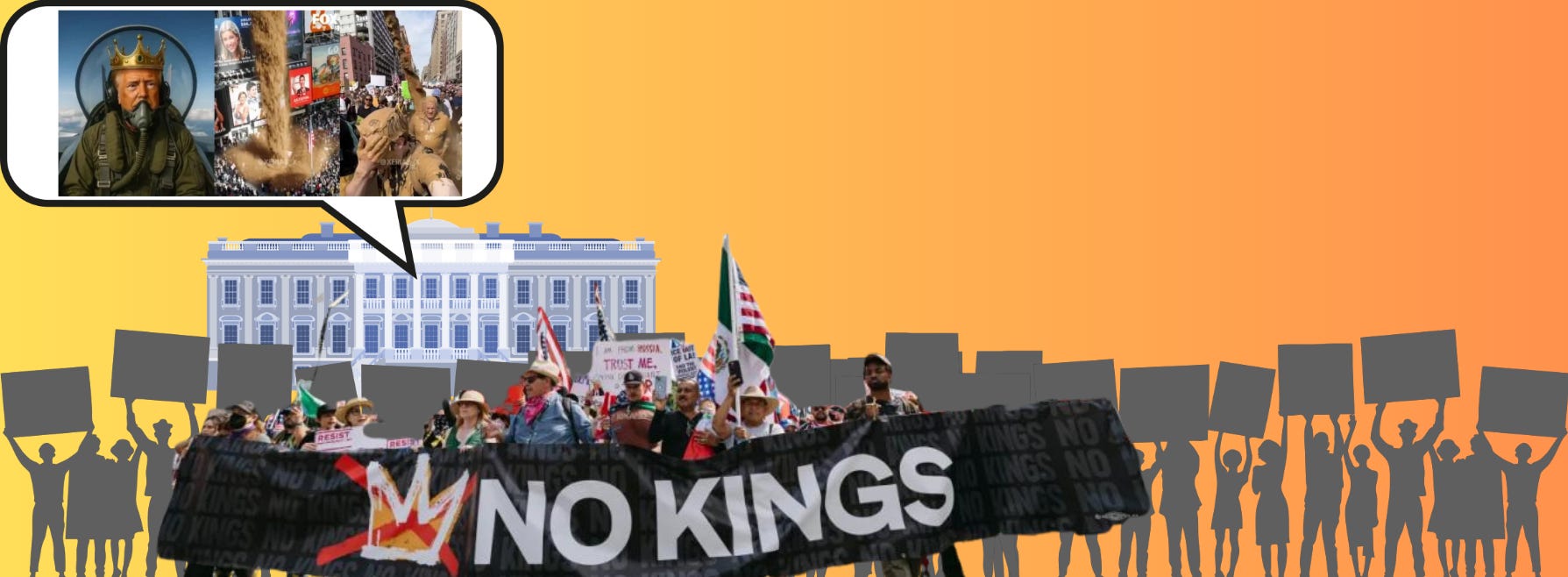
On October 18, 2025, seven million Americans marched against a fantasy. Across 2,700 cities, the “No Kings” protests filled streets with the most ordinary image of civic faith left to us — people walking together, believing that visibility still matters. Within hours, the White House answered with its own image: an AI video of Trump in a crown, piloting a fighter jet, dropping excrement on the protesters below.
It would be easy to dismiss the video as another grotesque flourish in a presidency defined by, well, a lot of them. But that would miss the deeper shift it revealed. The purpose of the image was not to persuade but to degrade — to turn the public itself into the object of mockery. In an earlier era, leaders sought legitimacy through competence or vision; now they rule through humiliation. When millions of citizens exercised their right to assemble, the state’s response was to defile the very idea of citizenship.
That was not a lapse in judgment but an assertion of power. What we saw was the state performing its contempt for the governed — a declaration that there are no limits left, no norms capable of constraining the will of a leader who can mock his people and still call it governance.
Republicans like Speaker Johnson and Representative Emmer framed the protests as “hate America rallies,” proof of national degeneracy rather than democratic vitality. Their words were not spontaneous rhetoric; they were part of a larger effort to reverse the moral polarity of democracy itself. To dissent is now to betray, to question authority is to side with enemies foreign and domestic. The same inversion appeared when Stephen Miller invoked “plenary authority” — a legal term for absolute power — to justify deploying the National Guard against domestic opposition. The claim was not legal argument; it was ritual proclamation: There is no law above the leader.
The sequence — from Miller’s slip on CNN to Trump’s AI crown — charts the full spectrum of authoritarian communication: legal language mutating into spectacle, spectacle hardening into norm. What begins as rhetoric ends as governance.
The protesters who filled the streets in June and October believed that exposure could still alter reality. They were right to march. But as Matt Watkins observed in a recent article in Common Dreams, we now live in the space after awareness — where seeing is no longer enough, where truth can be visible and still powerless. The crown was never meant to convince anyone it was real. Its purpose was to prove that reality itself no longer matters.
II. The Structure Beneath the Spectacle
The danger of the Trump era has never been just its spectacle. The crowned avatars and AI-generated fantasies of dominance are not deviations from governance — they are its expression. Power no longer hides behind institutions; it performs itself in broad daylight, demanding that we witness and then accept it as inevitable.
Trump’s AI video — of himself flying a fighter jet, dropping excrement on protesters — was not a lapse in judgment but an act of governance by humiliation. Its function was not persuasion but demonstration: I can do this, and nothing will happen. The grotesque has become the grammar of rule.
Watkins is right that we now inhabit the gap between recognition and power. Millions saw the danger clearly enough to march against it, and nothing changed. Because the system no longer depends on belief or legitimacy; it depends on exhaustion. When contradiction becomes constant, people stop expecting coherence. That is the point.
This is what Armitage calls the “post-democratic” phase — the moment when fascism operates not by overthrowing institutions but by inhabiting them. The Supreme Court still convenes. The press still publishes. Congress still meets. But the meaning of legality and representation has shifted. Law is now the instrument of impunity, procedure the camouflage of domination.
The media remains transfixed by performance, replaying the crown, the jet, the cruelty — mistaking exposure for accountability. But authoritarian power no longer fears exposure; it feeds on it. The more we see, the less we can do. Every new outrage becomes another proof of impotence.
What this moment demands is not more awareness but new forms of power — collective, organized and durable. Recognition alone is no longer resistance. To see clearly is only the beginning; to act structurally is the task.
III. After Awareness
The paradox of this era is that clarity no longer cuts. We live amid unprecedented transparency — livestreams, leaks, investigative reports, endless documentation — and yet impunity thrives. The exposure of wrongdoing has become a renewable resource. Each revelation arrives pre-absorbed by the spectacle that will neutralize it.
When the White House posted its crown video, the reaction followed a now-familiar choreography: outrage, explanation, fatigue. By nightfall, the image had already passed through irony, parody, and memeification. The cycle is the system. Authoritarianism adapts not by hiding information, but by flooding the public sphere until nothing retains moral weight.
What Watkins names “the space after awareness” is not apathy but saturation. Everyone sees. Everyone knows. The problem is not ignorance but impotence — the steady erosion of the idea that knowledge should confer leverage. The No Kings protests demonstrated this exhaustion in real time: millions of bodies in the street, a historic act of recognition, met with smirking indifference. Awareness became spectacle. Dissent became content.
That transformation marks a new stage of authoritarian rule — one that no longer fears dissent but depends on it. Outrage keeps the machine running. Anger fuels attention. Each protest confirms the regime’s ability to absorb resistance without consequence. The crown shines brighter each time it is denounced.
The task, then, is not merely to see but to interrupt. To recognize that transparency without consequence is not democracy but its simulation. Authoritarianism does not need to hide; it only needs us to keep watching.
To live after awareness is to confront the limits of witness. Truth still matters, but not automatically. It must be organized, weaponized, sustained — transformed into collective power rather than solitary comprehension. The No Kings protests offered a glimpse of that possibility. They named the truth in unison. The next step is learning how to make that chorus govern.
IV. The Architecture of Impotence
Hannah Arendt understood that totalitarianism does not begin with violence; it begins with unreality. When facts lose their footing, power can do anything. Her insight feels newly alive in this moment, when spectacle replaces governance and dissent itself becomes part of the show.
The No Kings protests were an act of genuine courage. Millions stepped into public space to declare that the presidency has no crown, that democratic power resides in the collective. It was a moral eruption, not a marketing campaign. And yet, even as the chants faded, the machinery resumed without pause. The spectacle consumed its own opposition.
This is not to dismiss the protesters. It is to recognize the trap set for them. The system no longer fears exposure or mass rejection; it feeds on them. Each wave of moral outrage expands the attention economy that keeps power intact. Each denunciation becomes proof of its centrality.
We live in what might be called a managed crisis — a politics of permanent emergency where outrage substitutes for leverage. Authoritarianism today does not suppress democracy; it simulates it. The marches, the hearings, the fact-checks — all proceed as rituals of accountability whose outcomes are already priced in. It is not that resistance fails, but that it is pre-contained.
Performative politics, in this light, is not a personal flaw but a structural effect. When every action becomes instantly mediatized, even sincerity becomes spectacle. The result is a collective exhaustion that feels like participation. We scroll, we share, we attend — and we mistake visibility for impact.
Real power operates elsewhere: in budgets, contracts, logistics, law. The levers that move material conditions remain insulated from moral spectacle. History’s turning points — the New Deal, decolonization, labor uprisings — were not produced by awareness alone but by organized withdrawal: strikes, boycotts, refusals that forced systems to halt. The U.S. has not seen a general strike in nearly a century. Perhaps it is time.
The protesters who filled the streets in October made the invisible visible. The next task is harder: to make the visible consequential.
V. The Weaponization of Language
Authoritarianism begins with redefinition. Before it silences, it renames. Before it imprisons, it classifies. The regime’s current vocabulary — plenary authority, law and order, terrorist, hate America rally — functions less as communication than as command. Each phrase performs power by collapsing meaning into allegiance.
When Stephen Miller invoked “plenary authority” on live television and then froze mid-sentence, he momentarily revealed too much. The words had slipped beyond euphemism. Plenary means complete. Unchecked. Absolute. It was the language of monarchy smuggled into a republic — the idea that one man could supersede law by invoking the need to defend it. His silence was not confusion. It was recognition. He had said the quiet part out loud.
The claim to plenary power is the logical endpoint of the last decade’s semantic drift. What began as “executive action” became “emergency powers,” then “wartime footing.” Each phrase stretched constitutional norms until the text itself became elastic. Trump’s allies now cite nineteenth-century war statutes to justify domestic troop deployments. The law becomes its own undoing.
At the same time, the language of resistance has been criminalized. Protesters labeled Antifa — that is, anti-fascist — are classified alongside foreign terrorists. To oppose fascism is, by definition, to be one. When Speaker Johnson calls the No Kings rallies “hate America events,” he inverts the moral axis entirely: love of democracy becomes proof of treason. The label does not describe behavior; it produces it. Once named, the target exists to be punished.
This is not merely propaganda. It is infrastructure. Words here function like switches, activating the machinery of surveillance, policing, and fear. When every critic becomes a potential terrorist, coercion no longer requires evidence. Only vocabulary.
The danger is not only that these terms distort reality — though they do — but that they replace it. They generate a parallel world where “law” means loyalty and “freedom” means obedience. Within that world, contradiction ceases to matter. Power writes its own dictionary.
To contest such language, we have to refuse its premises. To say plainly: plenary authority is the doctrine of kings. Democracy has no kings, no plenary men. Words matter not because they persuade, but because they delimit what can be done to us.
VI. Where It All Points
The disorientation many of us feel — the daily sense of surely this can’t be happening here — is not a failure of perception. It is the symptom of living through a political order that depends on disbelief to function. The surreal is the real. The absurdity is the system. The spectacle of a president posting AI-generated videos of himself dropping excrement on protesters is not a glitch in the matrix of power; it is how the matrix sustains itself — through humiliation as governance, through outrage as oxygen.
We keep expecting coherence to return, for the fever to break, for institutions to reassert themselves. But institutions are not independent actors. They are reflections of power, and power has learned that disbelief is a sedative. If people spend enough time saying “this can’t be real,” they will eventually stop responding to what is.
The civil-military crisis, the language of plenary authority, the reclassification of dissent as terrorism — these are not rhetorical excesses or symbolic gestures. They are dry runs for authoritarian normalcy. What begins as theater soon requires actors. What begins as parody becomes procedure.
Still, awareness is not futility. To see clearly that this is as bad as it seems is not to surrender. It is to refuse the narcotic of disbelief. The danger is not overreaction but underreaction — the slow numbing that sets in when every new atrocity feels indistinguishable from the last. Numbness is not neutrality. It is acquiescence by another name.
The work ahead will not be glamorous. It will look like organizing, withholding, building networks that bypass captured institutions — material actions, not symbolic gestures. The No Kings protesters were not wrong to take the streets; they were right to insist that democracy’s meaning is lived, not inherited. But protest is only the prelude. The real test will come when the cameras leave and the machinery keeps turning.
We are living through an authoritarianism that wears democracy’s clothes. To name that clearly is not alarmism; it is realism. The surreal is not an illusion. It is the texture of the moment. The task is not to wake from it, but to act within it — before disbelief becomes the final form of consent.
References
Anderson, Z., Ferrer, A., & Sangalang, J. (2025, October 19). Millions attend No Kings protests. Trump, White House post AI videos of him wearing a crown. USA TODAY. https://www.usatoday.com/story/news/2025/10/19/trump-ai-video-crown-no-kings-protests-signs-florida/86787408007/
Armitage, C. (2025, September 30). Republicans are an invading force: What are our options? The Existentialist Republic. https://substack.com/home/post/p-174957166
Cockburn, H. (2025, October 9). What is plenary authority, the dictator phrase that caused Stephen Miller to stop talking during CNN interview. The Independent. https://www.the-independent.com/news/world/americas/us-politics/plenary-authority-stephen-miller-cnn-dictator-b2841627.html
Nichols, T. (2025, October 8). The Civil-Military crisis is here. The Atlantic. https://www.theatlantic.com/newsletters/archive/2025/10/civil-military-crisis-trump-hegseth/684486/
Svirnovkiy Gregory. (2025, October 10). Johnson describes Planned No Kings Rally as ‘Hate America,’ ‘pro-Hamas’ gathering. Politico. https://www.politico.com/news/2025/10/10/no-kings-protest-mike-johnson-00602705?fbclid=IwZXh0bgNhZW0CMTEAAR4bPJfMqxwX68hghQh1M7djbi-vG8GUfsAI6dFxAiJ3_Mla8xW28fy18lrNWQ_aem_OG8XwjnsINAsX8so7iRrNw
Watkins, M. (2025, October 20). The No Kings protests proved that seeing and naming the problem is not enough. Common Dreams. https://www.commondreams.org/opinion/no-kings-awareness
____________________________________________________________________________
Means and Meaning publishes every Tuesday. If you found value in this analysis, I’d be very grateful if you’d consider buying me a coffee — your support helps me dedicate time to this work while keeping all content free and accessible.
You can also support this project by subscribing (it’s free!), sharing with others who might appreciate it, or joining the conversation in the comments. Sometimes the best antidote to anxiety is knowing you’re not alone in seeing what’s happening.
Next week, we’ll examine another piece of the machinery — and another opportunity to resist it.
Until then, keep questioning, keep connecting, and keep believing that another world is possible.
~ Chris