


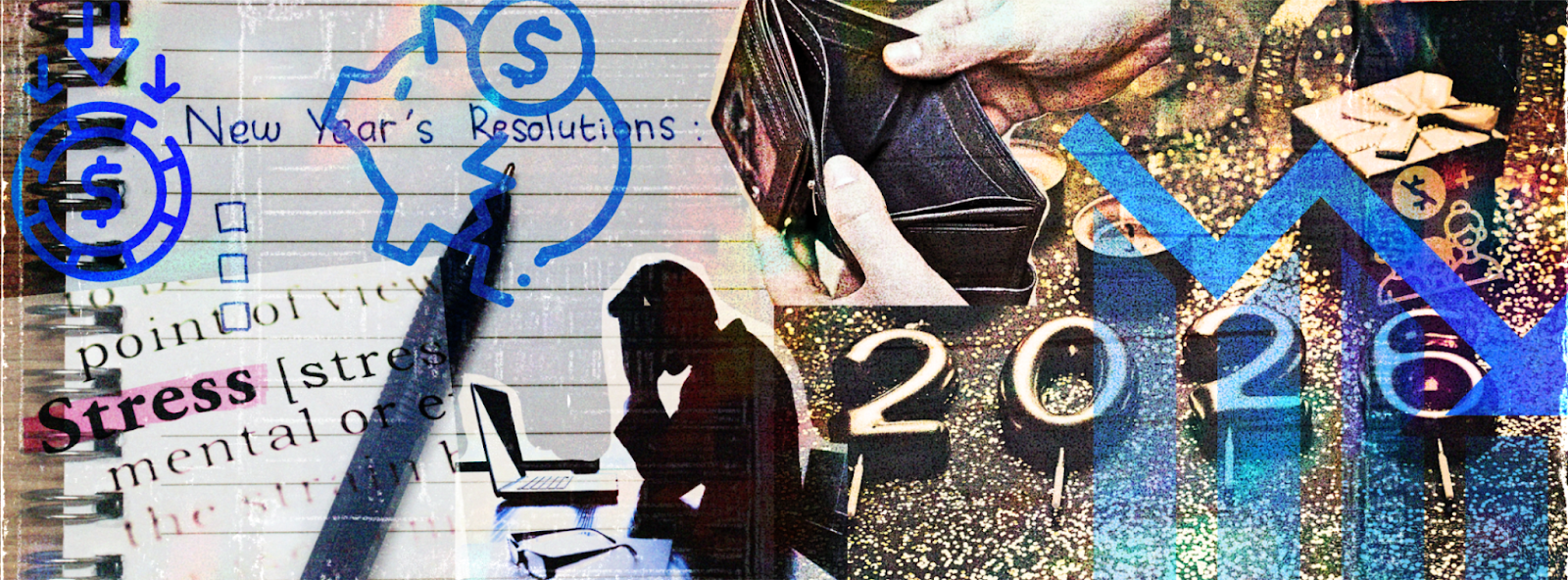
This piece is part of “Precarity Diaries,” a series exploring life under permanent instability — from economic anxiety to social isolation, examining how systemic insecurity shapes our relationships, health and possibilities.
Section I: New Year, Same Precarity
A healthy society produces citizens who plan decades ahead. They imagine futures. They save. They invest time in relationships, in communities and in skills that take years to mature. A sick society, on the other hand, does something else entirely: it produces workers who plan one rent cycle at a time.
That is the quiet reality of the American economy as another year begins. Not resolution-making, but damage control. Not “Where do I want to be in ten years?” but “Can I make it to the end of the month without something breaking?” This is not a cultural failure. It is an economic design.
When stability disappears, so does long-term thinking. You don’t plan for retirement when your checking account hovers near zero. You don’t imagine buying a home when rent resets every year like a slot machine. You don’t take career risks when one missed paycheck means catastrophe. Precarity collapses time. It forces people into the present tense.
Which is why one of the most jarring facts circulating quietly among economists should stop us cold: by some updated measures, the U.S. poverty line, if it actually reflected contemporary housing, healthcare, childcare, transportation and regional cost realities, would sit closer to $140,000 a year for a family. Not as a new rule or as doctrine. But as a diagnostic, and another way of revealing just how far official definitions have drifted from lived reality.
That number sounds absurd on purpose. It clashes violently with what we’ve been trained to think of as “doing well.” For millions of workers (teachers like myself included) it’s almost unimaginable. And yet that’s the point. The gap between the number and our wages is the story.
We are told the economy is strong, and we are shown charts. But an economy that forces the majority to think in weeks instead of years is not strong. It is extractive. And people feel it. In their bodies. In their exhaustion. In the shrinking horizon of what feels possible. This is where precarity begins, not as a mood, but as a material condition.
Section II: A K-Shaped Economy, With No Safety Net Left
A K-shaped economy is what happens when one part of society rises while another falls, and policymakers insist on averaging the two.
The upper arm of the “K” belongs to asset holders: households with stocks, home equity, and financial buffers. Their spending stays strong. Their opportunities remain intact.
The lower arm belongs to everyone else: workers whose lives are governed by rent, groceries, insurance premiums, and credit limits. For them, the economy doesn’t feel “mixed,” it actually feels punitive.
This isn’t just inequality; it’s class divergence hidden behind headline growth. And it deeply concerns Mark Zandi, the chief economist at Moody’s Analytics. He recently warned that “many Americans are deeply unhappy with their financial situation, and with good reason. They are grappling with a severe affordability squeeze… Meanwhile, pay increases are slowing as job growth has stalled and unemployment is on the rise.” Zandi’s warning isn’t abstract. It’s brutally concrete. The U.S. labor market has lost its shock absorbers. Millions are already living month to month - no savings, no margin and no cushion. In that kind of economy, a slowdown doesn’t need to be dramatic to become dangerous. It only needs to tip people already on what he calls “the financial edge.” That’s “fodder for a recession.”
An economy propped up by the spending of the wealthy is not resilient. It’s brittle. And the cracks are already visible: small businesses cutting jobs while large firms keep hiring; quit rates falling as workers grow fearful; layoff announcements piling up even as official unemployment lags. Young and minority workers, the usual canaries in the proverbial coal mine, are feeling it first.
This is the K-shaped economy in motion. One arm floats on asset gains and AI-fueled stock prices. The other hangs over open air. So when President Trump stands at a rally and gives his economy an “A+++++,” insisting prices are “coming down rapidly,” it isn’t optimism. It’s structural denial. Prices are still rising. Hiring is slowing. Wages are losing momentum. Telling people they’re doing great when they’re barely hanging on isn’t leadership—it’s gaslighting. And when the economy works only for the upper spur of the K, everyone else becomes expendable.
III. Exhaustion as an Economic Strategy
Burnout is not a personal failure. It is a system working exactly as designed.
When people say they are exhausted, anxious, stretched thin, they are describing material conditions, not a mindset problem. And yet, the official response is to tell them they are wrong. Inflation is “cooling.” The economy is “strong.” If it feels bad, that’s a perception issue.
Even Jerome Powell let the mask slip: “Americans aren’t interested in that story. Their prices are higher.” Translation: the charts say one thing, lived reality says another, and policymakers know it. This is where exhaustion becomes political. When wages lag productivity decade after decade - when workers produce more and receive less - the system requires people to internalize the gap. That missing pay doesn’t vanish. As Desmond argues, it is captured upward, extracted by those who benefit from scarcity.
Instead of regulating corporations, we’re told to download meditation apps. Instead of raising wages, teachers are offered mindfulness seminars. Instead of shortening workweeks, we’re sold “resilience.” Self-care thus becomes the pressure valve. Not to heal people, but to keep them functional enough to return to work tomorrow.
Burnout, then, is not an accident or a side effect. It is labor discipline by other means. A population too tired to organize, too stressed to plan and too busy surviving to ask why the gains of the economy never seem to reach them. Exhaustion isn’t a bug. It’s a feature.
IV. Breaking Even in a Rigged Economy
The disappearance of the middle class didn’t happen because millions of people suddenly forgot how to budget. It happened because the material foundations of a livable life were methodically stripped away.
Since the late 1970s, productivity has surged (upwards of nearly 90 percent) while wages crawled forward by roughly a third. That missing share didn’t vanish into thin air. It was captured. Extracted upward through profits, executive compensation, rents, fees and financialization. At the same time, the pillars that once stabilized ordinary life were hollowed out. Housing stopped being shelter and became an asset class. Healthcare became a billing labyrinth. Childcare turned into a second mortgage. Education shifted from a public investment into lifelong debt.
This wasn’t a cultural shift. It was a political one. In the postwar decades, these were treated, however imperfectly, as collective goods. By the 1980s, they were increasingly redefined as individual responsibilities to be purchased, optimized or endured. When those systems failed, the response wasn’t repair. It was moralization. Tighten your belt. Adjust expectations. Practice gratitude.
This is why “self-care” rhetoric explodes precisely when collective care collapses. When the social contract is dismantled, exhaustion is reframed as a personal failing, and survival itself is quietly downgraded into success.
V. New Year, Same Precarity: What Kind of Future Does This Economy Allow?
Breaking even is not a personal failure. It is a political outcome. An economy that forces millions of people to plan month to month is not malfunctioning; it is doing exactly what it was designed to do. When wages lag productivity, when housing and healthcare are priced as speculative assets, when layoffs arrive on schedule and leaders insist everything is fine, precarity becomes a tool. It disciplines workers. It narrows imagination. It keeps people too exhausted to demand more than survival.
That is why the system keeps telling us to be resilient instead of secure. To practice mindfulness instead of solidarity. To optimize our habits instead of questioning why a full-time job no longer guarantees a livable life. Self-care fills the void left by dismantled collective care, and then we’re told to be grateful for the void.
So the real questions aren’t about budgeting better or lowering expectations. They are structural, and they are uncomfortable:
What kind of society tells its people that breaking even is success?
Who benefits when stability becomes a luxury good?
Why does an economy that can generate enormous wealth insist that dignity is unrealistic?
And what would change if we stopped asking how to survive this system, and instead started asking why we tolerate it at all?
Because a healthy economy doesn’t produce desperate workers. It produces citizens who can plan, imagine and refuse to settle for less than a life that actually works.
References
Cameron, H. (2025, December 23). Mass layoffs taking place next month. Newsweek. https://www.msn.com/en-us/money/companies/mass-layoffs-taking-place-next-month/ar-AA1STn8b?ocid=winp1taskbar&cvid=694b38d74a4b457c9128a237d90edb14&ei=6
Cameron, H. (2025b, December 10). Trump’s “A+++++” review of economy clashes with Americans’ perceptions. Newsweek. https://www.newsweek.com/trump-a-plus-review-economy-clashes-with-americans-perceptions-11186280
Green, M. (2025, December 6). Is $140,000 the new poverty line for Americans? VICE. https://www.vice.com/en/article/is-140000-the-new-poverty-line-for-americans/?fbclid=IwY2xjawOlJdNleHRuA2FlbQIxMABicmlkETF5bW1xREJWV3BCOUo0R0c0c3J0YwZhcHBfaWQQMjIyMDM5MTc4ODIwMDg5MgABHn0-cNdrq0m_LRcsvvsToCAyqSpIy14Z9tytTOWWO8Li9nBmVByAFV0gC5uo_aem_tP4IlUhzJTOvcQfGRKwJ1A
Green, M. W. (2025, November 25). Why do Americans feel poor? Because they are. The Free Press.

Kaplan, J., & Hoff, M. (2026, January 2). The K-shaped economy of the rich doing fine and everyone else struggling is back — and it could mean a rocky 2026. Business Insider. https://www.businessinsider.com/wages-consumer-spending-low-high-earners-show-k-shaped-divide-2026-1
Roytburg, E. (2025, December 9). ‘Fodder for a recession’: Top economist Mark Zandi warns about so many Americans ‘already living on the financial edge’ in a K-shaped economy | Fortune. Fortune. https://fortune.com/2025/12/09/recession-fodder-k-shaped-economy-close-to-jobs-recession-layoffs-mark-zandi/
Whitaker, C. (2025, December 25). Breaking even is now the “American dream” for hourly workers. The Daily Overview. https://www.msn.com/en-us/money/markets/breaking-even-is-now-the-american-dream-for-hourly-workers/ar-AA1T1cWi?ocid=BingNewsSerp
____________________________________________________________________________
Means and Meaning publishes every Tuesday. If you found value in this analysis, I’d be very grateful if you’d consider buying me a coffee — your support helps me dedicate time to this work while keeping all content free and accessible.
You can also support this project by subscribing (it’s free!), sharing with others who might appreciate it, or joining the conversation in the comments. Sometimes the best antidote to anxiety is knowing you’re not alone in seeing what’s happening.
Next week, we’ll examine another piece of the machinery — and another opportunity to resist it.
Until then, keep questioning, keep connecting, and keep believing that another world is possible.
~ Chris