


This piece is part of “Signal/Noise,” rapid responses to breaking events — cutting through media static to find the patterns and power structures beneath the headlines.
I. The Return of the Gunboat Presidency
The blinding flash comes first, and then the sea catches fire. Somewhere off the coast of Colombia or Venezuela (or Nicaragua, or Panama, or Mexico - who knows?), another blue speedboat is torn apart by an American missile. The Pentagon releases a clipped video on social media: a dot on the horizon, a burst of light, the distant cheer of officials in Washington who call it “justice.” By week’s end, five more people - names unknown, crimes unproven - have vanished into the Caribbean.
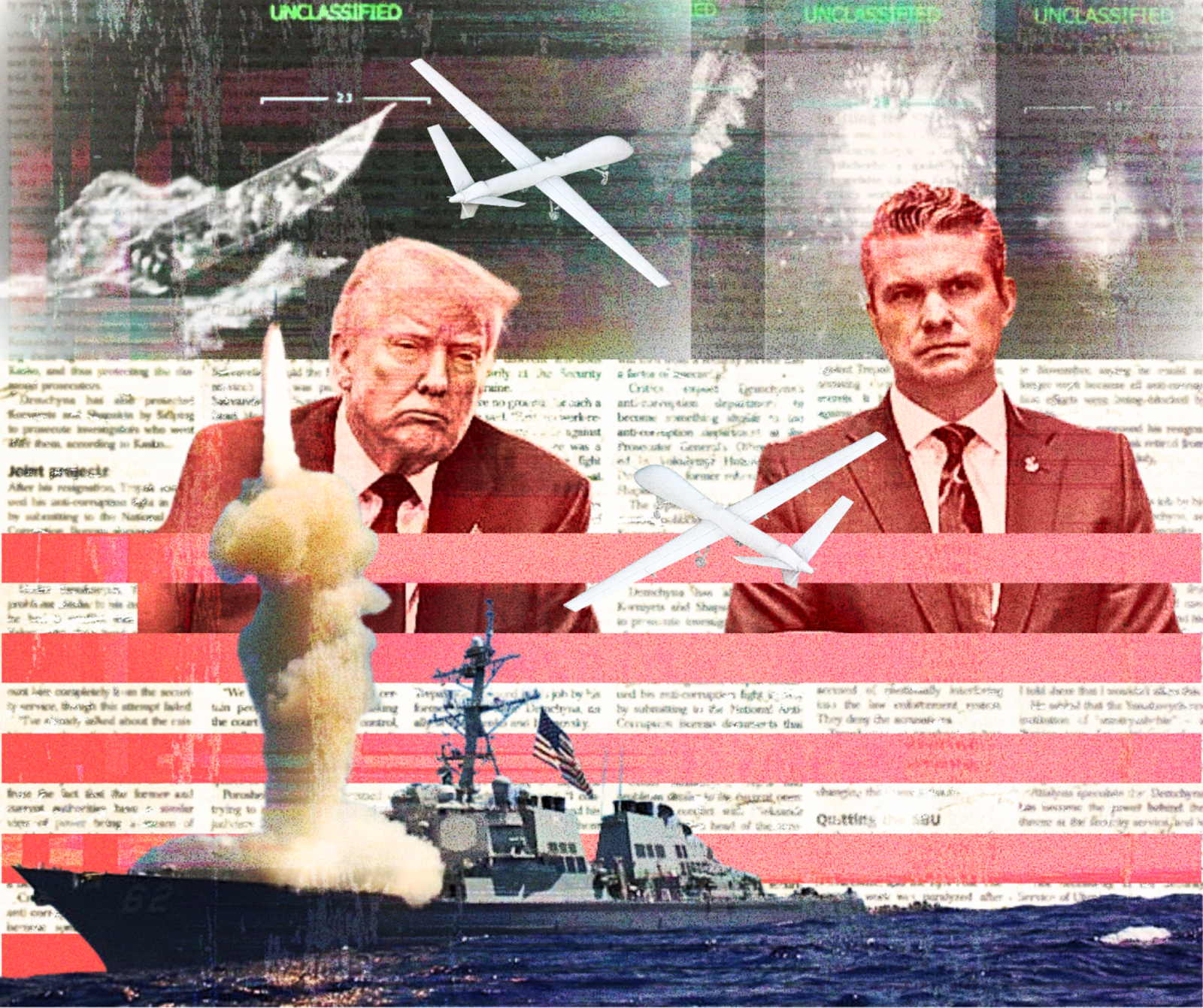
In less than two months, the United States has killed more than forty people in what President Donald Trump calls a “war on narco-terrorists.” He boasts that “every boat destroyed saves 25,000 American lives,” a number pulled from nowhere but repeated as gospel by his war council and echoed across cable news. The legality of these attacks is, at best, fictional. Congress has not declared war. No evidence of drugs has been made public. Yet the campaign expands by the week: Navy destroyers, F-35 fighter jets deployed to Puerto Rico, a carrier strike group repositioned to the Southern Command theater. The old Monroe Doctrine has found its modern instrument - the precision-guided bomb.
“Just as al-Qaeda waged war on our homeland, these cartels are waging war on our people,” Defense Secretary Pete Hegseth declared after one strike. But this is not war; it is performance - a spectacle of power meant to remind the hemisphere who controls its waters. International law calls such acts piracy. Washington calls it policy.
For those of us who know the Caribbean not as a military map but as a living place, the dissonance is unbearable. These are not abstract seas. They are routes once charted by enslaved Africans and indentured laborers, now patrolled by American drones. They are home to island nations still struggling under the weight of debt, climate crisis and a colonial legacy the United States never outgrew. And now, once again, they are being bombed in the name of “freedom.”
Trump doesn’t bother with euphemism. “We’re going to kill them,” he told reporters. “They’re going to be, like, dead.” The bluntness is the point: to strip away the last pretense of law, to normalize execution without trial. What is unfolding in the Caribbean is not an aberration but a culmination - the return of the gunboat presidency, unbound by Congress, unrestrained by conscience and perfectly at home in a country that no longer flinches when the sea burns.
II. Legality as Theater
The Trump administration insists there is nothing illegal about its campaign of extrajudicial bombings. The White House cites Article II of the Constitution, the president’s powers as commander in chief, and an alleged “armed conflict” with drug cartels designated as foreign terrorist organizations. It is, as one former State Department lawyer put it, “law by proclamation” - a pretext wrapped in legalese, signed with a missile strike.
The parallels to the early “war on terror” are impossible to miss. Then, too, the public was told that enemies without uniforms could be hunted anywhere, that “battlefields” had no borders, that the president’s prerogative was defense. Only this time the frontier has shifted closer to home: from Yemen to the Caribbean, from “insurgents” to “narco-terrorists.” The geography changes, but the logic - impunity disguised as law - remains constant.
Trump’s lawyers have even adopted the same euphemisms. Civilian deaths become “collateral damage.” International waters become a “zone of engagement.” Murder, rebranded as deterrence, becomes a sound bite for the evening news. A recent NPR report quoted one Pentagon source who claimed, without irony, that “every strike reinforces the rule of law.” It’s a perverse kind of theater: the law invoked only to consecrate its violation.
And Congress, as usual, plays its part. Democrats issue letters “expressing concern.” A handful of Republicans grumble about precedent. Then everyone returns to business as usual, relieved to let the executive branch shoulder the blood. When Senator Rand Paul warns that “indiscriminately killing people without knowing their names” is unconstitutional, his words vanish into the churn of a 24-hour cycle that prefers action to accountability.
The brazenness of it all reveals something deeper than one man’s authoritarian instincts. It shows how decades of bipartisan imperial practice have hollowed out the very meaning of legality. If Obama could vaporize “suspected militants” in Somalia, why can’t Trump blow up a fishing boat in the Caribbean? The question is not rhetorical; it’s the foundation of modern American statecraft. Each violation becomes the next administration’s precedent. Each normalization of violence makes the next outrage seem like continuity.
The law, in this sense, no longer restrains power - it performs it. It is staged before the public to reassure us that procedure still exists, that violence remains accountable to something other than will. But the charade is wearing thin. When the president declares, “We’re not going to ask for a declaration of war; we’re just going to kill them,” the mask slips. Legality, it turns out, was only ever part of the show.
III. Empire’s Familiar Waters
To anyone who knows the Caribbean, this latest campaign feels less like a rupture than a reprise. The United States has always treated these waters as its imperial laboratory — a place to rehearse domination under the cover of benevolence. From the Monroe Doctrine’s paternal decree in 1823 to the Marine occupations of Haiti, the Dominican Republic and Nicaragua a century later, Washington has never seen the region as sovereign territory so much as strategic backyard. The names change, and the tactics evolve, but the logic of control endures: sovereignty for us, subjugation for them.
That’s why Trump’s missile diplomacy feels at once shocking and familiar. It revives the old arrogance of “gunboat diplomacy” - except the boats now explode rather than merely threaten. The Caribbean becomes, yet again, the proving ground for America’s self-image as global enforcer, its so-called “freedom of navigation” campaign repurposed into freedom to kill without consequence. The U.S. Southern Command’s fleet arrayed off Venezuela recalls other moments of imperial assertion: the 1983 invasion of Grenada justified as “restoring democracy,” the decades-long embargo suffocating Cuba, the covert interventions that toppled governments from Guatemala to the Dominican Republic. Each episode cloaked in moral language, each leaving ruin behind.
Having lived in St. Croix and Grenada, I’ve seen how those legacies linger not as abstractions but as infrastructure — in who owns the ports, who extracts the profits, who dictates the terms of “security.” U.S. aid arrives with conditions, U.S. bases with curfews. The rhetoric of partnership masks a hierarchy etched into geography itself. Even the so-called “territories,” Puerto Rico and the U.S. Virgin Islands, remain reminders that colonialism never really ended - it just rebranded under the Stars and Stripes. It’s why the U.S. must submit a status report every year to the decolonization committee at the United Nations.
So when American drones obliterate a boat in international waters and call it justice, it is not a deviation from history; it is history continuing by other means. The region has long been where U.S. policymakers test the limits of what they can get away with. Trump’s difference lies only in his candor. Where past presidents invoked democracy or development, he speaks the truth of empire in the plain language of violence: we’re just going to kill them.
That bluntness should not obscure the continuity. These aren’t isolated acts of madness; they are policy shaped by precedent, power habituated to impunity. The Caribbean has always been where American law loosens and American might flexes. It is the mirror the mainland refuses to face - a reflection of what empire looks like up close.
IV. The Theater of Sovereignty
Every empire turns its violence into a show. Trump has simply dropped the pretense that it’s anything else. Each boat strike is accompanied by a glossy, slow-motion video released by the Pentagon or reposted from Hegseth’s feed: a speck of blue on the horizon, a missile slicing through the frame, then a bloom of fire, all soundtracked by triumphalist music. The president narrates them like highlight reels, boasting about the “power” and “accuracy” of America’s weapons, as if watching a fireworks display rather than the incineration of human beings.
The point isn’t policy - it’s performance. These “narco boat” killings are the latest episode in a show called Sovereignty Restored, staged for a domestic audience anxious about chaos and decline. The strikes offer a vicarious sense of control, an illusion that American power still commands the world, that someone is in charge. It’s imperial nostalgia rebranded as national defense.
But this theater of sovereignty depends on a dangerous slippage: if the president can kill unnamed people abroad by fiat, what limits remain at home? The same legal logic that lets him target “narcoterrorists” in the Caribbean can justify turning National Guard drones on protesters in Portland or Philadelphia. Already, the administration has declared Antifa a “terrorist organization” and expanded the Homeland Security Task Force into every state. The border, as always, is ideological, not geographic. Those who dissent are simply the next “cartel.”
It’s no accident that Trump’s most ardent supporters share and meme these attack clips online, treating them as digital proof of American resurgence. The violence works symbolically, too: it redraws moral hierarchies, dividing the righteous who applaud the explosions from the “un-American” who question them. It’s the old fascist formula - loyalty measured in enthusiasm for destruction.
What makes this moment so perilous is not just the lawlessness of the strikes, but their quiet absorption into the fabric of normal life. We scroll past videos of boats exploding as easily as we once scrolled past drone footage from Yemen. The spectacle no longer shocks; it soothes. Each “precision strike” is framed as a sign of order restored, when in fact it signals the corrosion of any remaining limits on executive power. If presidents can now wage private wars by decree — without names, without evidence, without even a pretense of oversight - then legality itself has become ornamental. The danger is not just that Trump is breaking the law. It’s that he’s teaching the public to stop caring whether the law exists at all.
V. Empire Without End
This is not an aberration of Trump’s foreign policy. It is the American empire returning to form. For two centuries, the Caribbean has been the testing ground for U.S. imperial practice - the place where doctrines are drafted, refined and made palatable to the mainland public. From the Monroe Doctrine to the seizure of Panama, from the invasion of Grenada to the decades-long suppression of the Puerto Rican independence movement, the region has been treated less as a community of nations than as a proving ground for domination.
After the 1898 war with Spain, the United States took possession of Puerto Rico, Cuba and the Philippines, and from that moment Americans learned to view the Caribbean not as a neighboring sea but as a sphere of supervision - unstable, corrupt and perpetually in need of guidance. When Roosevelt declared his 1904 corollary to the Monroe Doctrine, claiming for the U.S. the role of “international police power,” it marked a shift from hemispheric warning to imperial entitlement. Political supervision quickly gave way to economic control, as Washington pressed regional governments to transfer their debts from European to American banks. Under the banner of “Dollar Diplomacy,” the U.S. justified occupations and interventions across the hemisphere: the Dominican Republic under customs supervision (1905–1940, occupied 1916–1924); Cuba (occupied 1906–1909, 1917); Haiti (occupied 1915–1934); and Nicaragua (occupied 1912–1925, 1926–1933). The language was always the same - stability, order, freedom - but the reality was extraction and control.
When the U.S. Navy drops missiles on fishing boats and calls it counterterrorism, it is not just committing murder, it is rehearsing impunity. The Caribbean remains the imperial periphery where America perfects its ability to kill without consequence. The justifications echo through the centuries: protection of commerce, the defense of liberty, the fight against “bandits” or “narco-terrorists.” The language changes, the logic does not.
What makes this round of violence especially dangerous is how seamlessly it folds domestic politics into imperial projection. Trump’s “war on narco-terror” doubles as a war for control of narrative and nation - a way to perform strength abroad while manufacturing crisis at home. Bombing anonymous brown bodies in the Caribbean reassures a domestic audience that power still radiates outward, that the empire still functions, that decline can be reversed through force. It is empire as spectacle, and governance through explosion and applause.
But every empire that confuses violence with vitality ends up turning its arsenal inward. The same logic that justifies drone strikes over Venezuelan waters will justify them over American streets. Once law is replaced by prerogative, there is no limit to where “security operations” can reach. What begins as imperial projection metastasizes into domestic control. The Caribbean, once again, becomes the mirror in which America rehearses its future.
VI. The Empire Turns Home
The lesson is older than the republic itself: what a nation is willing to tolerate abroad, it will one day tolerate at home. Empires build their habits on the edges - on the decks of ships, in the jungles and on islands declared “strategic.” The violence that begins as projection always returns as precedent. The Caribbean has long been that distant mirror: a laboratory for domination, a place where American leaders test what they dare not yet do within their own borders.
Trump’s bombings are the latest stage in that cycle. They are justified as defense, branded as justice and consumed as spectacle. But they are also rehearsal. The president who now claims the unilateral right to vaporize fishermen in international waters has already claimed the right to send troops into American cities, to designate domestic dissent as “terrorism” and to use the same language of “cartels” and “insurgents” against journalists, migrants, and protesters.
Gustavo Arellano’s warning could not be clearer: this is “a president who dreams of treating his enemies, including American cities, like drug boats.” The distance between Caracas and Chicago is shorter than we think. Every strike that goes unchallenged abroad erodes the legal and moral barriers that protect life at home. When the executive branch can declare enemies by fiat, launch missiles without oversight, and mock Congress for even asking questions, the foundations of constitutional government are already compromised.
And yet, the greatest danger is not only lawlessness - it is habituation. The danger that we will come to see the footage of a burning boat and scroll past it. That we will mistake moral clarity for moral action. That we will grow so accustomed to emergency that we forget what normal looks like. Outrage, untethered from consequence, becomes just another form of surrender. It is not enough to see clearly. We must all act as though it matters.
Action begins with accountability. Because every empire forgets where its borders end, until the warships are aimed inward. That forgetting can still be stopped, but only if we refuse to look away. Only if we resist the drift toward spectator politics, and the drift toward outrage without consequence or clarity without courage. Demand hearings. Amplify Caribbean voices. Support the journalists, lawyers and activists who are risking everything to expose what this administration is doing in our name. The first step is to name the crime; the second is to make it impossible to continue. History will remember less what we knew than what we did after we knew it.
References
Arellano, G. (2025, October 25). Commentary: As Trump blows up supposed narco boats, he uses an old, corrupt playbook on Latin America - Los Angeles Times. Los Angeles Times. https://www.latimes.com/california/story/2025-10-25/trump-drug-boats-latin-america
Finley, B.. (2025, October 21). A timeline of US attacks in the Caribbean and what Congress has had to say. Military.com. https://www.military.com/daily-news/2025/10/21/timeline-of-us-attacks-caribbean-and-what-congress-has-had-say.html
Friedersdorf, C. (2025, October 18). What Won’t Congress Let Trump Get Away With?. The Atlantic. https://www.theatlantic.com/ideas/archive/2025/10/boat-strikes-trump-venezuela/684583/
Martin, P. (2025, October 23). Trump, Hegseth step up military murders in Latin America. World Socialist Web Site. https://www.wsws.org/en/articles/2025/10/24/lhcy-o24.html
Ordoñez, F. (2025, October 24). As strikes on alleged drug boats grow, so do questions about their legality and goal. NPR. https://www.npr.org/2025/10/24/nx-s1-5584173/trump-drug-boats-venezuela-maduro
____________________________________________________________________________
Means and Meaning publishes every Tuesday. If you found value in this analysis, I’d be very grateful if you’d consider buying me a coffee — your support helps me dedicate time to this work while keeping all content free and accessible.
You can also support this project by subscribing (it’s free!), sharing with others who might appreciate it, or joining the conversation in the comments. Sometimes the best antidote to anxiety is knowing you’re not alone in seeing what’s happening.
Next week, we’ll examine another piece of the machinery — and another opportunity to resist it.
Until then, keep questioning, keep connecting, and keep believing that another world is possible.
~ Chris