


The Big Squeeze is an ongoing series about the economic pressure that shapes daily life in America. Each installment follows the money: who extracts it, who hoards it, who goes without it, and how the system that produces all of this was designed. These aren’t market fluctuations. They’re policy choices. And you’re paying for every one of them.
I. The Smoke
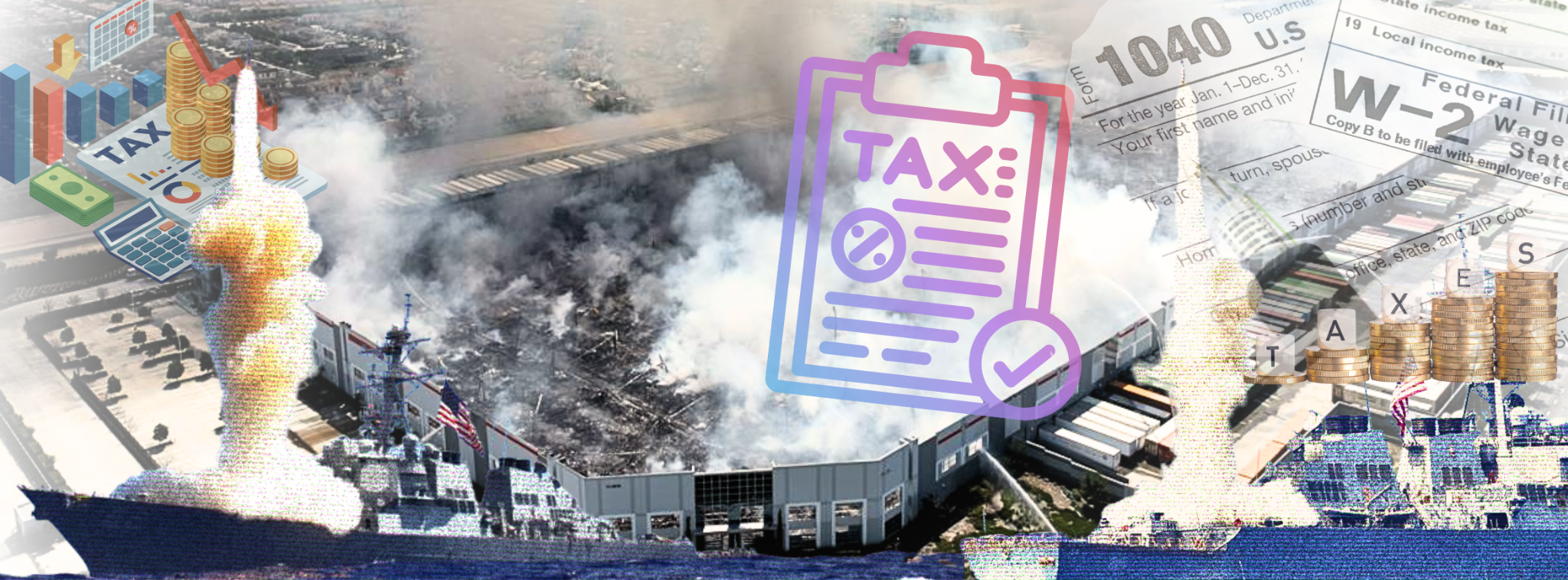
On April 7, a 29-year-old warehouse worker in Ontario, California named Chamel Abdulkarim set fire to the 1.2 million-square-foot Kimberly-Clark distribution center where he worked. He filmed himself doing it. He posted the video to Instagram. And in the footage, while the paper products he’d spent his shifts stocking went up in flames, he said: “If you’re not going to pay us enough to live or afford to live, at least pay us enough not to do this.”
The fire caused $500 million in damage. In texts afterward, he wrote: “All you had to do was pay us enough to live. Didn’t see the shareholders picking up a shift.”
He compared himself to Luigi Mangione, who shot a health insurance CEO. Abdulkarim burned a warehouse full of goods he couldn’t afford on the wages he earned stocking them. Two men, two acts of destruction, and the same five words at the center of both: pay us enough to live. The system is producing people who would rather destroy the infrastructure of their own exploitation than continue to operate inside it quietly. That’s not a crime story. That’s a diagnostic.
Abdulkarim was paying close to $6 a gallon for gas in California just to get to work. He belongs to a workforce where a third of all workers earn less than $42,000 a year. He filed his taxes in a country that just proposed $1.5 trillion for its next war budget and $73 billion less for everything else. The smoke from that warehouse is a signal. And if you’re paying attention to what’s fueling it, the fire started long before he struck the lighter.
II. The War Tax
The March inflation report landed like a grenade. Consumer prices jumped 0.9% in a single month, triple the pace from February, pushing the annual rate to 3.3%, its highest in two years. The culprit wasn’t mysterious. Gasoline prices surged 21.2% in one month, the largest single-month increase since the Bureau of Labor Statistics began tracking the number in 1967. That’s not a spike. That’s a record. The national average crossed $4 a gallon for the first time in four years. In California, where Abdulkarim was filling his tank to drive to the warehouse he’d burn down, the average hit $5.92.
The war in Iran did this. The Strait of Hormuz, those twenty-one miles of water I traced across five centuries of empire two weeks ago, is now producing the number on your gas station sign. And gasoline accounted for nearly three-quarters of the entire inflation increase. Three-quarters. One commodity, one chokepoint, one war you never voted for.
But gas doesn’t stay at the pump. It rides the supply chain into everything. Trucking costs climb, and groceries climb with them. Fertilizer spikes, and food production follows. Food prices rose 2.7% year-over-year. Ground beef that cost $2.20 a pound in 2009, when the minimum wage was last set at $7.25, now costs $8.34. Seventeen years, no raise, and the beef nearly quadrupled.
Dean Baker, senior economist at the Center for Economic and Policy Research, put it plainly: “Inflation pressures were already building before the war and are now intensifying.” The tariffs were already squeezing, but the war against Iran has really turned the vise.
III. Where Your Money Goes
On April 3, the White House released its proposed budget for fiscal year 2027. The number: $1.5 trillion for defense. A 42% increase. The highest level of military spending in a single fiscal year since World War II. Defense now consumes 63 cents of every discretionary dollar the federal government spends. Everything else, every school, every hospital, every road, every research lab, every meal program, splits the remaining 37 cents. To help pay for it, the administration proposed $73 billion in cuts to nondefense spending. Five billion from the National Institutes of Health. $768 million from refugee resettlement. $356 million from the agency that prepares the country for public health emergencies. The Forest Service, responsible for 193 million acres of national forest, ordered dismantled and relocated to Utah, the state currently suing to seize 18.5 million acres of public land, right before what’s projected to be a devastating wildfire season. Twenty-two million families lost SNAP benefits. And the $1.5 trillion isn’t even the ceiling. A supplemental war spending package, estimated between $80 and $100 billion for Iran alone, is coming separately. The supplemental exceeds the savings from the cuts. The “fiscal responsibility” is theater. At an Easter luncheon, the president said the quiet part into a microphone: “We can’t take care of daycare. We’re fighting wars.” He said it three times. He told the states to pay for it instead. But here’s what that looks like: New York City, under a mayor who ran as a democratic socialist, is now cutting up to $800 million from public schools and abandoning homeless assistance to close a $5.4 billion gap. The money the president told the states to find doesn’t exist. It’s in the Pentagon budget.
IV. The Architecture
This isn’t one bad budget. This is the architecture of American fiscal priorities, exposed by a war that made the scaffolding visible.
The United States government does believe in public spending. It believes in it passionately, urgently, and without limit, as long as the spending builds weapons. Military Keynesianism is the quiet consensus that has organized the federal budget for decades: the government will spend enormous sums to stimulate the economy, but only through defense contractors, only through munitions pipelines, only through systems designed to kill. Lockheed Martin gets cost-plus contracts. Your kid’s school gets a funding formula and a prayer.
The reconciliation process made the machinery plain. The administration used a partisan budget tool requiring zero Democratic votes to pass the largest military expenditure since 1945. In its own budget documents, the Office of Management and Budget described the strategy as “decoupling funding for Republican priorities from Democrat waste.” They said it out loud. Every social program, every piece of domestic infrastructure, every dollar spent on people instead of ordnance, is apparently just “waste.”
Meanwhile, the wealth moved where it always moves. Billionaire net worth surged 120% between 2017 and 2025. The top 1% now holds 50.2% of all corporate equities and mutual fund shares. Over 50 million workers, a third of the labor force, earn $20 an hour or less. The squeeze has a direction. Wealth flows up. Costs flow down. The warehouse worker stocking shelves he can’t afford to shop from and the teacher stocking freeze-dried food in his pantry are living inside the same structure. One struck a match. The other is planning for what comes next.
V. Where It All Points
Today you file your taxes (if you haven’t already done so earlier this spring). Every dollar you send to Washington enters a budget that allocates $1.5 trillion for war and $73 billion less for you. A government that found unlimited money for Tomahawk missiles at $1.7 million apiece, for Patriot interceptors at $4 million each fired in pairs at $20,000 drones, and for a golden dome in outer space, looked at daycare and said: we can’t afford that.
The war tax isn’t a metaphor. It’s on every receipt. Gas at $4, at $5.92 in California, surging at a rate never recorded in the history of the measurement. Groceries climbing because the fuel that trucks them to the shelf climbed first. Beef at $8.34 a pound while the minimum wage sits frozen at the same $7.25 it’s been since the year Obama was inaugurated. The inflation you feel every week at the pump and the checkout is a direct product of a war fought in a strait twenty-one miles wide, funded by a budget that treats your school, your hospital, your forests, and your food assistance as line items to be sacrificed.
The squeeze is not an accident. It is the system performing exactly as designed: public wealth extracted, converted to military contracts, and funneled upward to the same class whose net worth doubled while yours eroded. Sixty-three cents of every discretionary dollar to defense. Thirty-seven cents for everything that keeps you alive. And a supplemental war bill, still growing, that will cost more than all the cuts combined.
Chamel Abdulkarim lit a match in a warehouse in Ontario, California. Millions more are doing the math quietly tonight at kitchen tables, in gas station parking lots, and in the aisles of grocery stores where the prices changed again this week. The pressure is building. Something has to give.
So here’s the question you should be asking yourself today, tax day, as you sign the return: who is your tax dollar fighting for, and is it you?
References
Crosse, J. (2026, April 11). Fuel shock sends inflation soaring while the oligarchy grows richer. World Socialist Web Site. https://www.wsws.org/en/articles/2026/04/11/byxk-a11.html
Curry, B. (2026, April 10). First inflation report since Iran war stuns Wall Street as conflict sends shockwaves through the economy. . . and you’re paying the price. Mail Online. https://www.dailymail.co.uk/yourmoney/article-15722081/march-cpi-inflation-report-iran-war-stuns-sall-street.html
Daniels, S. (2026, April 10). Unpacking the $1.5 Trillion FY 2027 Defense Budget Topline, Center for Strategic International Studies. https://www.csis.org/analysis/unpacking-15-trillion-fy-2027-defense-budget-topline
Pattiz, J. (2026, April 2). BREAKING: Trump Administration Orders Dismantling of the U.S. Forest Service. The Wildlife News. https://www.thewildlifenews.com/2026/04/02/breaking-trump-administration-orders-dismantling-of-the-u-s-forest-service/
Shapiro, E. (2026, April 10). Man facing federal charges for allegedly setting massive fire that destroyed warehouse: DOJ. ABC News. https://abcnews.com/US/man-facing-federal-charges-allegedly-setting-massive-fire/story?id=131920421
Watson, K., & Navarro, A. (2026, April 3). Trump’s 2027 budget asks Congress for $1.5 trillion in defense spending, with 10% cuts elsewhere. CBS News. https://www.cbsnews.com/news/trump-releases-proposal-blueprint-2027-budget/
____________________________________________________________________________
Means and Meaning publishes every Tuesday. If you found value in this analysis, I’d be very grateful if you’d consider buying me a coffee — your support helps me dedicate time to this work while keeping all content free and accessible.
You can also support this project by subscribing (it’s free!), sharing with others who might appreciate it, or joining the conversation in the comments. Sometimes the best antidote to anxiety is knowing you’re not alone in seeing what’s happening.
Next week, we’ll examine another piece of the machinery — and another opportunity to resist it.
Until then, keep questioning, keep connecting, and keep believing that another world is possible.
~ Chris