


Precarity Diaries is an ongoing series connecting personal economic experience to structural conditions. Each installment starts where most of us actually live, in the anxiety of bills, the grind of underpaid work and the impossible math of modern survival, and follows those threads back to the systems that produce them. These aren’t just personal stories. They’re the diaries of a system working exactly as designed.
I. Learning to See
On August 29th, 2001, after my mom and two younger brothers drove away and the car disappeared from sight, I took my first few steps back toward the Merrill A dorm and something happened that I didn’t plan. I raised both arms over my head with clenched fists and took the biggest conscious inhale and exhale of my life. It was completely spontaneous, purely physical, a body responding to a freedom it had never felt before. Everything I had been working toward, all the challenges of high school, and the raging fire of a mind desperate to break out, released in one simple gesture. I was nineteen years old, standing in a parking lot in western Massachusetts, and I was free.
That night I couldn’t sleep. I sat in my single room on the second floor overlooking the quad, and tried to put into words what had just happened to my life. At the top of a page in a spiral-bound notebook (which would become my on and off again first year journal), underlined, I wrote three words: “Holy Fucking Shit.” Centered beneath them: “A Dream Come True.” And in the upper right corner: “1st day - biggest freedom high ever!”
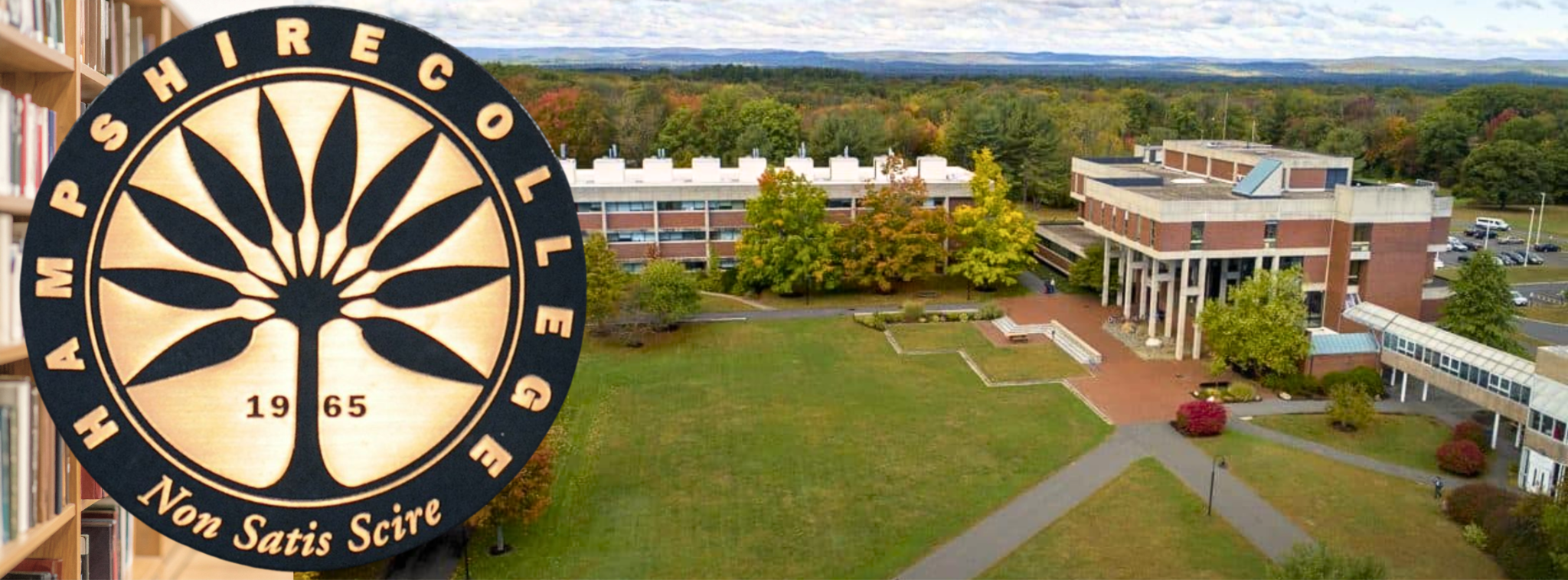
Hampshire College, for anyone who hasn’t encountered it, requires some explanation. Founded in 1970 as a deliberate experiment in higher education, it had no grades, no majors and no core classes/traditional distribution requirements. Students designed their own education through a system of three Divisions: first, a series of exploratory projects across disciplines, then a self-designed concentration built around your own questions, and finally a year-long independent thesis. The whole “choose your own adventure” system was built on the premise that the most important thing a college can teach you is how to ask the right questions, and then pursue them with intense rigor and independence. The student body when I arrived was around 1,300. My graduating class would be about 350. It was small enough to know faces everywhere, intellectually intense enough that dining hall conversations turned into two-hour debates about postcolonial theory, and absurd enough that community bikes painted yellow and welded together in purposefully ridiculous configurations were scattered around campus for anyone to ride.
At every other school I had attended growing up, I had been the unusual one. At Hampshire, for the first time in my life, I was normal. But the invisibility I felt wasn’t loneliness, it was belonging. I had found my bee people, and the relief was overwhelming.
Hampshire’s faculty were also unlike any I’ve encountered before or since. Laurie Nisonoff, a feminist Marxist economist who became my Div II advisor, had the kind of mind that could see injustice at any scale. In her U.S. Labor History course, she would present some appalling episode of American history and turn to the class and exclaim: “We’re NOT making this up!” Frederick Weaver, who chaired my Div III thesis, could name the theoretical tradition behind whatever concrete problem I was fumbling toward. I would pitch some idea about St. Croix’s economy and he would listen carefully and say, “Well, now you’re touching upon Marx’s labor theory of value,” and I would think: wait…what? But working with Weaver taught me something I’ve carried into every classroom since: the value of grounding abstract theory in real, specific, local problems. Margaret Cerullo’s Contemporary Social and Political Theory cracked open my entire intellectual framework through Nietzsche, Foucault, Arendt, and Asad. Falguni Sheth, who served on my Div II committee, introduced me to Critical Race Theory and taught me to see how racial divisions function as strategies of political management. And Vivek Bhandari, whose course on Gandhi’s Critique of Modernity systematically dismantled everything I thought I knew about progress and the West, gave me one of the most powerful classroom experiences of my life. The morning that the horrifying Abu Ghraib prisoner abuse photographs broke, Bhandari came into class visibly fuming but helped us connect what we were seeing to colonialism, neocolonialism and imperialism in real time. In the previous session, we had watched a documentary with footage of the first President Bush declaring that “the laws of the jungle will not stand.” The line from that declaration to those photographs was unbroken, and our professor gave us the tools to trace it. That is what Hampshire education could do at its best: the world breaks into the classroom, and your professors help you understand it.
The academic moment that probably meant the most to me wasn’t my thesis defense and ringing the bell (although that was of course truly special). It was actually the afternoon my Div II was passed, a year earlier. I walked out of Nisonoff’s office after she and my other committee member, Falguni Sheth, had gone through my entire portfolio, every class, every paper, every evaluation, and summarized my intellectual arc in a way that even I couldn’t have articulated. It was incredibly validating in a way that went beyond any grade, because Hampshire doesn’t give grades. It was two brilliant women telling me that the journey I had taken through their institution, from Asian philosophy and consciousness studies to Caribbean political economy, made sense, that it cohered, that it added up to something. I walked back to Mod 26 clutching my fat Div II binder under my arm and felt probably the smartest I’d ever felt in my life up to that point.
What I really learned at Hampshire was how to see. How to see systems behind events. How to see colonialism not as history but as ongoing condition. How to see economics not as abstract models but as the distribution of power and suffering and possibility. I learned to see my own home island, St. Croix, not as the paradise of the tourism brochures or the “tropical ghetto” of the colonial imagination, but as a real place with real people navigating structures designed to benefit someone else.
On Tuesday morning, April 14th, 2026, an email arrived at 9:05 AM. The Board of Trustees had voted to permanently close Hampshire College following the Fall 2026 semester. I read the words on my phone between classes, and then I read them again, and then I sat with them for a long time. I spent the rest of the day reading Facebook posts in the alumni group page and messaging former classmates, people I hadn’t spoken to in years, people who didn’t need me to explain what we had just lost because they had lost it too.
Ken Burns, one of Hampshire’s most famous graduates, called it “an incalculable loss, the reverberations of which will be felt in ways none of us can imagine.” Professor CJ Gill, who taught at Hampshire for more than twenty years, told reporters she was feeling grief and was stunned. A first-year student named Liam Hennessy, who had been at Hampshire for less than a year, said something that stopped me: “This is kind of a swan song for liberal institutions.”
He was more right than he knew.
II. What Killed Hampshire
“How did you go bankrupt?” one character asks another in Hemingway’s The Sun Also Rises. “Two ways,” his friend answers. “Gradually and then suddenly.”
That is how colleges die.
Hampshire had been in financial trouble since at least 2019, when the administration announced it would not admit a full incoming class and began seeking a merger partner. What happened next is one of the most remarkable chapters in the history of American higher education. Students staged a 75-day sit-in at the president’s office, the longest occupation of a college president’s office in American history. Faculty revived their AAUP chapter to protect positions. Alumni mobilized from across the country. The president and several trustees resigned. The community didn’t just protest the decision. They used the education Hampshire gave them to challenge the institution that gave it to them, and they won. Hampshire stayed independent. A new president launched a $60 million fundraising campaign. The curriculum was redesigned around global challenges. Enrollment recovered from a low of just 13 admitted students in 2019 to classes of 200 to 300. As recently as January 2025, Forbes cited Hampshire as a model for how small liberal arts colleges could survive.
Fifteen months later, it’s gone. Last fall, Hampshire enrolled 168 new students against a target of 300, missing its goal by nearly half. A $21 million bond couldn’t be refinanced. The New England Commission of Higher Education placed the college on “show cause” status. A land sale meant to shore up finances fell through when a developer walked away over permitting and environmental concerns. By the time the Board voted to close, Hampshire was caught in a spiral familiar to anyone who has watched these institutions die: a college trying to sell land to pay bonds to satisfy accreditors to stay open long enough to enroll enough students to generate enough tuition to service the debt. Past a certain point, the spiral becomes irreversible.
I want to be honest about something here. Hampshire’s internal challenges were certainly real. The financial model was always fragile: a small endowment, deep dependence on tuition revenue, and an identity so beloved that it made institutional evolution agonizingly difficult. But the external forces bearing down on Hampshire would probably have crushed the college even with perfect adaptation. The community did everything right. They organized, they gave, they reinvented and they fought for seven years. Hampshire even took in roughly three dozen students fleeing New College of Florida after Governor DeSantis’s political takeover in 2023, offering them matching tuition so they could continue their liberal arts education at the same cost they’d been paying at a public school in Florida. A financially struggling institution absorbing students at a loss because it was the right thing to do. That is who Hampshire was. And it still wasn’t enough.
This is because Hampshire is not an isolated case. It is one data point in a wave of closures sweeping through American higher education. Since March 2020, at least 64 nonprofit colleges have closed, affecting nearly 46,000 students. Since 1996, more than 1,670 have shut their doors. And according to Huron Consulting, nearly a quarter of the country’s 1,700 private, nonprofit four-year institutions may be forced to close or merge over the next decade. Three credit rating agencies issued unfavorable outlooks for 2026. Hampshire isn’t the end of this wave. It’s near the beginning.
The casualties are everywhere. Marlboro College in Vermont, my mother’s alma mater, closed in 2020. Goddard College, a fellow experimental institution in Vermont, gone. Birmingham Southern College in Alabama, where a student facing transfer to a less accepting school told a professor, “I guess I’ll go back in the closet.” Cabrini University in Pennsylvania, where fewer than half of displaced students successfully transferred. Wells College in New York. Iowa Wesleyan in Iowa. Northland College in Wisconsin. Martin University, Indiana’s only predominantly Black institution, quietly shut down at the end of 2025 with almost no national attention. The closures are not distributed equally. The institutions serving the most distinctive educational missions and the most marginalized communities often die the quietest deaths.
The structural forces behind these closures are well documented. The number of American 18-year-olds is projected to fall 13 percent between 2026 and 2041. The share of high school graduates enrolling in college immediately after graduation has dropped from 70 percent to 62 percent in the last decade. Confidence in higher education has collapsed, falling from 57 percent to 36 percent in just ten years according to Gallup. Nearly a third of Americans now say college is too expensive, and a quarter say students aren’t being taught what they need to succeed, where “succeed” means earn. Meanwhile, the financial model of small private colleges has become almost impossibly fragile: institutions that close have median operating margins of just 3 percent, with tuition accounting for 86 percent of revenue. The average private nonprofit discount rate hit a record 51 percent in 2022, meaning these colleges are giving away more than half their sticker price in financial aid just to fill seats. The market isn’t just shrinking, it’s sorting, and what it sorts against is exactly the kind of education that Hampshire provided.
William “Wolfie” Krebs arrived at Hampshire in 2022 uncertain whether he even wanted to attend college. Four years later, he’s headed to a PhD program in mathematics. He fell in love with math in a whole different way, he told Inside Higher Ed. When asked about the closure, he said something that has stayed with me: “I hope it’s not seen as a failure, because it wasn’t.”
He’s right. Even the people closing the college said so. In their announcement, the Board wrote that they remain “unwavering in our belief that the experience a Hampshire College education provides is exactly what the world needs.” The education worked. The financial model broke. Those are different verdicts, and the country that can’t tell the difference between them is the country that keeps losing institutions like Hampshire.
III. The Architecture of Defunding
Hampshire was a private college, and I want to be upfront about that. My analytical frame in this publication usually focuses on public institutions and public funding, and on the ways government policy shapes the conditions ordinary people have to navigate. Hampshire didn’t receive state funding. It lived and died on tuition and donations. But the forces that killed it are not private forces. They are the same structural pressures dismantling public education across this country, and the distinction between public and private matters far less than the shared condition: a society that has decided, through its budgets and its policies and its cultural assumptions, that education’s purpose is job training, and that anything beyond job training is a luxury the country can’t afford.
That assumption has become so deeply embedded that it no longer feels like an assumption at all. It just feels like common sense. College should prepare you for a career. A degree should lead to a job. Education is an investment, and investments should generate returns. By this logic, an institution that teaches you to think rather than to earn looks like a bad investment. Hampshire’s entire existence was a rejection of that premise, and the premise won.
One Hampshire alum, Elizabeth Patterson, noticed something in the days after the announcement. Reading through post after post from fellow alumni, she observed that people weren’t saying “I wouldn’t have the career I have without Hampshire” or “I wouldn’t have gone into my field.” They kept reaching for the same words Ken Burns used. “I keep seeing ‘I wouldn’t be who I am,’” she wrote. “Not ‘what I do,’ or ‘how I do it.’ Who I Am. Maybe that’s why it’s hitting us all so hard. Because when something changes who you are on this kind of cellular level and then it goes away, there’s an odd kind of fear mixed in with the grief and the loss.” An education measured by return on investment asks what you do with it. Hampshire’s alumni, in their grief, keep answering a different question entirely. That difference is the whole argument.
You can see it in the numbers. Vocational community college enrollment increased 16 percent in a single year between 2022 and 2023. A growing number of major employers have dropped degree requirements for entry-level positions. The cultural signal is clear and consistent: thinking is a luxury, and earning is the point. And as that signal strengthens, the institutions that exist to cultivate thinking rather than credential earning lose students and revenue and, eventually, the ability to keep their doors open.
But this isn’t just a market story. It’s a political one. In 2023, when Governor DeSantis seized New College of Florida and transformed it into a conservative institution, Hampshire offered refuge to those students. Three years later, the refuge itself is gone. Last September, Florida’s Commissioner of Education issued a memorandum to every school district superintendent in the state, reminding educators that their First Amendment rights “do not extend without limit” into their professional duties and warning that the Commissioner’s office would investigate and potentially discipline any educator whose public speech was deemed to undermine trust or reduce their effectiveness. The memo was forwarded down the chain of command, from superintendents to principals to every teacher’s inbox, including mine. It closed with three words: “Govern yourselves accordingly.” Book bans have also swept through school districts across the country. And a state legislator in Kansas signed a law prohibiting what it calls “DEI-CRT” in general education. The pattern isn’t subtle. Institutions that produce critical, independent thinkers are under pressure not just from declining enrollment and financial fragility, but also from a political establishment that has identified critical thinking itself as a threat. This is a two-front war, and institutions like Hampshire were caught between market forces that couldn’t sustain them and political forces that didn’t want to.
And behind all of it is the question of priorities. Last year, the United States allocated $1.5 trillion for defense spending while cutting $73 billion from nondefense discretionary programs. The Forest Service has been gutted. Twenty-two million families lost SNAP benefits. Palantir received $61.8 million to install surveillance infrastructure inside the Department of Education. The country found unlimited resources for weapons systems and data collection but couldn’t sustain the institutions that produce citizens capable of questioning what those weapons and that data are for.
The pattern holds at every level. Penn State’s Board of Trustees voted to close seven commonwealth campuses serving 3,200 students due to enrollment and financial pressures. That same year, the university invested $700 million in a stadium renovation at the flagship campus and paid a $9 million coaching buyout. The money exists. It has always existed. The question has never been whether we can afford to educate people. The question is whether we want to, and our budgets have answered clearly.
Laura De Veau, a visiting professor at Boston College who served as an administrator at Mount Ida College when it closed in 2018, looked at Hampshire’s situation and concluded that the college had “pulled many of the levers they needed to, but the clock ran out.” She’s right. But clocks don’t run out on their own. Someone sets them. Someone decides how much time an institution gets, how much support and how much oxygen. Hampshire ran out of time because the country that built it decided, through a thousand budget lines and policy choices and cultural signals, that what Hampshire did wasn’t worth the cost of keeping it alive.
The cruelest irony is that the capacity Hampshire cultivated, to question assumptions and to trace the architecture of power, is exactly the capacity a country needs most when it is making choices this destructive. We are defunding the very institutions that produce the people equipped to explain why the defunding is a catastrophe. And we are doing it in the name of common sense.
IV. What Could Survive
Four days before Hampshire announced its closure, Maine Governor Janet Mills signed a supplemental budget making her Free Community College program permanent. Same week. Opposite directions. Same country.
Since 2022, more than 23,000 Maine high school graduates have enrolled tuition-free at the state’s seven community colleges, pursuing associate degrees and workforce credentials without taking on debt. The program, which had bipartisan support from former governors of both parties, is now written into the state’s baseline budget, no longer dependent on annual reauthorization or political goodwill. The same budget includes phased increases to minimum teacher salaries: $45,000 in 2027, $47,500 in 2028, $50,000 by 2029. Maine is doing two things at once that most of the country has refused to do at all: making education accessible to students and making teaching sustainable as a profession.
I was born in Brunswick, Maine, and I taught at Maine Connections Academy during the 2022-2023 school year, the first year of the free college program. My colleagues and I actively promoted it to our seniors. Some of them took advantage of it. I watched the principle work.
But none of this should be mistaken for a replacement. Community college cannot replicate Hampshire. Nothing can. The self-designed concentration, the detailed, narrative evaluations, the intellectual culture of a 1,300-student experimental campus, professors who could take the morning’s breaking news and trace it back through centuries of imperial history, students who staged a historic sit-in to save their school (and also, when I was there, a student walkout on October 10, 2001 to protest the start of the bombing in Afghanistan), that is gone, and pretending otherwise dishonors what was lost. You don’t replace a place that taught people how to see by offering them two years of free tuition. Those are different things, and both of them matter.
What Maine proves is something more modest and more important: that investing in education is a choice. Not a market inevitability. Not a line item that can only shrink. A choice. The same country that found $1.5 trillion for the Pentagon and $700 million for a football stadium can fund community colleges and pay its teachers a living wage if it decides those things are worth doing. Maine decided that they were. The question is whether the rest of the country will follow Maine’s worthwhile example or continue following its budgets toward a future in which the institutions that teach people to think are luxuries we’ve decided we can’t afford, while the institutions that teach people to obey are the only ones left standing.
V. Where It All Points
In the days after the closure announcement, my social media feeds filled with something that felt like a collective evaluation. Hampshire alumni don’t process loss the way other people do. We process it the way Hampshire taught us to: we reflect, we analyze, we tell the story of the experience, and we methodically lay out what we learned. It is, as one alumna wrote, what we were trained to do. For every class we wrote self-evaluations. For every concentration we wrote self-assessments. And now, for the closing of the institution itself, we are writing one more.
McKinley Melton, a professor who taught at Hampshire from 2007 to 2012, posted something particularly thoughtful. He wrote about the privilege of teaching what he called “bad” students. Students who didn’t adhere to deadlines because time was a construct. Who rarely acquiesced to authority because what is hierarchy. Who questioned everything, sometimes googling in real time. Hampshire students, he wrote, were “bad” at being students because they had no desire to be what so many believed good students should be. They weren’t interested in collecting a degree as if it were simply a document to propel them toward a higher income. And yet, he wrote, they were “some of the most intellectually hungry (far beyond curious), rigorously self-challenging, beautifully independent-minded, and thoughtful students” he had ever worked alongside. They believed in the school’s motto and in James Baldwin’s declaration that it is your responsibility to change society if you think of yourself as an educated person. “To be clear,” he concluded, “this is not just the closing of a college. It’s the shuttering of a distinctive institution in the landscape of Higher Education. We are all the poorer for its absence.”
Another alum, Kristen Harbeson, wrote what amounted to a final self-evaluation of her thirty-four years in what Hampshire calls Div IV, the practicum, the part of your education that never ends. She described arriving at Hampshire as someone who, from the moment of her birth, didn’t belong anywhere but in her family. And then finding, for the first time, people who accepted her for her whole, oddball self without preamble or trial period. She recalled a philosophy professor whose evaluation she still carries with her three decades later: “Kristen’s work is always good, and occasionally excellent. When she realizes the kind of sustained effort it takes to be excellent, her work will be consistently excellent.” That evaluation, she wrote, might as well be tattooed on her heart. No grade could have done that. No letter on a transcript could have reached that deep.
“The closure of Hampshire hits so many of us so hard,” she wrote, “because it demonstrates, once again, that there is no place for us. The society that we live in is not one that can support, tolerate, or allow the cultivation of rebellious, relentless, unconventional, intellectual inquiry.” She’s right. And the data confirms it. Fewer than half of students whose college closes successfully transfer to another institution. The rest simply don’t finish. When Hampshire closes at the end of this year, some students will complete their degrees. Some will transfer to Amherst or Smith or UMass, the very institutions whose presidents founded Hampshire as an experiment in 1965. Some will stop altogether. Each unfinished education is a capacity to see that never fully develops. That is the cost, and it is incalculable in the precise sense that Ken Burns meant when he used that word.
Burns said something else that has stayed with me: “Hampshire’s ethos and probing way of seeing the world doesn’t disappear when a campus goes quiet. The thousands of lives transformed by this miraculous, improbable place will carry its revolutionarily generative spirit forward for generations to come.” He’s right too. And he’s not enough. Yes, the seeing survives in the people Hampshire produced. But the institution that generated the seeing is gone, and nothing guarantees that capacity gets reproduced without it. Burns can carry Hampshire’s legacy forward. So can I. So can all fellow alumni writing evaluations on Facebook this week. But who produces the next generation of people who learn to see?
Robert Coles, who taught at Hampshire for twenty years and whose Prison Literature course I took during spring semester of my first year (those class discussions definitely often continued later in our dorm rooms!), posted something this past week that I also keep returning to. “Hampshire might be closing,” he wrote, “but the spirit of Hampshire remains open. It is not the institution (buildings, classrooms, physical location, national ranking, etc.) that matters in a college; what matters, ultimately, are the PEOPLE who are/were involved—working with a shared philosophy or vision.”
He’s describing something I’ve watched happen all week. In every Facebook post, every group text, every phone call between classmates who haven’t spoken in years, the shared philosophy is still operating. We are still evaluating, still analyzing, still tracing systems, still refusing to accept the surface explanation when the structural one is right there underneath it. The institution taught us how to do that, and then the institution closed, and we are still doing it, a true testament to what Hampshire built.
As I write this, there are alumni working around the clock to find a path forward, exploring models from cooperatives to continuing education communities. I hope they succeed. But whatever emerges from those efforts, it won’t be the Hampshire that made us who we are. That Hampshire is the one this piece is for.
Non Satis Scire. To know is not enough.
What Hampshire gave me wasn’t a fixed body of knowledge. It was a way of thinking that hasn’t stopped evolving since I left, one that turns every classroom I teach in, every article I write, and every system I encounter into something that can be understood, questioned and named. But thinking and knowing alone didn’t save Hampshire. Seeing the structural forces clearly doesn’t make them stop operating. The motto cuts both ways: knowing is not enough to change the world, and knowing is not enough to save the institutions that teach us how to know. Frantz Fanon, whose work I first encountered through Hampshire’s classrooms, put it even more directly: ‘What matters is not to know the world but to change it.’ But changing it starts with seeing it clearly. And if the capacity to see that Hampshire cultivated in its students is going to survive the closure of the institution that produced it, then it falls to us, every oddball alumn and every professor who believed we were worth the sustained effort, to carry it forward. Not just as memory, but as practice.
The buildings will close. The seeing doesn’t have to. But it will, eventually, if we don’t build and fund the institutions that produce it. Whether we do that, whether we invest in the places that teach people to see the architecture or allow them to disappear one by one until the only institutions left are the ones that teach people not to look, is not just an educational policy question. It is a deeper moral question about what kind of country we want to live in.
Hampshire taught me to see. I’m still seeing. And if you’ve read this far, so are you.
References
Casey, M., & Willingham, L. (2026, April 14). Hampshire College to close after fall semester amid financial struggles | AP News. AP News. https://apnews.com/article/hampshire-college-closing-ken-burns-d2cc7834ead91f6220d1b17b980453b7
Frenier, A. (2026, April 14). Hampshire College announces closure effective this fall. New England Public Media. https://www.nepm.org/regional-news/2026-04-14/hampshire-college-announces-closure-effective-this-fall?utm_term=nprnews&utm_medium=social&utm_campaign=npr&utm_source=facebook.com&fbclid=IwY2xjawRLrQ5leHRuA2FlbQIxMQBzcnRjBmFwcF9pZBAyMjIwMzkxNzg4MjAwODkyAAEeeCpEDoeM2IIuN1upuJR25ADNd5l83jq3shJSlgKkFfvDlDEeuRtc5T5nPqU_aem_SXO6kO1nycleMyQOlVi7Kg
Kelchen, R., Ritter, D., & Webber, D. (2026, April 9). Colleges Are Closing. Who Might Be Next? Education Next. https://www.educationnext.org/colleges-are-closing-who-might-be-next-how-machine-learning-fill-data-gaps-forecast-future/
Moody, J. (2026, April 14). Hampshire College announces closure. Inside Higher Ed | Higher Education News, Events and Jobs. https://www.insidehighered.com/news/business/financial-health/2026/04/14/hampshire-college-announces-closure
Moody, J. (2025, December 18). The colleges that couldn’t survive 2025. Inside Higher Ed | Higher Education News, Events and Jobs. https://www.insidehighered.com/news/business/mergers-collaboration/2025/12/18/colleges-couldnt-survive-2025
Penprase, B. (2025, January 29). Saving and reviving liberal arts colleges. Forbes. https://www.forbes.com/sites/bryanpenprase/2025/01/29/saving-and-reviving-liberal-arts-colleges/
Reider, J. (2026, April 14). No margin, no mission. Docnotes. https://docnotes.net/2026/04/14/no-margin-no-mission/?fbclid=IwY2xjawRLsTxleHRuA2FlbQIxMABicmlkETFpSW9MdVR1WkxTd3Vwc1VOc3J0YwZhcHBfaWQQMjIyMDM5MTc4ODIwMDg5MgABHumAQBag_gIKsS4hQPCK9Azcykm-YSVFwciw7QefjEFepYzoha4JnJ5Ru6hf_aem_Bgd0R9uLRYidlciw7pQ9jA
Schooley, M., & Parseghian, A. (2026, April 14). Hampshire College closing in Amherst, Massachusetts. Graduate Ken Burns calls it “incalculable loss.” CBS News. https://www.cbsnews.com/boston/news/hampshire-college-closing-amherst-massachusetts/?fbclid=IwY2xjawRLsL1leHRuA2FlbQIxMQBicmlkETFjeWM1d1dGTGs3clJGM2Z2c3J0YwZhcHBfaWQQMjIyMDM5MTc4ODIwMDg5MgABHreuBzVdmzccEBX9oClZ7cMy0QsyjrHPSzvrocwOzbZkhiTZ86wLU4pV_9Zo_aem_3g0Sk8Bc0HPir8GyUXThZg
Williams, A. (2024, October 29). When Colleges close: The devastating effects of liberal arts college shutdowns. The Politic. https://thepolitic.org/when-colleges-close-the-devastating-effects-of-liberal-arts-college-shutdowns/
____________________________________________________________________________
Means and Meaning publishes every Tuesday. If you found value in this analysis, I’d be very grateful if you’d consider buying me a coffee, as your support helps me dedicate time to this work while keeping all content free and accessible.
You can also support this project by subscribing (it’s free!), sharing with others who might appreciate it, or joining the conversation in the comments. Sometimes the best antidote to anxiety is knowing you’re not alone in seeing what’s happening.
Next week, we’ll examine another piece of the machinery, and another opportunity to resist it.
Until then, keep questioning, keep connecting and keep believing that another world is possible.
~ Chris