

Half a Mile from Free Speech
Newark, ICE, and the Bipartisan Enforcement of Silence

The Quiet War is an ongoing series about the war that doesn’t make the front page. Each installment traces the infrastructure of repression being built while most people’s attention is elsewhere: the surveillance systems, the detention machinery, the erosion of rights that happens not in dramatic confrontation but in contracts, policies and code. This war is quiet by design. Naming it is the first act of resistance.
I. The Perimeter
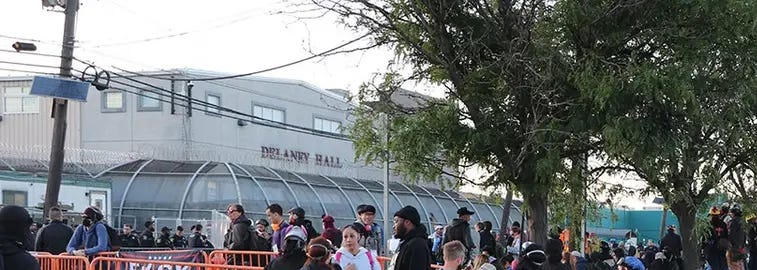
A half-mile curfew zone surrounds Delaney Hall, an ICE detention center in Newark, New Jersey. Inside the zone: riot police, tear gas, flash bangs and mounted officers. Outside it: a “free speech zone” where you’re allowed to exercise rights the Constitution says have no geographic limit.
The last time I checked, the entire country was a free speech zone. Designating one means everywhere else isn’t.

Governor Mikie Sherrill, a Democrat, deployed New Jersey State Police to establish what she called a “peaceful, protected protest zone.” Protected. As if the danger is the protesters’ proximity to the building, and not what’s happening inside it. Before the state troopers arrived, workers from the GEO Group, the private prison company that operates Delaney Hall, walked outside and painted yellow lines on the sidewalk. They posted “private property” and “no trespassing” signs at the main entry points. A corporation that profits from detention literally drew the lines of containment on the ground, and the governor then sent police to enforce them.
The curfew runs 9 PM to 6 AM, nightly, until further notice. Protesters who refused to leave were arrested. A WNBC news crew was pulled from a clearly marked press vehicle. Six people were taken into custody Friday night. Sherrill noted that five of them came from out of state, the nearest being New York, thirteen miles away.
She called them “outside agitators.” That phrase has a history, which will be explored shortly.
II. What’s Inside The Perimeter
Three hundred detainees launched a hunger and labor strike on May 22, led by a man named Martin Soto. Their letter, made public by The American Prospect, described decaying food containing worms, bathrooms in inhumane condition, and staff ignoring serious illness. Congressional delegations confirmed it: maggots in meals, one doctor for hundreds of detainees, cancer patients untreated, a pregnant woman denied proper care. Conditions bad enough, according to the New Jersey Alliance for Immigrant Justice, for people to lose their pregnancies.
The state’s response to Martin Soto was to promptly transfer him out of the facility. Just disappear the organizer.
Homeland Security Secretary Markwayne Mullin denied the hunger strike was even happening at all. When pressed on the food, he said detainees were “refusing to eat because they want their ethnic food. Well, they can go back to their country and get whatever food they want.” An attorney representing people inside the facility responded: “I think they just don’t want to eat worms.”
Border czar Tom Homan went on Fox News and threatened to force-feed the hunger strikers, even though many international human rights organizations classify force-feeding as torture. Kathy O’Leary of Pax Christi, who has worked with detainees directly, agreed: “These are all documented textbook forms of torture.”
The perimeter isn’t protecting public safety. It’s protecting the public from seeing this.
III. “Outside Agitators”
Bull Connor used the phrase in Birmingham. George Wallace used it in Selma. Every authority confronted with dissent it cannot discredit on substance reaches for the same word: outside. The implication is always the same: legitimate protest can only come from people directly affected, in the location the state designates, at the time the state permits.
So who was actually outside Delaney Hall?
Pax Christi, a Catholic peace organization. SEIU and CWA, two of the largest labor unions in the country. People’s Organization for Progress, a Newark-based civil rights group. CosechaNJ, an immigrant rights network. Community members who have been protesting the facility for over a year. Faith groups. Union workers. Neighbors.
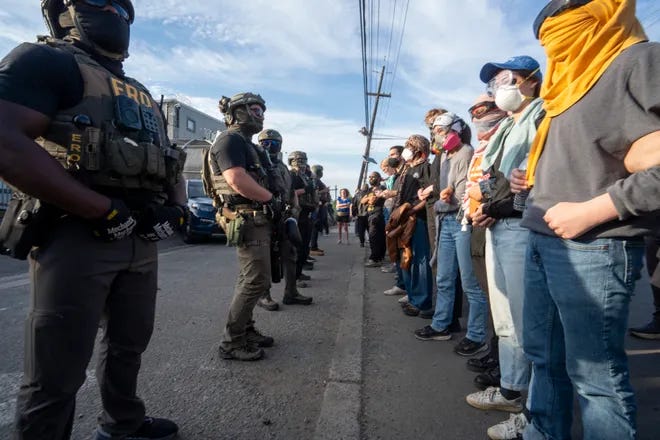
Protesters lock arms and stand in front of Immigration and Customs Enforcement agents outside Delaney Hall on Wednesday, May 27, 2026, in Newark. Photo by Julian Leshay Guadalupe/NorthJersey.com
These are not “national extremist groups,” as Sherrill claimed without identifying a single one. These are churches, unions, and community organizations doing what churches, unions, and community organizations have always done when the state brutalizes people: showing up.
Meanwhile, a volunteer medic named Adam Marshall was handing out water to families outside the facility when ICE agents grabbed him and took him away. He was found several towns over and returned only after a medical review. A man distributing water was physically disappeared from a protest and deposited miles from where he was seized. In week one of this publication, I called ICE operations kidnappings. Forty weeks later, the vocabulary still fits.
As Declan wrote on Substack last week: “In the United States, you are not an ‘outside agitator’ because you cross from New York or Pennsylvania into New Jersey to protest a federal injustice. You are a citizen exercising a national right against a national abuse of power.”
The only true outside force at Delaney Hall is ICE itself.
IV. The Bipartisan Architecture
The most dangerous moment in the quiet war is not when one party builds the architecture of repression. It’s when both parties enforce it. Not out of shared ideology, but out of shared operational logic. That’s what Delaney Hall reveals.
Mikie Sherrill did not endorse the conditions at Delaney Hall. She did not defend Mullin’s mockery of starving detainees or Homan’s threat to force-feed them. She said she wanted the facility closed. Then she sent state troopers with tear gas to protect it, established an indefinite curfew, and arrested the people who refused to be contained.
The quiet war does not need both parties to share an ideology. It just needs both parties to enforce the same perimeter.
And DHS noticed. Secretary Mullin publicly thanked Sherrill for “now allowing the New Jersey State Police to cooperate with us” and called her deployment “a win for law and order.” When the Trump administration’s border czar calls your actions a win, you are not resisting the architecture. You are the architecture.
Compare Minneapolis. When ICE launched its surge there, Minnesota’s Democratic officials treated the federal operation as the crisis, not the protesters. They went to court against DHS. After sustained community resistance, ICE withdrew most of its agents. That’s what it looks like when elected officials understand the assignment: you stand with your community against federal abuse, not between your community and the facility door.
Sherrill had the same choice. She chose the perimeter.
V. Where It All Points
Forty weeks ago, this publication began with a piece about ICE and the language of disappearance. I argued that when the state takes a person from their home, their family, their life, and deposits them into a system designed to make them invisible, we should call that what it is. Not “enforcement.” Not “removal.” Kidnapping.
This week, detainees inside ICE facilities in New Mexico and Tacoma formed an organization and chose their own name: La Unión de Secuestrados por ICE. The Union of People Kidnapped by ICE. They arrived at the same word independently. Because when you are inside the machinery, you don’t need a Substack to tell you what it is.
And at Delaney Hall, the architecture has added a new tool: disappearing the protest itself. Not by banning it, which would be too visible, and too obviously unconstitutional. But by containing it, with a half-mile perimeter. And a curfew until further notice. Yellow lines painted on the sidewalk by a private prison company earning $705 million in quarterly profits, paying detainees a dollar an hour for their labor under a loophole in the Thirteenth Amendment that was written to preserve slavery by another name. The food has worms in it. Fifty-six people have died in immigration custody under this administration. And the state’s priority is making sure the people who object to this can’t be seen from the building.
The hunger strikers inside Delaney Hall cannot be heard. The protesters outside the perimeter cannot be seen. The press crew that tried to document it was physically removed. The medic handing out water was seized and deposited towns away. The organizer who led the strike was transferred to another facility. The architecture is complete: invisible suffering, inaudible dissent, and a bipartisan consensus that the most important thing is keeping the perimeter intact.
As Declan wrote, protest is not supposed to be convenient. It is not a suggestion box. It is not a civic pageant managed by the state. It is the refusal to let injustice proceed in peace. The people at Delaney Hall, inside and outside those walls, understand that.
Forty weeks ago I asked what we call it when the state disappears people. This week the question is simpler, and harder: what do we call it when the state disappears the dissent?
References
Declan. (2026, May 31). Protest is not supposed to be convenient. Better is Possible.

Editor. (2026, June 1). Shut down Delaney Hall and all ICE detention centers! Workers World. https://www.workers.org/2026/06/92997/
Fan, C. (2026, May 28). Protests over inhumane conditions at ICE facility Delaney Hall in Newark become violent. CBS News. https://www.cbsnews.com/newyork/news/delaney-hall-protests-ice-facility-newark-nj/
Pazmino, G. (2026, June 1). After weekend clashes, protests continue under curfew near Newark ICE facility. CNN. https://www.msn.com/en-us/news/news/after-weekend-clashes-protests-continue-under-curfew-near-newark-ice-facility/ar-AA24qCGZ?ocid=BingNewsSerp
Public Square Amplified team. (2026, May 30). Notes from on the ground outside Delaney Hall — PUBLIC SQUARE. PUBLIC SQUARE. https://www.publicsq.org/latest-articles/z5sjfp57415yj4mhfhof1h8srlnofh
____________________________________________________________________________
Means and Meaning publishes every Tuesday. If you found value in this analysis, I’d be very grateful if you’d consider buying me a coffee — your support helps me dedicate time to this work while keeping all content free and accessible.
You can also support this project by subscribing (it’s free!), sharing with others who might appreciate it, or joining the conversation in the comments. Sometimes the best antidote to anxiety is knowing you’re not alone in seeing what’s happening.
Next week, we’ll examine another piece of the machinery — and what it tells us about how the rest of it works.
Until then, keep questioning, keep connecting, and keep believing that another world is possible.
~ Chris