


This piece is part of “Workers Rising,” an ongoing series about the people whose work keeps everything running. The flight attendants and warehouse pickers, the dispatchers and gate agents, the mechanics and teachers and nurses and ground crews. Each installment follows the work: who does it, who depends on it, who pays when something breaks, and what the people inside the work see that the headlines miss. These aren’t just labor stories. They’re the foundation the rest of the economy stands on.
I. The Last Flight
There were supposed to be sixteen minutes between my Spirit flight landing in Fort Lauderdale and my rescheduled connection pushing back for Tampa. I made it with six.
This was November 29, 2025, the Saturday after Thanksgiving. I’d spent the week-long school break in St. Croix with my family, and I was trying to get back to Ocala on a $200 budget itinerary because that’s what teachers fly. The departure board at Henry E. Rohlsen Airport showed my 4:36 PM flight delayed, then delayed again, then delayed to 7:51, and I sat at the gate doing the math on whether I’d make my connection while the gate agent kept her face neutral and answered the same questions twenty times an hour (eventually, she was thankfully able to get me on a later connecting flight, the last one out that day).
We finally pushed back at 7:13. As we taxied to the runway, the flight attendant got on the intercom and said the delay had been caused by an Airbus software update that affected six thousand flights worldwide. Six thousand flights. One vendor decision halfway around the world, and a Spirit jet sat on the tarmac in the Caribbean for four hours while a flight attendant explained to a planeload of strangers what her employer hadn’t.
I made the Tampa connection because the gates were thankfully only three apart. I drove home to Ocala past midnight with the windows down and classic rock loud enough to keep me awake. I remember thinking that the airline was held together with duct tape and optimism.
Five months later, it was gone. At 3:00 AM Eastern on Saturday, May 2, 2026, Spirit Airlines ceased all operations. The night before, in the company’s operations center in Orlando, a dispatcher named Wes Egan (who had worked at Spirit for twenty-three years) sent a message through the cockpit alert system to one of the carrier’s pilots, who had been asking what was happening. The message, in all caps (because that’s how dispatch messages are formatted), read: UNOFFICIALLY WE STOP FLYING AT 0300 EST ON 05/02. GODSPEED MY FRIEND.
Seventeen thousand people lost their jobs that night. Software engineers. DOT compliance specialists. Flight attendants. Senior maintenance planners. Heavy maintenance project managers. Pilots, mechanics, dispatchers, ground crews. They got three and a half hours’ notice from their supervisors and an email from the CEO. The airline they had built was killed by a war they didn’t vote for, a merger they couldn’t save, and a government that found money for everything except them.
This is their story.
II. Death By A Thousand Structural Failures
To understand what killed Spirit Airlines, it’s worth stepping back to see how the carrier sat at the intersection of five distinct pressure points: financial, mechanical, regulatory, geopolitical and political. None of them alone would have necessarily done it, but all five together left no room to breathe.
The financial pressure started first. Spirit hadn’t turned an annual profit since 2019. Six straight years of losses, and the workers kept showing up, flying the routes, fixing the engines, staffing the gates, and dispatching the flights. The mechanical pressure came next. Pratt & Whitney engine defects grounded a significant portion of Spirit’s fleet, parking planes the mechanics couldn’t fix because the problem wasn’t theirs to fix. The senior maintenance planners scheduled inspections on aircraft that weren’t allowed to fly. The regulatory pressure followed in January 2024, when the Department of Justice blocked Spirit’s $3.8 billion merger with JetBlue on antitrust grounds. The merger would have retained Spirit’s 15,000 workers and added 10,000 more by 2026, according to projections the two airlines filed at the time. Twenty-five thousand projected aviation jobs evaporated when a federal judge sided with the DOJ. Spirit filed for Chapter 11 protection that year, and again in August 2025. Despite this, the flight attendants kept smiling at boarding.
Then came the geopolitical pressure. In late February 2026, the U.S.-Israel attacks on Iran closed the Strait of Hormuz and spiked jet fuel costs by 70%. Spirit absorbed over $100 million in fuel costs in two months. It simply couldn’t keep up. And the political pressure was the last one. Spirit sought a $500 million federal bailout. Late on Friday, May 1, Commerce Secretary Howard Lutnick called CEO Dave Davis to tell him the bondholders had rejected the deal. There was no remaining way out. And the workers got the news at 3 AM.
III. The Architecture Was Visible from a Long Way Off
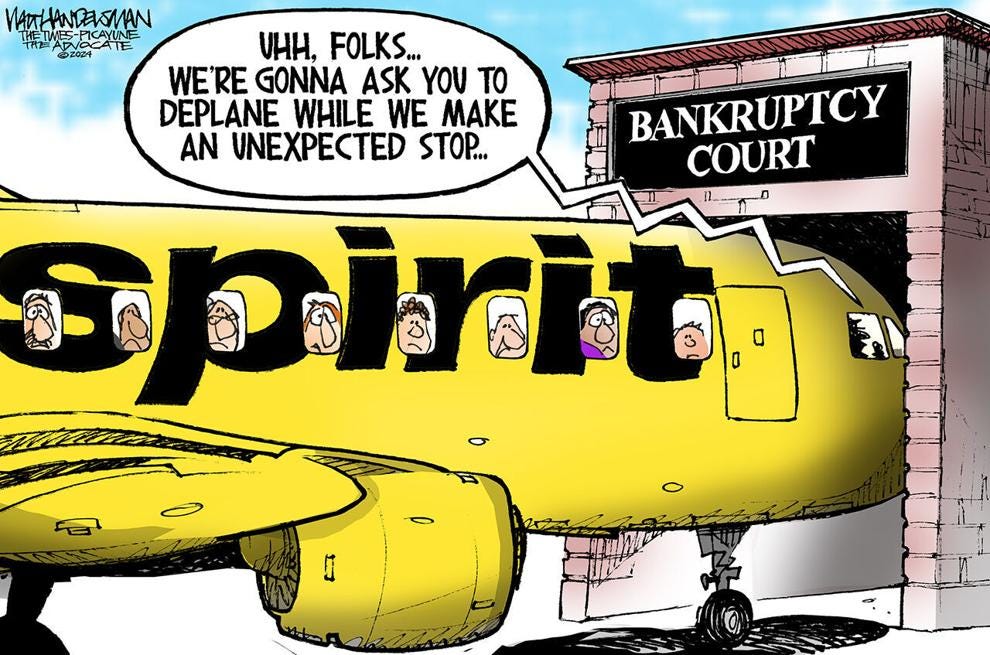
Walt Handelsman, The Times-Picayune | The Advocate, 2024. Spirit had just filed its first Chapter 11.
Editorial cartoonists were drawing Spirit’s death two years before it died. The architecture wasn’t hiding. Anyone paying attention could see what was coming. Spirit wasn’t the first carrier to be removed from the American sky, and it won’t be the last.
Every year I show my high school Economics students an infographic from USA Today when we cover oligopolies and game theory. It tracks the airline industry from the 1970s through the early 2010s, and it looks like this:
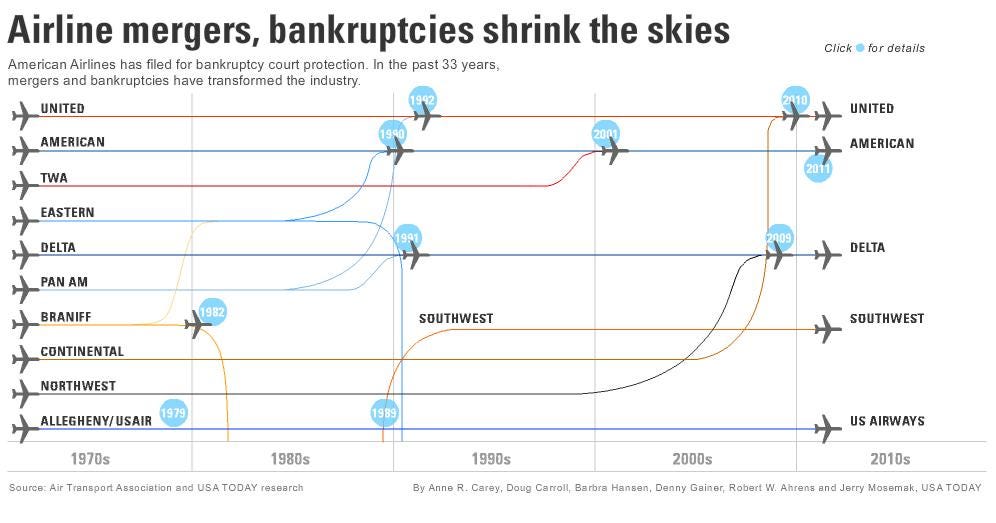
Ten carriers enter the chart on the left. Four exit on the right. Pan Am and Eastern collapsed in 1991. TWA was absorbed by American in 2001. Northwest disappeared into Delta in 2009. Continental into United in 2010. US Airways into American in 2011. The names that built American commercial aviation are gone, and the workers who built their careers at those carriers are scattered across the survivors or out of the industry entirely.
Diana Moss, president of the American Antitrust Institute, named the result in 2022: “We basically have a four-firm oligopoly. Having this fringe of smaller carriers breathing down their necks is really the only thing left that keeps the Big Four on their toes.” Four firms (American, Delta, United and Southwest) controlling roughly 80% of domestic capacity. Spirit was part of that fringe.
As I help my students see in this same lesson, in a four-firm oligopoly the surviving carriers don’t have to collude formally. They just have to recognize that everyone makes more money when nobody starts a price war. Brandon Oglenski, an airline analyst at Barclays, said the quiet part out loud the Monday after Spirit’s collapse: industry pricing will “benefit significantly for nearly all airlines given the removal of excess point-to-point capacity.” Translated: a Spirit-sized hole in the market means the survivors can raise fares.
JetBlue moved within hours. It announced new flights from Fort Lauderdale to Cali, Barranquilla, Santo Domingo, Santiago de los Caballeros, and Ponce, the Caribbean routes that Spirit had served. The merger would have integrated Spirit’s workers. The collapse let JetBlue absorb the routes without them.
And while the workers who flew those routes were filing for unemployment, Spirit was asking the bankruptcy court to approve millions in retention bonuses for the executives staying on to manage the wind-down. The lawsuit recently filed by six laid-off workers alleges that Spirit had told employees as recently as April 16 to “ignore the rumors” about the airline’s collapse. Sixteen days before the lights went out, the workers were being told to stay optimistic. The bondholders were already counting.
IV. The Cannibalization
Within two weeks of Spirit’s collapse, more than ninety of its aircraft had been flown to airports around the country and parked, many of them at Phoenix Goodyear Airport, where the dry Arizona climate slows down the deterioration of planes nobody is flying. Of those ninety aircraft, more than sixty were leased. Spirit didn’t actually own most of the airline it operated. The yellow paint was Spirit’s. The planes belonged to finance companies, and the finance companies were already lining them up for their next lease.
The repossession was handled by a company called Nomadic Aviation Group, whose managing partner told NPR that some of the abandoned Spirit aircraft were “already probably in the pipeline to be leased again.” Other planes would have their engines pulled and transplanted into different aircraft. Each engine is worth between fifteen and twenty million dollars. A two-engine A320 is sitting on thirty to forty million dollars of resaleable hardware. The metal continues. The labor, however, is severed from it.
It all reminds me of a scene in Oliver Stone’s 1987 film Wall Street where Charlie Sheen’s character realizes what his mentor’s deal actually means for Bluestar Airlines, the fictional carrier his father has worked for his entire adult life. In a smoky, wood-paneled office, a dozen executives seated around a gigantic table talk over each other about how to rapidly liquidate it. “...build condos where the hangars are,” “...lay the airplanes off to [the next buyer],” “...and I’ve got the Texas boys drooling at my kneecaps for the rest.” And then the line that lands the whole scene: “The beauty of this deal is the overfunded pension. Gekko makes seventy-five million dollars there. Fifty million buys them the minimum annuities for six thousand employees, and he walks away with the rest…not bad for a month’s work.”

Charlie Sheen as Bud Fox in Wall Street (1987), realizing that the deal his father warned him about is about to liquidate Bluestar Airlines and the 6,000 workers who made it fly.
Stone made that film thirty-nine years ago, but the cannibalization that he dramatized as moral horror has since become routine operating procedure. Spirit had seventeen thousand employees, not six thousand. The engines are worth more than the pensions. And the boardroom is now spread across thirty airports, twelve leasing companies and a half-dozen repo contractors.
Incredibly, even some of the pilots flying Spirit’s planes to Arizona are actually former Spirit pilots. Nomadic hired them as 1099 contractors. The same workers who held airline jobs with health insurance and retirement benefits two weeks ago are now gig workers flying their former employer’s planes to a graveyard in the desert. Their labor has been recategorized into a worse version of itself. They are being paid to ferry their own funeral.
And this is not just contained to Spirit. For example, Lufthansa has cancelled twenty thousand flights through October. AirAsia X has raised fares forty percent and cut capacity by ten. Air New Zealand has cancelled eleven hundred flights. More than thirteen thousand flights were cancelled across Europe in May alone. American Airlines is projecting four billion dollars in additional fuel costs this year. Delta reported a two-billion-dollar fuel cost spike in the second quarter alone.
Neil Sorahan, CFO of Ryanair, told CNBC the Monday after Spirit’s collapse that he expects “some of the weaker carriers who were already struggling before the war possibly go to the wall in the winter.” Spirit is not the last airline that will be cannibalized. It is the first.
Ryanair, meanwhile, hedged eighty percent of its fuel at sixty-seven dollars a barrel before the war began. Jet fuel is currently trading at one hundred sixty-three. Ryanair reported a 2.6 billion-dollar profit for 2026, a forty percent increase year over year. Same war, same fuel, same architecture, but opposite outcome. So you basically have it where the country that started the war is the country whose airlines are dying from it. And the workers who didn’t vote for it are the ones flying their own planes to the desert.
V. Take Your Uniform Off
Seventeen thousand workers lost their jobs at 3 AM on May 2. Three thousand pilots (represented by the Air Line Pilots Association), fifty-five hundred flight attendants (organized with the Association of Flight Attendants-CWA), and fifty-five hundred ground crew, mechanics and maintenance workers (who belonged to the International Association of Machinists and Aerospace Workers). Plus three thousand contractors and indirect workers whose paychecks also ended when the gates closed.
Because Spirit liquidated rather than furloughed, the seniority those workers had spent careers building was destroyed in a single night. A flight attendant with twenty-seven years at Spirit doesn’t get hired by Delta as a twenty-seven-year veteran; she gets hired as a new hire. And as any teacher who has ever left a school to go work in another district or state knows, the skills survive, but the place in line does not.
Last December, Spirit pilots had agreed to cut their hourly wages by 8% in order to meet the airline’s financing requirements. Additionally, flight attendants gave back per diem rates and accepted reductions in their minimum credit hours. The workers took the pay cut because they wanted to believe the airline could be saved. The bondholders were already drafting the recovery they would later reject.
Sara Nelson, president of the Association of Flight Attendants-CWA, said the workers had “invested their hearts and souls into this airline,” and that their lives were now “hanging in the balance.” She has asked the federal government for a six-month, $600 weekly supplement to state unemployment, plus healthcare coverage through the end of 2026. However, the same administration that found $1.5 trillion for the Pentagon and started the war that doubled jet fuel prices has so far offered neither.
The architecture made every decision that killed Spirit, and the architecture is still making them. The DOJ blocked the merger. The bondholders rejected the bailout. The lessors reclaimed their planes. The repo contractors are now hiring Spirit’s former pilots to ferry their own planes to the desert. And the same president whose Commerce Secretary made the final phone call to Spirit’s CEO is currently demolishing the East Wing to build his ballroom, with bunkers and data centers beneath it.
Yeneshia Thomas was at home in Central Florida when she got the email at 12:30 AM. A forty-two-year-old flight attendant. She had been furloughed in December and called back in March. She took a pay cut to come back. “I had hopes that we were going to make it,” she told Business Insider. “Because they called us back.”
A few hours later, Spirit sent another email telling employees they were no longer permitted to wear their uniforms. One of Thomas’s colleagues hadn’t read it yet. She showed up at the airport in her Spirit uniform, the same one she had worn for years to work she had been proud to do. A TSA agent (just another worker, doing his job) looked at her and said the only thing he was authorized to say: “Take your uniform off.”
That is the architecture. That is what it has always been. And that is what it will keep being until the workers it depends on refuse to absorb its consequences any longer.
References
Bujor, M. (2026, May 7). Spirit Airlines Company shutdown: 17,000 jobs gone overnight. AirMag.aero. https://aeronauticsmagazine.com/news/spirit-airlines-is-gone-what-happens-next-to-the-17000-workers-left-behind
Chokshi, N. (2022, February 7). “Frontier and Spirit Airlines Plan to Merge.” The New York Times. https://www.nytimes.com/2022/02/07/business/frontier-spirit-airlines-merger.html
Edmonds, L. (2026, May 4). Inside the chaotic morning Spirit workers learned they were out of a job: “Take your uniform off.” Business Insider. https://www.businessinsider.com/spirit-airlines-collapse-employees-jobs-workers-flight-attendant-2026-5
Josephs, L. (2026, May 5). “Godspeed my friend”: Inside the final hours of Spirit Airlines. CNBC. https://www.cnbc.com/2026/05/02/spirit-airlines-shutdown-inside-the-final-hours.html?&qsearchterm=spirit
Josephs, L. (2026, May 4). How Spirit Airlines’ demise will benefit rivals — and raise airfares even more. CNBC. https://www.cnbc.com/2026/05/04/spirit-airlines-flights-rivals.html?&qsearchterm=spirit
Jordan, W. A. (1988). Problems Stemming from Airline Mergers and Acquisitions. Transportation Journal (American Society of Transportation & Logistics Inc), 27(4), 9–30.
Lyons, D. (2026, May 14). Ex-Spirit workers sue, saying airline failed to give proper layoff notices, owes back pay and benefits. Sun Sentinel. https://www.sun-sentinel.com/2026/05/13/ex-spirit-workers-sue-saying-airline-failed-to-give-proper-layoff-notices-owes-back-pay-and-benefits/
Payne, R. (2026, May 16). More than 90 Spirit Airlines aircraft with $20M parts were abandoned at airports — here’s why retrieving and selling them is a challenge. AOL.com. https://www.aol.com/finance/more-90-spirit-airlines-aircraft-154500863.html
Siskos, D., Maravas, A., & Karatzas, J. (2025). Pan-Caribbean Airlines: Unlocking Regional Aviation Potential. Collegiate Aviation Review International, 43(2), 1–21.
Syme, P. (2026, May 18). More airlines could follow Spirit into bankruptcy due to the Iran war fuel crisis, Ryanair exec says. AOL.com. https://www.aol.com/articles/more-airlines-could-spirit-bankruptcy-112021000.html
____________________________________________________________________________
Means and Meaning publishes every Tuesday. If you found value in this analysis, I’d be very grateful if you’d consider buying me a coffee — your support helps me dedicate time to this work while keeping all content free and accessible.
You can also support this project by subscribing (it’s free!), sharing with others who might appreciate it, or joining the conversation in the comments. Sometimes the most important thing is naming what you see, and naming who paid for it.
Next week, we’ll examine another piece of the machinery — and what it tells us about how the rest of it works.
Until then, keep questioning, keep connecting, and keep believing that another world is possible.
~ Chris