


This piece is part of the Signal/Noise series, rapid responses to breaking events - tracing how power operates not only through policy and violence, but through culture, spectacle, and the stories a society tells itself about who belongs.
I. The Spectacle and the Threat
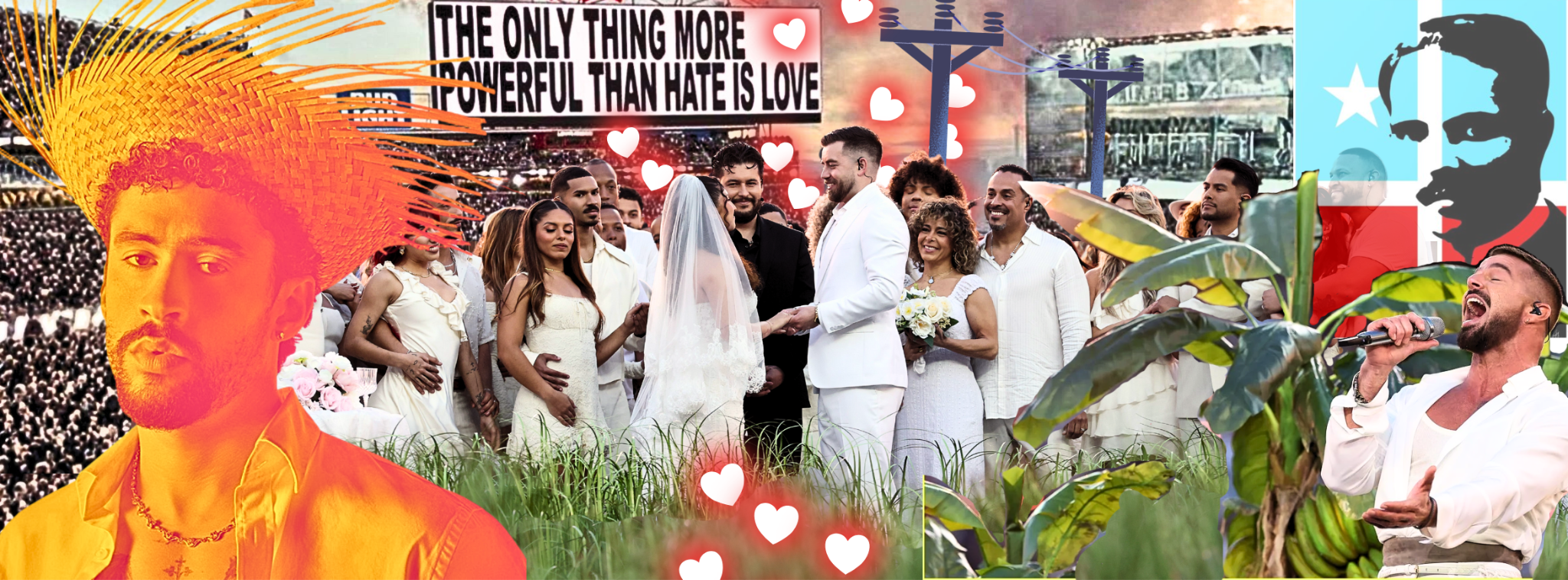
On Sunday, February 8, 2026, 130 million people across the Americas watched a Puerto Rican wedding. Not a simulation. Not a performance about a wedding. An actual ceremony, with vows exchanged, rings placed and a kiss sealed before the world. Families danced. An uncle spun with his niece. Grandparents swayed to salsa. The bride and groom’s joy radiated through Levi’s Stadium in Santa Clara, California, as Bad Bunny (now one of the most streamed artist on Earth) turned the Super Bowl halftime show into something the empire hadn’t anticipated: a celebration of Puerto Rican life so exuberant and so unapologetically itself, that it left the president of the United States sputtering with rage.
Donald Trump didn’t just skip the show, though he’d threatened to. He watched. And then he melted down. On Truth Social, he called it “absolutely terrible, one of the worst, EVER!” The dancing, he claimed, was “disgusting, especially for young children.” The performance was “a slap in the face to our Country.” The president whose name appears thousands of times in recent Justice Department emails related to Jeffrey Epstein was clutching his pearls about people twerking at a football game. The president who days earlier had called Puerto Ricans “garbage” was now offended that they dared to exist joyfully, in Spanish, on America’s biggest stage.
This is the real battle unfolding across the United States: pride versus intolerance, joy versus domination, and the future versus a past that refuses to die. And 130 million people, in the US, across Latin America and around the world, chose joy.
But 5 million Americans made a different choice. They tuned out. They switched channels. They watched Turning Point USA’s “All-American Halftime Show” instead, which featured Kid Rock and three white country singers performing for an audience that sees Bad Bunny’s Spanish, his Puerto Rican flag, his hemisphere of solidarity all as existential threats. That’s not a culture war. That’s rehearsal for something darker: the infrastructure of separation, the mechanics of an ethnostate movement that’s building parallel institutions, claiming a different country, preparing for a future where the rest of us don’t exist.
So here’s the question threaded through everything that follows: Why does a wedding threaten power? Why does joy, performed in Spanish by a former Econo grocery bagger from Vega Baja who became the world’s biggest artist, provoke a president to rage? Why does a man waving flags and naming countries send conservatives scrambling to create counter-programming, attempting to assert their vision of “real America” against the one 130 million people celebrated?
The answer isn’t about music or language or even patriotism. It’s about hegemony - who controls the culture, who defines what’s normal, and who gets to claim the national stage as theirs. As Antonio Gramsci argued, domination doesn’t rely on force alone. It relies on common sense, on making hierarchy feel natural and inevitable. When the story holds, guns stay holstered.
Bad Bunny didn’t accept the story. He told a different one. And for thirteen minutes, millions listened not to the empire’s narrative about who belongs and who doesn’t, and not to the president’s rage about “real Americans” versus colonial subjects, but to a vision of the Americas as plural, interconnected, joyful and free. That’s what unsettles power - not the performance itself, but what it revealed: that cultural control is slipping, that joy is being built beyond permission, that the future is arriving without asking.
This is the story of how a halftime show became an act of decolonization - and why the empire is terrified of what comes next.
II. Mass Spectacle as Contested Terrain
When Bad Bunny emerged from a field of sugar cane stalks to open his Super Bowl performance, it wasn’t decoration. It was history made visible. Spain brought sugar to Puerto Rico in the 1500s, built slave plantations, and extracted wealth for centuries. The United States seized the island in 1898 and did the same, with mainland corporations controlling production, reaping massive profits, and treating Puerto Ricans, as TIME put it, as “mostly a nuisance to be managed.” The stalks therefore weren’t a simple backdrop. They were memory. And walking through them, surrounded by workers cutting cane to the rhythm of reggaeton, Bad Bunny was claiming a history the empire would rather forget.
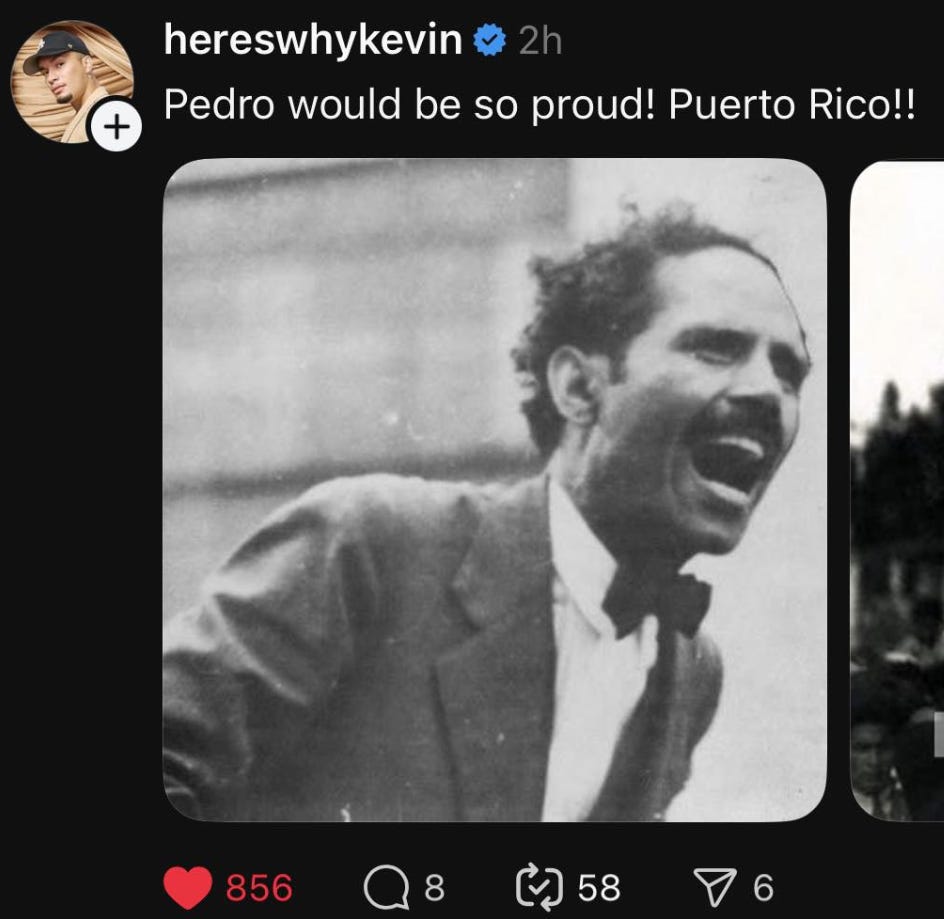
Eighty years ago, the United States made it illegal to fly the Puerto Rican flag or sing patriotic songs. The 1948 Ley de la Mordaza (the Gag Law) passed by a territorial legislature aligned with U.S. interests, criminalized Puerto Rican identity itself in order to crush the independence movement. Thousands were arrested. Pedro Albizu Campos was imprisoned and tortured. The flag could get you thrown in jail. On Sunday, Benito Antonio Martínez Ocasio waved that flag on America’s biggest stage, surrounded by Latinos carrying banderas from across the hemisphere, singing entirely in Spanish before 130 million people. This wasn’t permission granted. This was space taken.
The Super Bowl halftime show has always been contested terrain, a brief window where culture, power, and national identity collide. For decades, the unspoken rule was assimilation. Michael Jackson’s 1993 performance was historic, but its themes were carefully universal. The so-called Latin Explosion of the late 1990s required crossover, English lyrics and softened edges. Even Jennifer Lopez and Shakira’s 2020 performance, widely celebrated as a breakthrough, still operated largely within that framework. Inclusion was conditional.
Bad Bunny just shattered that model. As Slate’s Joshua Rivera observed, he didn’t cross over; he made them cross to him. Lady Gaga didn’t duet in English. She adapted, singing salsa with visible joy. TIME called it “reverse assimilation.” This is what a crack in cultural hegemony looks like. Not representation, but recentering.
As Stuart Hall argued, representation is never neutral. Culture is a battleground where meaning is fought over. When Beyoncé performed “Formation” in 2016, she claimed that stage for Black resistance. When Kendrick Lamar danced inside a divided American flag in 2025, he made fracture unavoidable. Bad Bunny went further, claiming the stage for the colonized, the Spanish-speaking, the hemisphere the empire has tried to erase.
That is why the reaction was so intense. As Vanity Fair’s Michelle Ruiz observed, “fiesta is a form of protest; joy is its own kind of rebellion.” Bad Bunny didn’t need to shout “fuck ICE” or deliver a lecture on imperialism. He just showed everyday Puerto Rico (the bodegas, the piragua stands, the dominoes, the wedding, the power lines and the flags) and let 130 million people see a culture that doesn’t need the empire’s approval to thrive. Dick Hebdige wrote about how marginalized groups claim space through style and culture, turning symbols of subordination into declarations of identity. Bad Bunny took the Super Bowl, the most expensive, corporate, quintessentially American spectacle, and made it Puerto Rican. He turned imperial theater into decolonial celebration.
III. The Parallel Show: When 5 Million Watch Something Else
While 130 million people watched Bad Bunny, 5 million Americans made a different choice. They tuned into Turning Point USA’s “All-American Halftime Show,” where Kid Rock and three white country singers performed what organizers called “real America.” This wasn’t just counter-programming. It was infrastructure building. When a movement creates parallel concerts, parallel narratives, and parallel definitions of the nation, it is rehearsing for separation.
The danger here isn’t guns. An armed citizenry can, under certain conditions, defend liberty. Vietnam and Switzerland both make that clear. The danger is who those guns are imagined to be for. When 5 million people choose Kid Rock over Bad Bunny, they aren’t just picking different music. They are choosing a different country, one that does not include the rest of us.
This is what Benedict Anderson called an “imagined community,” a nation brought into being through shared symbols, shared exclusions, and shared fantasies of purity. And as Aimé Césaire warned, fascism is colonialism turned inward. The ethnostate project now taking shape mirrors the logic once used to subordinate Puerto Rico: some people belong, others are problems to be managed or removed.
As The Independent’s Mark Beaumont put it, “Would you rather be here shaking multicultural booty with Bad Bunny, or watching a bunch of bitter country bores in a miserable Texan bar?” The choice was not aesthetic. It was existential. One show celebrated mixture, joy, and defiance. The other performed resentment, purity, and retreat. One imagined hemispheric solidarity. The other dreamed of walls and deportations.
This is the real battle, pride versus intolerance. And 130 million people chose pride. So now we have to reckon with what they were shown.
IV. The Class Contradictions and the Hijacking
The Super Bowl is capitalism’s cathedral. Eight million dollars for thirty seconds of advertising. Billionaire owners in luxury boxes. A spectacle designed to sell everything from trucks to tax software. The game itself is secondary to the commodity fetishism, the ritual where products become personalities and consumption becomes identity. This is what Guy Debord called “the society of the spectacle,” where authentic human experience is replaced by its representation, where life becomes something you watch rather than live, and where even rebellion is packaged and sold back to you.
And then Bad Bunny hijacked it.
The Situationists had a word for this: détournement, the practice of stealing the master’s tools and turning them against the master’s house. Not reforming the spectacle, but redirecting its power. For thirteen minutes, the most expensive advertising platform on Earth became a celebration of Puerto Rican joy, anti-colonial memory, and working-class life. The oligarchs paid for the stadium. Bad Bunny decided what it would mean.
The contradictions were impossible to miss. An artist from an island with a 44 percent poverty rate performing for an audience of billionaires. A colonized people’s culture broadcast by the empire that still governs them. A wedding, the ultimate gift economy where value flows from relationship and obligation from love, smuggled into a spectacle surrounded by ads insisting meaning can be bought.
Marx wrote that capitalism turns everything into commodities, alienating us from our labor, our relationships, and ourselves. Bad Bunny reversed that logic. He inserted use-value back into exchange-value. He turned the Super Bowl from a machine for selling things into a space for being together. The performance was not for sale. It was for us.
That is why it was dangerous. The empire can tolerate representation, diverse faces selling the same system. It cannot tolerate transformation. Someone used its biggest stage to show that another world already exists, that joy does not require permission, and that working people from colonized islands can claim space the powerful assumed they owned. That is not inclusion. It is insurgency. And 130 million people watched it happen in real time.
V. Authenticity as Politics: The Wedding, the Bodega, the Blackout
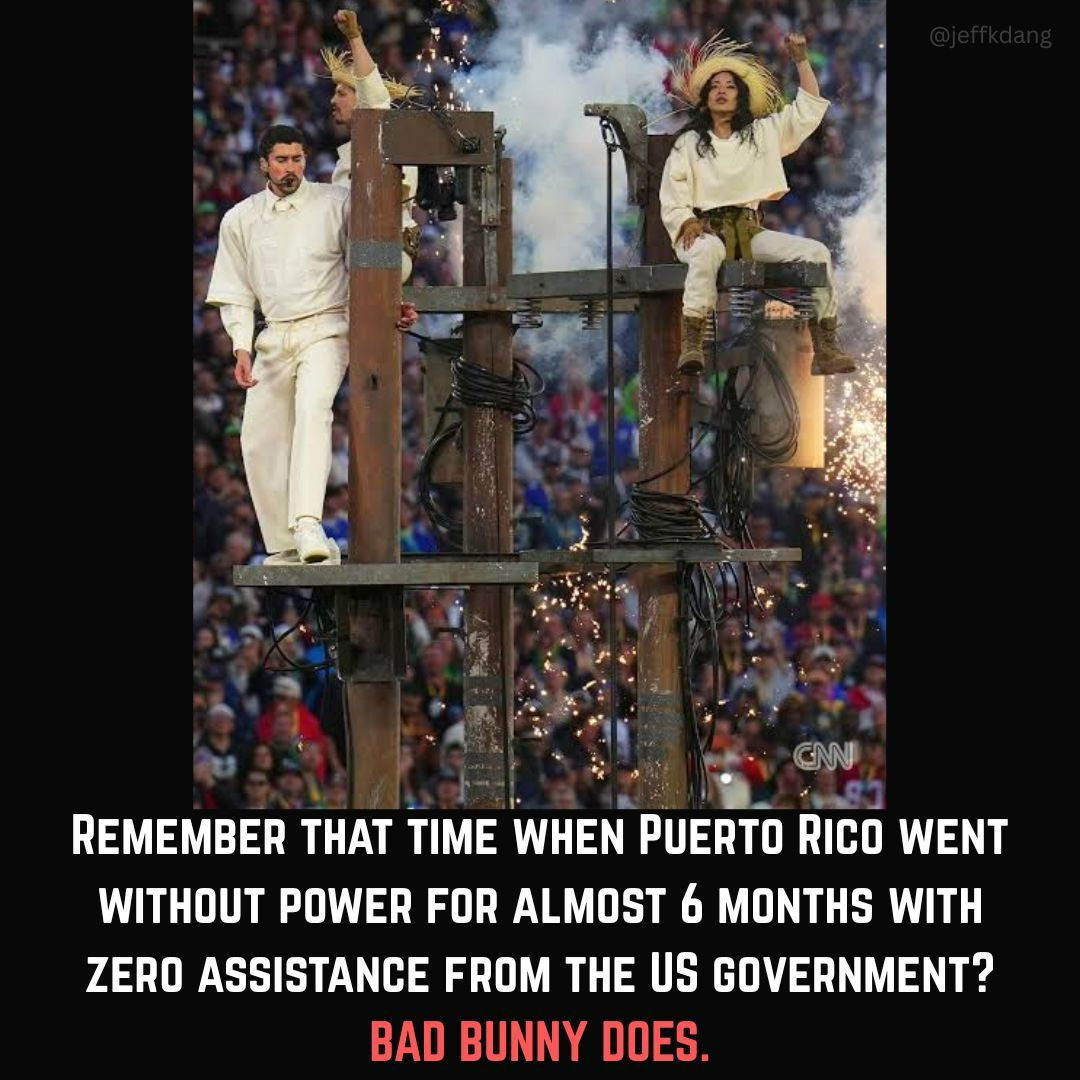
When Bad Bunny climbed the electrical pole during “El Apagón,” sparks flying as workers in pava hats surrounded him, he wasn’t staging a metaphor. He was showing what imperial neglect looks like. This is what happens when territories receive infrastructure designed for extraction rather than for people. “El Apagón” means “the blackout,” and in Puerto Rico it names the routine collapse of a power grid now run by LUMA Energy, a private mainland corporation that profits while the lights go out. The song’s 22-minute video, featuring the amazing journalist Bianca Graulau, documents how Act 22 tax incentives invite wealthy mainlanders to privatize beaches and drive up rents while working-class Boricuas lose power, land, and home.
This is what Frantz Fanon called the “zone of non-being,” the space where colonized people live outside the protections and recognition granted to the metropole. Puerto Rico doesn’t lack a functional grid by accident. Its territorial status makes disposability administrative policy. Walter Rodney taught us that underdevelopment isn’t backwardness; it is produced. PREPA’s collapse followed that logic precisely.
I learned what this looks like in St. Croix, where WAPA’s failing grid made outages routine and hurricanes exposed how provisional belonging becomes when aid arrives late, if it arrives at all. When Bad Bunny staged the blackout, I recognized it immediately. This is what disposability looks like. Infrastructure reflects political status.
Bad Bunny’s rise coincided with Hurricane Maria because catastrophe clarifies who the system serves. While federal aid stalled and Trump tossed paper towels, while the grid failed and mainland corporations profited, a grocery bagger from Vega Baja began making music about what working-class Puerto Ricans were already living. He didn’t study poverty. He bagged groceries. He didn’t theorize colonialism. He lived under it.
This is what Gramsci called the “organic intellectual.” Bad Bunny’s politics aren’t performance. They are material analysis made into music, gift economy smuggled into spectacle, and real lives made impossible to ignore on the empire’s biggest stage.
VI. “God Bless America”—Every Single One of Them
When Ricky Martin belted “Lo Que Pasó a Hawaii” alongside Bad Bunny, it wasn’t just a cameo. It was a bridge. Hawaii and Puerto Rico were both seized in 1898, both reshaped into sugar colonies, both still subordinated to an empire that extracts their land while dismissing their people. After Puerto Rico’s 1899 hurricane, recruiters transported thousands of Boricuas to Hawaii’s plantations, where they labored alongside Kānaka Maoli, Filipinos, Japanese, and Chinese workers. What emerged there was solidarity forged in cane fields. What Bad Bunny offered on Sunday was memory. A reminder that these struggles are connected, that the empire’s logic is the same whether its flag flies over Honolulu or San Juan.
And then came the flags. All of them.
As the performance reached its climax, dancers filled the field carrying banderas from across the hemisphere: Mexico, Colombia, the Dominican Republic, Venezuela, Cuba, Argentina, and more. Bad Bunny named them one by one, out loud, on America’s biggest stage. In doing so, he reclaimed the word “America” itself, redefining it from imperial possession into continental belonging. This is what José Martí meant in 1891 when he wrote of “Nuestra América,” an America that is plural, interconnected, and resistant to any empire that claims the name for itself. It is what Simón Bolívar envisioned as well: unity not through domination, but through liberation, rooted in the understanding that our struggles are facets of the same fight.
I studied Caribbean economics at Hampshire College under scholars like Fred Weaver and Laurie Nisonoff — historians and political economists who taught in the traditions of Rodney, James, and Marx, and who understood what Bad Bunny demonstrated in thirteen minutes: that Puerto Rico’s colonization, Haiti’s debt, Jamaica’s structural adjustment, and the territorial status of the U.S. Virgin Islands are not separate tragedies. They are outcomes of the same imperial system. When Bad Bunny named every country, he did what decolonial thinkers have long insisted upon: he saw the whole, not the fragments the empire creates to keep us divided.
So what makes a president rage at flags and names? What makes five million people flee to Kid Rock rather than witness this vision of hemispheric joy? Because they understand what’s happening. This wasn’t inclusion. It wasn’t a polite request for a seat at America’s table. It was redefinition. A declaration that the table was always ours, that “America” names the whole damn hemisphere, and that the empire squatting in Washington is just one country among many, not the center of the world.
And the empire knows what that redefinition threatens. If “America” means all of us, from Tierra del Fuego to the Arctic, from favelas to reservations to colonized islands, then the legal fiction that allows the United States to rule Puerto Rico while denying Puerto Ricans equal citizenship collapses. In 2022 (not 1922, but 2022) the U.S. Supreme Court denied Puerto Ricans equal Social Security benefits and also refused a case that sought to confer birthright U.S. citizenship to those living in another U.S. territory, American Samoa. The Court cited the Insular Cases, those 1901 decisions grounded in fears of “savage” peoples becoming citizens. Modern defenders call this “cultural preservation.” Legal scholars call it what it is: colonialism with better vocabulary.
When Bad Bunny waved the Puerto Rican independence flag, he wasn’t simply celebrating culture. He was defying a legal order that still classifies Puerto Ricans as “appurtenant and belonging to,” but not “part of,” the United States. Second-class by Supreme Court precedent. The Insular Cases remain good law. The Gag Law was repealed, but its spirit lives on in every ruling that upholds unequal treatment. And still, there was Bad Bunny, showing 130 million people what sovereignty looks like. Not asking permission. Not pleading for recognition. Simply claiming existence.
Frantz Fanon wrote that decolonization is always a violent phenomenon, not because the colonized are inherently violent, but because the colonizer never relinquishes power willingly. But Fanon also understood decolonization as creation, the bringing into being of a world the empire cannot imagine. That is what happened Sunday night. For thirteen minutes, a different world existed. Not someday. Not after the right elections or the right court rulings. Now. A world where Puerto Ricans don’t code-switch, where Spanish doesn’t apologize, where the colonized dance at their own weddings while the empire watches, unable to stop the joy.
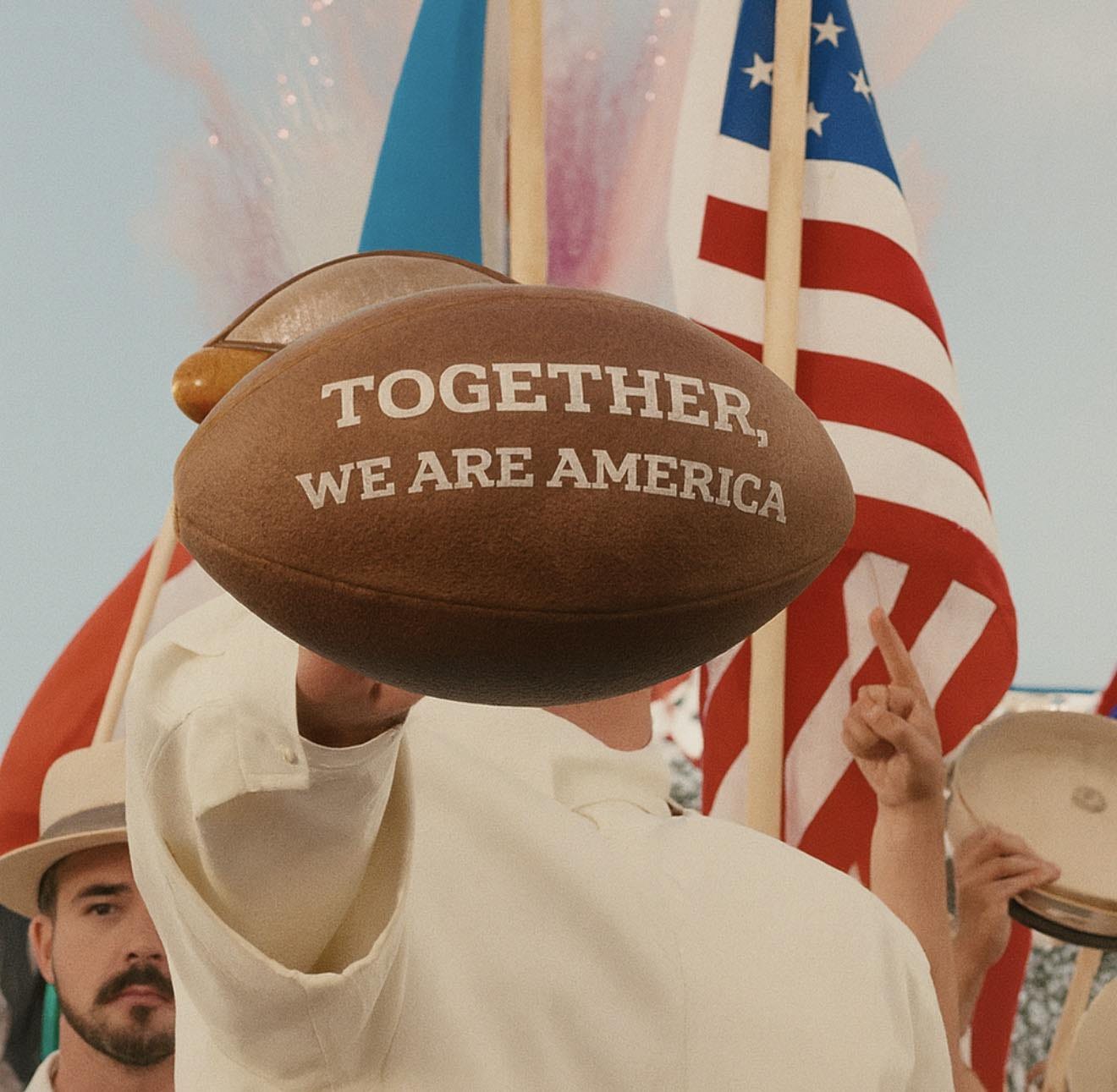
At the end, Bad Bunny held up a football painted with four words: “TOGETHER WE ARE AMERICA.” Not their America. Not the empire’s America. Our America. Nuestra América. The one Martí dreamed of. The one Bolívar fought for. The one that has always existed, despite every attempt to erase it. Together. Plural. Hemispheric. Free.
That is what terrifies them. Not the performance, but what it revealed. That the empire’s cultural hegemony is cracking. That people are building joy the colonizer cannot control. That 130 million people watched the future arrive and chose to dance.
The question isn’t whether the empire will accept this vision of the Americas. The question is whether the empire can survive it.
Seguimos aquí. We’re still here. And we’re not asking permission anymore.
God bless America. Every single one of them.
References
Beaumont, M. (2026b, February 9). Bad Bunny review, Super Bowl 2026 halftime show: This wild, inclusive fiesta was an inherently political stand. The Independent. https://www.the-independent.com/arts-entertainment/music/reviews/bad-bunny-review-super-bowl-2026-halftime-show-b2916046.html
Bonlarron Martinez, C. (2026, February 9). Bad Bunny’s Super Bowl Show Was Political Art at Its Best. Jacobin. https://jacobin.com/2026/02/bad-bunny-super-bowl-puerto-rico
Chow, A. R. (2026, February 9). Bad Bunny’s Super Bowl halftime show was an exuberant act of resistance. TIME. https://time.com/7373018/bad-bunny-super-bowl-halftime-show-analysis/
Pappas, S. (2026, February 9). Bad Bunny’s Super Bowl halftime show highlighted Puerto Rico’s power grid. Here’s why. Scientific American. https://www.scientificamerican.com/article/bad-bunnys-super-bowl-halftime-show-highlighted-puerto-ricos-power-grid/
Power, M. (2023). Solidarity Across the Americas : The Puerto Rican Nationalist Party and Anti-imperialism. The University of North Carolina Press.
Rivera, J. (2026, February 9). What Gringos might have missed about Bad Bunny’s halftime show. Slate Magazine. https://slate.com/culture/2026/02/bad-bunny-super-bowl-halftime-show-2026-lady-gaga.html
Román, E., & Sagás, E. (2025). Race and Empire: The United States Over Puerto Rico. Oregon Law Review, 103(2), 483–518.
Ruiz, M. (2026, February 9). Bad Bunny’s Super Bowl 2026 show was a joyful act of resilience—and resistance. Vanity Fair. https://www.vanityfair.com/culture/story/bad-bunny-super-bowl-halftime-2026
____________________________________________________________________________
Means and Meaning publishes every Tuesday. If you found value in this analysis, I’d be very grateful if you’d consider buying me a coffee — your support helps me dedicate time to this work while keeping all content free and accessible.
You can also support this project by subscribing (it’s free!), sharing with others who might appreciate it, or joining the conversation in the comments. Sometimes the best antidote to anxiety is knowing you’re not alone in seeing what’s happening.
Next week, we’ll examine another piece of the machinery — and another opportunity to resist it.
Until then, keep questioning, keep connecting, and keep believing that another world is possible.
~ Chris