


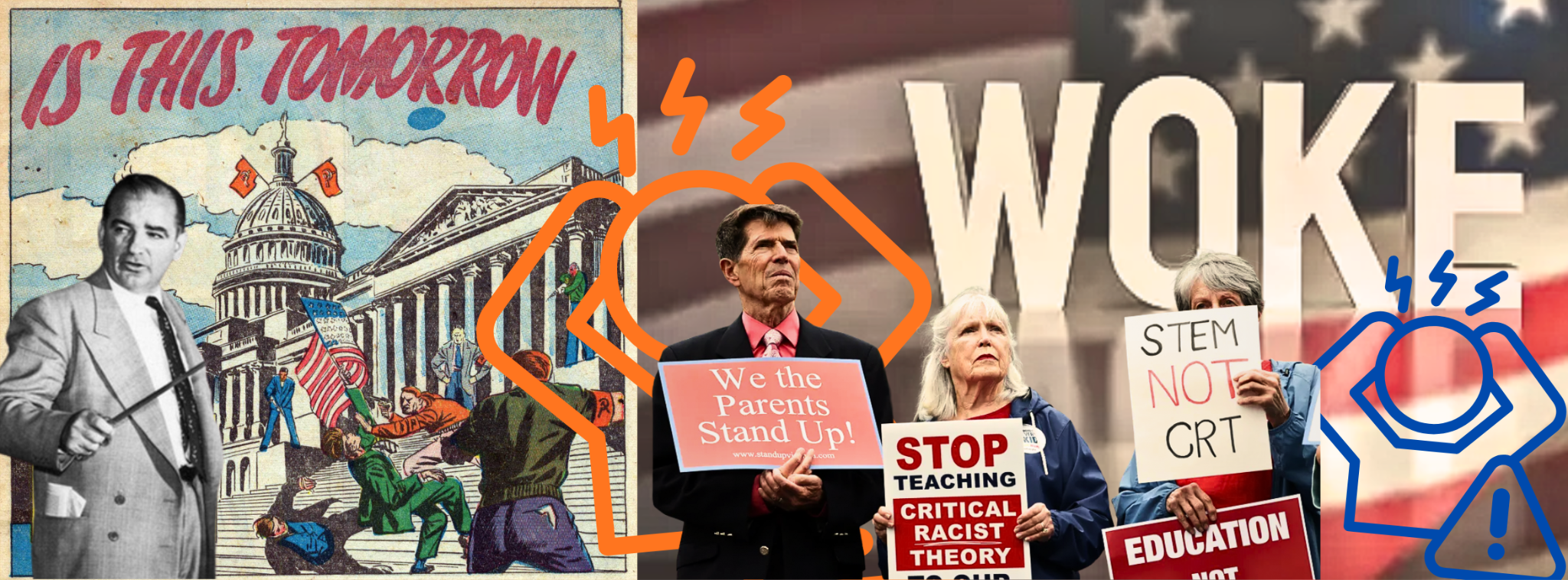
History Rhymes is an ongoing series tracing the echoes between past struggles and present crises. Each installment revisits a moment of resistance, from labor uprisings to political repression, to reveal the patterns that persist, the forces that evolve, and the lessons we can use now. History doesn’t repeat, but power does. And so does the courage to challenge it.
I. Introductory Section Setting the Stage
One of the most revealing things about any political era is which words get transformed into weapons. The process is always the same: take a term that describes something ordinary or even admirable, drain it of its original meaning, and reload it as a threat. In the 1950s, the word was “communist.” In the 2020s, the word is “woke.” Both function the same way: a label broad enough to encompass any form of critical thinking, vague enough to be applied to anyone, and threatening enough to make institutions police themselves before power has to lift a finger. This is the mechanism, and it has not changed in seventy years.
Joseph McCarthy did not need to investigate every teacher, professor, screenwriter, journalist, union organizer or government employee in America. He just needed enough of them to hear about the investigations that many of the rest stopped saying anything actually worth investigating. The conservative activist Christopher Rufo understood this perfectly. In 2021, he stated his strategy openly: “We have successfully frozen their brand, ‘critical race theory,’ into the public conversation... We will recodify it to annex the entire range of cultural constructions that are unpopular with Americans.” McCarthy built the template. Rufo followed the blueprint. The vocabulary changed. The architecture didn’t.
The real damage is never the hearing, the ban, or the firing (although they certainly can have severe life-long impact). The real damage is the professor who avoids the topic before anyone investigates it. The journalist who softens the story before anyone complains. The government employee who scrubs the language from the report before anyone reviews it. The teacher who stops assigning the book before anyone bans it. The chilling effect is the system’s most efficient product, because it turns its targets into its own enforcers.
II. The Loyalty Oath
The machinery of McCarthyism was pretty straightforward. Loyalty oaths for teachers and government employees, basically sign or lose your job. The Hollywood blacklist, where careers got destroyed not by evidence of wrongdoing but by association, accusation, and refusal to name names. The HUAC hearings: spectacles of public humiliation designed less to uncover actual threats than to demonstrate what happened to people who thought the wrong things out loud. As historian Clay Risen documented in book Red Scare, the anti-communist hysteria was not a spontaneous eruption of patriotic vigilance. It was an outgrowth of the conflict between social conservatives and New Deal progressives, a political weapon aimed at the movements that threatened the existing economic and racial order.
But the real damage was never in the hearing room. It was in the hallway, the faculty lounge, the writers’ room, the editorial meeting where someone decided not to say what they were thinking because the cost of being wrong was too high.
And the targets were not random. C.L.R. James, the Trinidadian historian and radical intellectual whose The Black Jacobins remains one of the most important works of revolutionary history ever written, was deported from the United States in 1953 under the McCarran-Walter Act. Claudia Jones, a Trinidad-born journalist and organizer, was imprisoned and then deported. Caribbean radicals were among the first silenced because their analysis did something the Red Scare could not tolerate: it connected American racism to global imperialism. The people who could see the structure most clearly were the first ones expelled from the country that most needed them to stay.
III. The New Vocabulary
“Communist” became “woke.” “Un-American activities” became “CRT” and “DEI.” Loyalty oaths became “govern yourselves accordingly.”
The legislative machinery arrived fast. Between 2021 and 2022, nearly 200 anti-CRT bills were introduced across 41 state legislatures. Sixteen were signed into law in 15 states, targeting how teachers are permitted to discuss race, racism, and discrimination in their own classrooms. As researchers Filimon and Ivanescu documented in Policy Studies, these laws operate through a three-part structure that would have been instantly recognizable to anyone who lived through the 1950s: define a set of prohibited concepts (kept deliberately vague), create mechanisms to detect violations, and establish penalties for transgressors. Define, prohibite, punish. The loyalty oath, updated for the twenty-first century.
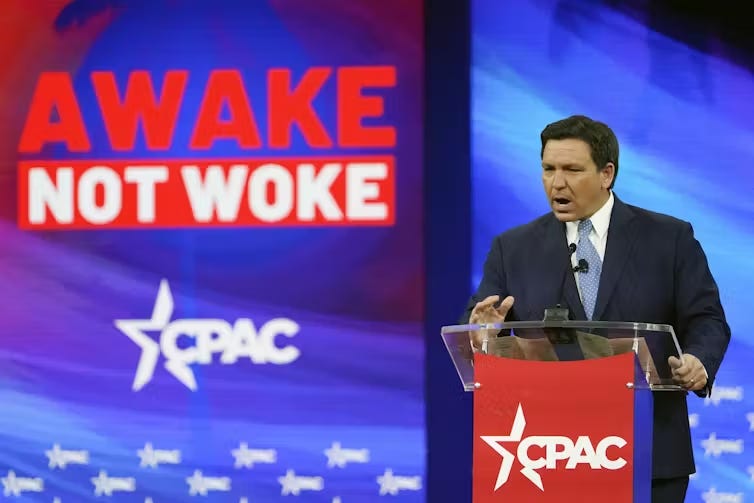
Florida Governor Ron DeSantis speaks at the Conservative Political Action Conference in February 2023 in Orlando, Florida (AP Photo/John Raoux)
Governor DeSantis seized New College of Florida and transformed it into a conservative institution. A state legislator in Kansas signed a law prohibiting what is calls “DEI-CRT.” Florida’s HB7 instructed the State Board of Education to develop a curriculum called “Stories of Inspiration,” replacing structural analysis with patriotism by legislative mandate. And last September, Florida’s Commissioner of Education issued a memorandum reminding every educator in the state that our First Amendment rights “do not extend without limit” into our professional duties. The memo was forwarded from superintendents to principals to every teacher’s inbox, including mine. It closed with three words: “Govern yourselves accordingly.” I wrote about what that felt like last week. The mechanism works. I know because I felt it working on me, and I am someone who studies and teaches about these systems for a living.
IV. What the Panic Protects
Here is the structural question History Rhymes exists to ask: what is the panic for?
McCarthyism did not emerge because communists were about to overthrow America. It emerged because labor organizing, civil rights activism, and anti-colonial solidarity were threatening the economic and racial order. The “communist” label was applied to anyone who challenged that order. The “woke” label functions identically: it is applied to anyone who names systemic racism, questions economic hierarchy, or teaches history that makes the current arrangement look designed rather than natural. As such, the panic does not protect the country from a threat. It protects the architecture from being seen.
Researchers on both sides of the Atlantic have documented this. Thomas, Bancel, and Blanchard traced how academics in France who scrutinize colonial history and structural racism are labeled “Islamo-Leftists,” the same mechanism operating in a different national vocabulary. Dini and Pesce, writing in RSA Journal, named the function with precision: the term “woke” operates “to buttress high status groups against threats to their position, stymie the consciousness-raising effects of online discourse, and reduce universities to producers of uncritical neoliberal subjects.” From this perspective, the defense of tradition, free enterprise, and national pride enlisted against critical scholarship are “ancillary to what is essentially a circling of the wagons of those who benefit from the structure of American society as it stands.”
The wagons are indeed circling. The question is what they are protecting.
V. Where It All Points
McCarthy was finally censured by the Senate in 1954, and the panic eventually receded, not because America chose free thought but because the political utility of the hysteria expired and the man behind it became more of a liability than an asset. But the careers that had been destroyed stayed destroyed. The movements that had been disrupted did not simply reassemble. The intellectual traditions that had been broken, the ones carried by people like C.L.R. James and Claudia Jones before they were expelled from the country, took a generation to rebuild. The panic faded, but the damage settled into the soil of American institutions like a slow poison, shaping what was sayable and what was fundable and what was thinkable for decades after the last hearing ended.
The current panic has not faded. Books are still being pulled from shelves. Curricula are still being rewritten to replace structural analysis with inspiration. “Govern yourselves accordingly” is still sitting in teachers’ inboxes across the state of Florida. And earlier this month, the institution that taught me to see the structure behind these very patterns announced that it is closing its doors forever, not because of a book ban but because of the slower, quieter machinery of financial starvation in a country that has decided critical thinking is a luxury it can no longer afford.
The Red Scare did not end because the country learned its lesson, and nothing about this moment suggests we are any closer to learning it now. The vocabulary changes, the mechanism never does, and history, as it always has, rhymes. The only question worth asking is whether we will recognize the pattern while there are still institutions and teachers and traditions of thought left to protect, or whether we will do what America has done before and wait until the damage is done to ask how we let it happen again.
References
Avlon, J. (2023, April 26). Opinion: The welcome pushback against campus wokeness — coming from colleges themselves. CNN. https://www.cnn.com/2023/04/26/opinions/harvard-stanford-cornell-woke-right-avlon/
Dini, R., & Pesce, E. (2024). “That’s What All This Wokeism Is About”: Books Erased, Printed Word Censorship, and US National Identity. RSA Journal: Rivista Di Studi Nord-Americana, 35, 9–46. https://doi.org/10.13135/1592-4467/10777
Filimon, L.-M., & Ivănescu, M. (2024). Bans, sanctions, and dog-whistles: a review of anti-critical race theory initiatives adopted in the United States since 2020. Policy Studies, 45(2), 183–204. https://doi.org/10.1080/01442872.2023.2214088
Marie, A., & Petersen, M. B. (2023). Speech Repression and Outrage from Orthodox Activists as Attempts at Facilitating Mobilization and Gaining Status among Allies. Psychological Inquiry, 34(3), 192–197. https://doi.org/10.1080/1047840X.2023.2274401
Risen, C. (2026). Red Scare: Blacklists, McCarthyism, and the Making of Modern America. Simon & Schuster.
Thomas, D., Bancel, N., & Blanchard, P. (2023). Decolonial Theory or the Invention of a Common Enemy. Contemporary French & Francophone Studies, 27(2), 200–211. https://doi.org/10.1080/17409292.2023.2185413
____________________________________________________________________________
Means and Meaning publishes every Tuesday. If you found value in this analysis, I’d be very grateful if you’d consider buying me a coffee — your support helps me dedicate time to this work while keeping all content free and accessible.
You can also support this project by subscribing (it’s free!), sharing with others who might appreciate it, or joining the conversation in the comments. Sometimes the best antidote to anxiety is knowing you’re not alone in seeing what’s happening.
Next week, we’ll examine another piece of the machinery — and another opportunity to resist it.
Until then, keep questioning, keep connecting, and keep believing that another world is possible.
~ Chris