


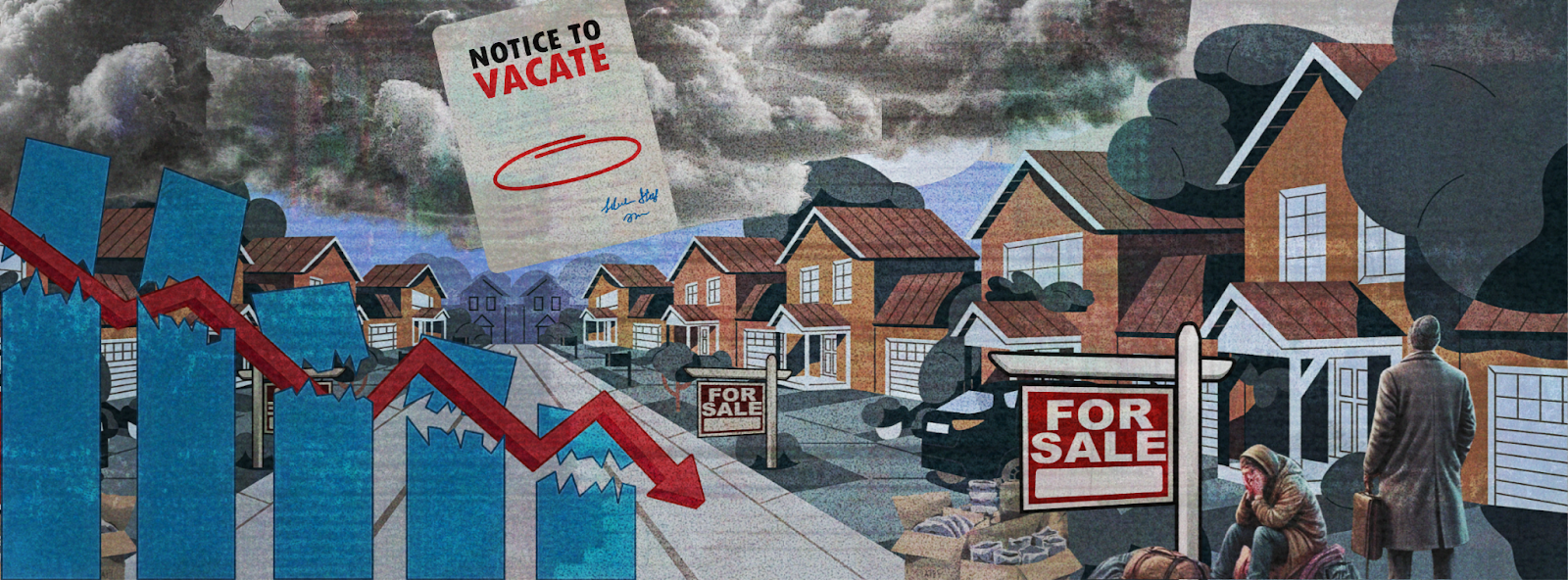
This piece is part of “The Big Squeeze,” a series examining how capital extracts value from every aspect of daily life — from subscription traps to housing crises, revealing how systematic wealth transfer is disguised as innovation and convenience.
I. The Dream Foreclosed
The rule of thumb, they say, is that you shouldn’t spend more than a quarter of your income on housing. Maybe a third, if you’re stretching. But who actually lives by that rule? Certainly not me. Except for a few years teaching abroad, when housing was included, I’ve never even come close. And I’m far from alone.
According to Harvard’s Joint Center for Housing Studies, half of all renters in the United States now spend more than 30 percent of their income on rent and utilities. Half. As Timothy Noah put it in The New Republic, “Half of all renters couldn’t afford what they paid in rent.” That’s not a market “correction.” That’s a society fundamentally out of alignment with human need.
The Harvard data shows home prices rising 60 percent in just six years—the sharpest jump on record. Mortgage rates are back to early-1990s highs. Rents keep climbing even as wages stall. Simply existing under a roof has become a luxury—financed through debt, side hustles and sheer anxiety.
Politicians call this a “housing affordability crisis.” But the word crisis suggests something temporary, a glitch that can be fixed with the right policy tweak. This isn’t temporary. It’s structural. It’s the American Dream itself - privatized, securitized and sold back to us at compound interest.
When even Brookings and the Harvard Business Review start sounding like socialists, admitting the market has failed to deliver affordable shelter, you know the problem isn’t bad policy design - it’s the system itself.
Homeownership was once branded as freedom, a way to tether working people to stability and belonging. But somewhere along the way, the dream got repossessed. The banks took the house. The hedge funds took the neighborhood. And we’re left renting the illusion that any of it still belongs to us.
II. The Rent Is Too Damn Structural
We keep hearing that the problem is “supply and demand.” Build more, deregulate zoning, unleash the market - and, somehow, housing will trickle down. But we’ve been told that story for forty years, and rents have only gone one way: up.
As Rachel Cohen noted in The Nation, even when cities like San Francisco and New York build more housing, prices barely budge. The problem isn’t a lack of cranes; it’s a system built to extract. Developers build what’s profitable, not what’s needed. Investors buy homes not to live in them, but to turn shelter into a speculative asset. Empty condos sit in the sky while families sleep in cars below.
In The New Republic, Timothy Noah asked why “Build, baby, build” hasn’t worked, pointing to Washington, D.C. - where the housing supply grew by nearly a third since 2000, but median rents more than doubled. That’s not scarcity. That’s enclosure. A rigged market pretending to be natural law.
The same story repeats from coast to coast. Harvard’s 2025 housing report shows that rents rise even as vacancy rates rise, because landlords and hedge funds hold units hostage to preserve “market value.” Meanwhile, builders and bankers - yes, even the National Association of Home Builders - now plead for relief from the crisis they helped create. When even they start calling it unsustainable, you know the rot runs deep.
This isn’t a housing market malfunction. It’s a business model. As long as homes are treated as commodities rather than human rights, every “solution” will only inflate the next bubble. The rent isn’t just too damn high - it’s too damn structural. It’s built into the very foundations of capitalism, where even the ground we stand on must turn a profit.
III. The Numbers We Don’t Count
For all the talk of economic indicators and market trends, the U.S. still can’t answer a basic question: how many people lose their homes each year? Evictions, foreclosures, disaster displacements, forced moves - all of it remains largely invisible. We can tell you the national unemployment rate every month, down to the decimal point. But ask how many Americans were forced from their homes last year, and no one really knows. As Yuliya Panfil and Sabiha Zainulbhai argued in Politico, “you can’t fix something you can’t measure.”
That’s not an accident. Measurement is political. It decides what - and who - gets seen. We track GDP growth obsessively but ignore the social wreckage that often fuels it. We can map interest rate shifts in real time, but not how many families are doubling up, sleeping in cars or couch surfing to survive. By failing to count home loss, policymakers can pretend the housing crisis isn’t as catastrophic as it is.
Most Americans already feel it. The rent hikes, the shrinking paychecks, the creeping anxiety when the lease renewal arrives - these are the lived metrics of the housing economy. But few people realize how widespread it’s become. Half of all renters now spend more than 30 percent of their income on rent and utilities. Entire generations have been priced out of homeownership before they’ve even had a chance.
Ultimately, these data gaps aren’t just bureaucratic oversights; they’re choices. We know exactly how to count what Wall Street cares about, yet we’ve chosen not to track what happens when ordinary people lose their homes. That silence is convenient for those in power. Because if the crisis can’t be quantified, it can always be minimized - and what isn’t measured can be ignored.
IV. The System That Built the Crisis
Behind the headlines about “not enough houses” lies a deeper truth: the housing system we have isn’t broken - it’s working exactly as designed. For decades, housing policy has quietly shifted from serving people to serving investors.
As economist David Hartery noted, housing has been turned into fictitious capital - property held not for use, but for profit. After the 2008 crash, giant investment funds swept in, buying up foreclosed homes and turning entire neighborhoods into rent streams. These “vulture funds,” as they’re called, can sit on empty units or wait out higher prices, because their real income comes from speculative gains, not rent checks. The result: homes exist, but they’re locked out of reach.
The same dynamic plays out in zoning and financing. The Brookings paper by Glaeser and Gyourko shows how land-use rules, local resistance and banking incentives all conspire to push up prices - protecting property values for the few who already own, while shutting everyone else out. When policy treats a house like an appreciating asset rather than a social good, scarcity becomes profitable.
Even back in 1990, planner Tom Angotti warned that as public housing was gutted and private finance took over, the U.S. was building inequality right into its cities. Today’s housing crisis is the long tail of those choices - a system that rewards speculation, punishes renters and calls the outcome “natural.”
The truth is simple: the crisis isn’t just about what we failed to build. It’s about what we did build, which is a machine for turning human need into financial yield.
V. A Home Is Not a Commodity
When even Harvard Business Review admits the market can’t fix the housing crisis, you know something’s broken beyond repair. For years, we’ve been told the same story: build more, deregulate more, trust the market. But what we’ve actually built is a landscape of luxury towers, ghost condos and record rent burdens.
As S. Schwartz pointed out in CommonLands, there are roughly three vacant homes for every unhoused person in America. That’s not scarcity - that’s policy. Half of all low-income renters now spend more than half their income just to keep a roof overhead; a quarter spend over 70 percent. These numbers don’t describe a housing shortage. They describe a market designed to profit from desperation - a system that calls itself efficient while it bleeds people dry.
Even mainstream economists are starting to catch on. Politico recently argued that we can’t solve what we refuse to measure, proposing a “housing loss rate” like the unemployment rate - a way to finally count how many people lose their homes each year. Measurement matters. But as anyone who’s ever been priced out, evicted or outbid by a hedge fund knows, counting the damage isn’t the same as stopping it.
Fixing this means treating housing as infrastructure, not an investment vehicle. It means building and maintaining public housing, enforcing rent caps, taxing vacancies and giving tenants rights that actually mean something. It means admitting that the dream of “homeownership for all” was never about shelter - it was about speculation.
Because the truth is simple, even if it’s uncomfortable: a home is not a commodity. It’s the ground beneath everything else we dare to call a life.
VI. Where It All Points
If housing is where our lives begin and end, then the crisis surrounding it is more than economic - it’s existential. Every rent check, every mortgage payment and every eviction notice tells a story about what kind of country we’ve become. A nation that treats shelter as a luxury good can’t pretend to be free or fair for long.
I don’t have a tidy blueprint for fixing this - no five-step plan or policy miracle. But I do know that the problem runs deeper than bad zoning laws or high interest rates. It’s about who gets to belong, and who gets to build a life with any sense of stability. It’s about a system that prioritizes profit over people, speculation over security and scarcity over dignity.
The solutions, when they come, won’t start with developers or think tanks. They’ll start with tenants’ unions demanding rent control, with neighbors blocking evictions, with local governments finally choosing homes over hedge funds. They’ll start when enough people realize this isn’t just a housing issue - it’s a test of whether we still believe in the basic promise of a shared society.
Because at the end of the day, housing is not an isolated crisis. It’s the mirror in which every other inequality reflects itself. Solve this, and we start to solve everything else. Ignore it, and the cracks only spread.
References
Angotti, T. (1990). The Housing Question: Progressive Agenda and Socialist Program [Review of Critical Perspectives on Housing; Rethinking Rental Housing; A New Housing Policy for America; A Progressive Housing Program for America, by R. G. Bratt, C. Hartman, A. Meyerson, J. I. Gilderbloom, R. P. Appelbaum, D. C. Schwartz, R. C. Ferlauto, D. N. Hoffman, & Institute for Policy Studies]. Science & Society, 54(1), 86–97. http://www.jstor.org/stable/40403051
Bandyopadhyay, P. (1982). Marxist Urban Analysis and the Economic Theory of Rent. Science & Society, 46(2), 162–196. http://www.jstor.org/stable/40402393
Callaci, B., & Vaheesan, S. (2024, September 12). The Market Alone Can’t Fix the U.S. Housing Crisis. Harvard Business Review. https://hbr.org/2024/09/the-market-alone-cant-fix-the-u-s-housing-crisis
Cohen, R. (2020, June 16). The deep roots of our housing crisis | The Nation. The Nation. https://www.thenation.com/article/society/the-deep-roots-of-our-current-housing-crisis/
Glaeser, E., & Gyourko, J. (2025, March 26). America’s housing affordability crisis and the decline of housing supply. Brookings. https://www.brookings.edu/articles/americas-housing-affordability-crisis-and-the-decline-of-housing-supply/
Goldstein, D.. (2025, March 21). Deconstructing housing. Democracy Journal. https://democracyjournal.org/magazine/76/deconstructing-housing/
Hartery, D. (2022, May 30). Marxism and the housing crisis. Socialist Voice. https://socialistvoice.ie/2021/04/marxism-and-the-housing-crisis/
Harvard report shows the housing affordability crisis worsening. (2025, June 26). NAHB. https://www.nahb.org/blog/2025/06/harvard-report-shows-the-housing-affordability-crisis-worsening
Noah, T. (2024, January 26). America’s rent crisis is getting worse. The New Republic. https://newrepublic.com/article/178466/rent-housing-affordability-crisis-study
Panfil, Y. (2023, May 4). The First Step to Solving the Housing Crisis Might Be Simpler Than You Think | Politico. https://www.politico.com/news/magazine/2023/05/04/solving-the-housing-crisis-00095075
Plested, J. (2023, May 27). Socialist solutions to the housing crisis | Red Flag. https://redflag.org.au/article/socialist-solutions-housing-crisis
Sibert, J. (2020, November 26). SOLVING THE HOUSING CRISIS | Socialist Currents.
https://socialistcurrents.org/?p=3609
Schwartz, S. (2021, November 10). The Housing Crisis in America: a Chronically Ignored Symptom of a Broken System | Medium. https://medium.com/@commonlands_us/the-housing-crisis-in-america-e2094ca3b4ba
Wikipedia contributors. (2025, October 20). Housing crisis in the United States. Wikipedia. https://en.wikipedia.org/wiki/Housing_crisis_in_the_United_States
____________________________________________________________________________
Means and Meaning publishes every Tuesday. If you found value in this analysis, I’d be very grateful if you’d consider buying me a coffee — your support helps me dedicate time to this work while keeping all content free and accessible.
You can also support this project by subscribing (it’s free!), sharing on your social media with others who might appreciate it, or joining the conversation in the comments. Sometimes the best antidote to anxiety is knowing you’re not alone in seeing what’s happening.
Next week, we’ll examine another piece of the machinery — and another opportunity to resist it.
Until then, keep questioning, keep connecting, and keep believing that another world is possible.
~ Chris