


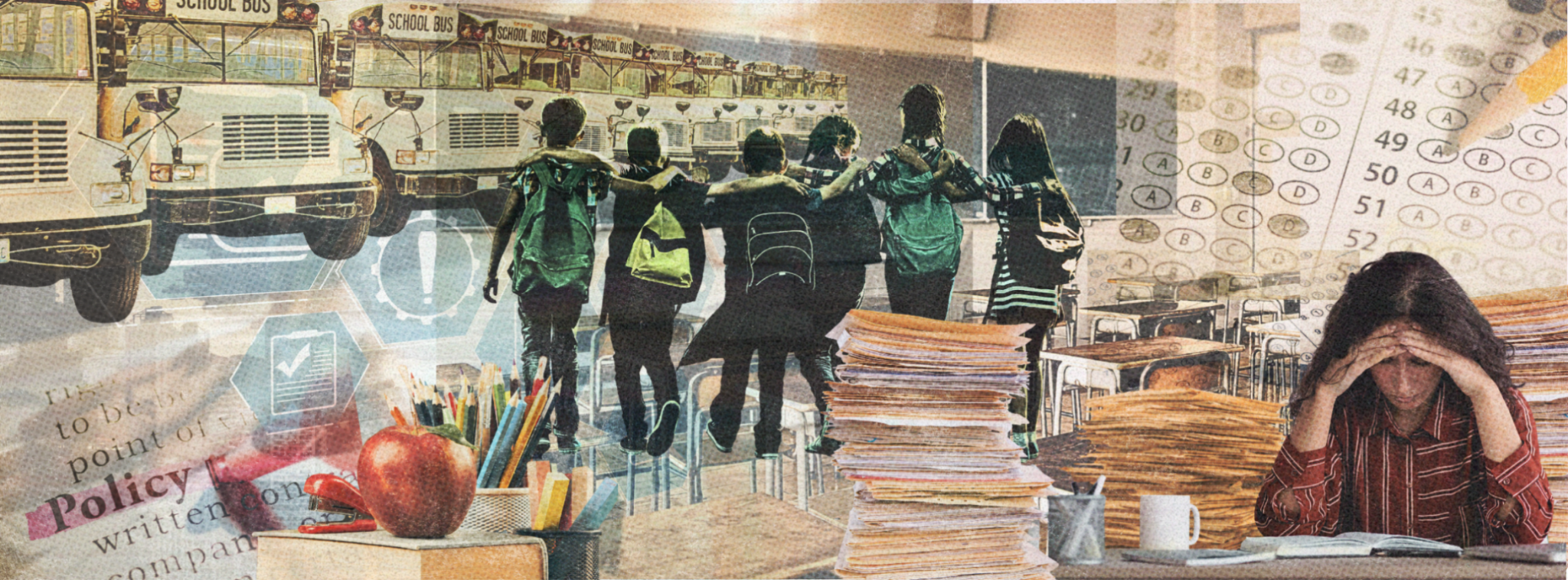
Public education is collapsing from every direction - politically gutted from above, exhausted from below. Yet amid the wreckage, teachers keep showing up, holding space for a future that still deserves to exist. From the series Precarity Diaries, which traces how instability shapes our work, relationships and hope - and how we might find connection within the collapse.
I. The Classroom at Ground Zero
Every morning, millions of teachers enter rooms already on fire. The smoke isn’t visible, but it’s there - in the missing aides, the flickering lights, the silence where a counselor used to sit. They arrive early, stay late, and still feel they’re falling behind. What once felt like a calling now feels like triage. They teach through grief, paperwork, hunger, fear. The children see it too. Everyone in the building can sense that something fundamental is breaking.
Numbers tell the same story in colder language. Forty-four percent of K-12 teachers say they feel burned out “often or always.” Half a million have left since the pandemic. Eighty-five percent call the work unsustainable. These are not anomalies; they are the metrics of collapse. The profession that holds up the rest of society is running on fumes, asked to absorb every social failure (everything from poverty, trauma, hunger and neglect), while smiling through it for the sake of the kids.
We call it burnout, but that word is too small. What’s happening is structural depletion, basically the slow extraction of human energy to keep a failing system afloat. Each exhausted teacher is both worker and warning, proof that the nation’s safety net has frayed to a single thread. To keep showing up under these conditions is an act of devotion. To name the conditions for what they are is an act of resistance.
II. The Machinery of Burnout
The crisis in the classroom doesn’t begin there. It starts in policy offices, budget hearings, and boardrooms where decisions are made to stretch teachers thinner each year. The Department of Education (already the smallest federal agency) has been gutted, losing half its staff and now bracing for another round of layoffs that will leave core programs hollow. Civil-rights offices shuttered, special-education teams reduced to skeleton crews. Meanwhile, billions in K-12 funds have been frozen or slashed, and states and territories are told to “do more with less.” The government’s withdrawal isn’t neglect; it’s strategy. Dismantle the public sphere, then blame its workers for the wreckage.
At the same time, the administration’s priorities are crystal clear: privatize, punish, and control. Federal funds once meant for high-poverty schools are being rerouted into private vouchers and charter expansions. Districts that teach diversity or gender inclusion are threatened with losing funding. Every dollar withheld from a public classroom becomes profit for someone else. This is what it looks like when education is treated as a marketplace instead of a public good - competition replacing care, and extraction replacing trust.
Teachers live inside the fallout. They’re told their exhaustion is personal even as policy conspires to make it inevitable. Burnout becomes a business model: low pay, high turnover, infinite unpaid labor. What we call a “teacher shortage” is really a surplus of political cruelty. The machinery of burnout keeps grinding because it was built to. And still, teachers show up each morning, trying to create meaning in a system designed for depletion.
III. Designed for Failure
Even before the latest political assaults, America’s schools were already built on fault lines. The inequities run deeper than any single administration. As Matthew Lynch wrote just this week in The Edvocate, “schools in affluent areas often receive significantly more resources than those in low-income neighborhoods,” leading to “inadequate facilities” and “lower salaries for teachers.” The result is a geography of opportunity mapped by zip code. Wealth buys smaller class sizes, better materials and calmer hallways. Everyone else gets austerity dressed up as reform.
David Steiner called it last year: “Education policy leaders have eroded the instructional core and designed our education system for failure.” Curriculum, testing and teacher training exist in silos, state tests measure what isn’t taught and funding mechanisms reward inequality. Billions flow into ed-tech and “21st-century skills,” while teachers beg for paper and pencils. The same logic that governs the broader economy - efficiency without humanity - governs the classroom. Every reform promises innovation while stripping teachers of time, autonomy and joy.
This is capitalism’s pedagogy: extract maximum output from minimal investment, then label the exhaustion “accountability.” We keep pretending the system is broken when it’s simply working as designed to reproduce inequality, obedience and despair. As test scores fall and teachers leave, new markets open for consultants and algorithms to “fix” what policy destroyed. The architecture of failure becomes the next profit stream. And through it all, teachers keep improvising beauty amid the wreckage, proof that the human spirit is harder to standardize than any test.
IV. The Ideology of Blame
When systems collapse, language rushes in to cover the ruins. Teachers are told to be resilient, to practice self-care and to show grit. Districts circulate mindfulness tips instead of pay raises. Consultants preach “growth mindset” to people who haven’t had a planning period in weeks. As one National Education Association survey put it bluntly, “Eighty-five percent of teachers define their work as unsustainable.” Yet the official message remains: if you can’t handle it, you’re the problem.
The rhetoric is cruel in its optimism. “Self-care” becomes the polite term for unpaid triage. “Choice” becomes the banner under which public funds are siphoned to private schools. “Accountability” means measurement without support. The very words meant to empower now discipline instead. Matthew Lynch listed “standardized testing” and “bureaucracy” among the top reasons education is failing, and yet both survive because they keep the blame flowing downward. Teachers absorb the system’s shame so policymakers don’t have to.
And still, the heart of the profession refuses to die. In the late hours of grading and worry, teachers keep imagining what education could be if language told the truth - if resilience meant solidarity, if accountability meant justice and if choice meant opportunity for all. Their endurance is not proof the system works; it’s proof that compassion can persist even when the institution built around it has stopped making sense.
V. Teaching Through the Ruins
Every generation of teachers inherits a system it didn’t design and a hope it refuses to surrender. Even now, amid all of the layoffs, the censorship and burnout, the old faith in learning survives. In staff rooms and union halls, in late-night text chains and weekend rallies, educators are rediscovering one another. What begins as venting becomes organizing; what begins as exhaustion becomes resolve. The ruins, as it turns out, are also a meeting place.
Across the country, teachers are reminding us what collective care looks like. In Chicago and Los Angeles, they’ve struck not only for pay but for counselors and nurses. In West Virginia, entire communities fed children during the walkouts. Parents have joined to defend inclusive curricula and fight voucher schemes that drain their schools. Each act of refusal is also an act of teaching - a lesson in what democracy requires when the institutions built to sustain it have gone silent. As one organizer told Education Week, “We’re not just fighting for our jobs. We’re fighting for the idea of public.”
The collapse is real, but so is the courage. Every classroom that still hums with curiosity is a small rebellion against despair. To teach under these conditions is to practice faith without permission - to believe that knowledge, empathy and solidarity still matter in a world that keeps insisting they don’t. The walls may be crumbling, but inside them something luminous persists: people who keep showing up for one another, even when the lesson plan has been lost.
References
Lynch, M. (2025, November 10). 18 Reasons the U.S. Education System is Failing | The Edvocate. https://www.theedadvocate.org/18-reasons-the-u-s-education-system-is-failing/
Peck, D (2025, January 3). Teacher Burnout Statistics: Why teachers quit in 2025 | Devlin Peck. https://www.devlinpeck.com/content/teacher-burnout-statistics
Public education under threat: 4 Trump administration actions to watch in the 2025-26 school year. (2025, August 7). Center for American Progress. https://www.americanprogress.org/article/public-education-under-threat-4-trump-administration-actions-to-watch-in-the-2025-26-school-year/
Schultz, M. L. (2025, October 16). Ed. Dept. Offices Will Be Virtually Wiped Out in Latest Layoffs. Education Week. https://www.edweek.org/policy-politics/ed-dept-offices-will-be-virtually-wiped-out-in-latest-layoffs/2025/10?utm_source=li&utm_medium=soc&utm_campaign=edit&utm_content=nl-lnks
Steiner, D. (2024, May 30). America’s education system is a mess, and it’s students who are paying the price. Thomas B. Fordham Institute. https://fordhaminstitute.org/national/commentary/americas-education-system-mess-and-its-students-who-are-paying-price
____________________________________________________________________________
Means and Meaning publishes every Tuesday. If you found value in this analysis, I’d be very grateful if you’d consider buying me a coffee — your support helps me dedicate time to this work while keeping all content free and accessible.
You can also support this project by subscribing (it’s free!), sharing with others who might appreciate it, or joining the conversation in the comments. Sometimes the best antidote to anxiety is knowing you’re not alone in seeing what’s happening.
Next week, we’ll examine another piece of the machinery — and another opportunity to resist it.
Until then, keep questioning, keep connecting, and keep believing that another world is possible.
~ Chris
I enjoyed your thoughtful and engaging essay. It shouldn’t be either/or. Our children deserve both strong public schools and real school choice.
I grew up in public schools and state universities, and while I share many Democratic Socialist views, I believe education funding should be equal for every child—public, charter, private, or homeschool.
As a parent and special education professional, I’ve seen how misplaced priorities stretch teachers thin. Millions are spent on flashy renovations and social media marketing, while PTAs fundraise for basic library books. Teachers juggle customer service training, endless “data digs,” and constant assessments, leaving little time for core subjects. Pay remains low, costs rise, and students spend excessive time on iPads instead of recess or clubs.
Parents are rarely informed of these policies. I left public schools after witnessing abuses and moved my child to private school, where teachers are free from standardized testing, offer arts and languages, and ensure daily outdoor time.
“Choice” should not siphon funds away from public schools. Instead, it should drive reform—adopting what works in charter, private, and homeschool models, such as hybrid programs for families of children with Autism.
Families like mine are not elite; we simply prioritize our children’s needs. The path forward isn’t choosing sides—it’s choosing children. Fund both, and let every school thrive.