


History Rhymes is an ongoing series tracing the echoes between past struggles and present crises. Each installment revisits a moment of resistance - from labor uprisings to political repression - to reveal the patterns that persist, the forces that evolve, and the lessons we can use now. History doesn’t repeat, but power does. And so does the courage to challenge it.
I. When the Company Arrived First
Picture a dusty rail stop in 1890: a half-finished depot, a water tower and a line of wooden houses rising almost overnight. The mill came first, then the town. Workers arrived from everywhere, drawn by wages and the promise of stability. The company owned the factory, the stores, often the housing, and sometimes even the local newspaper. Life organized itself around a single economic engine. Prosperity felt real…until it wasn’t.
New England’s textile towns, Midwest rail hubs, and northern lumber camps all followed this pattern. Capital moved in fast, built what it needed, extracted value, and left behind communities tethered to forces far beyond their control. When demand shifted or resources ran out, these places didn’t “pivot.” They collapsed.
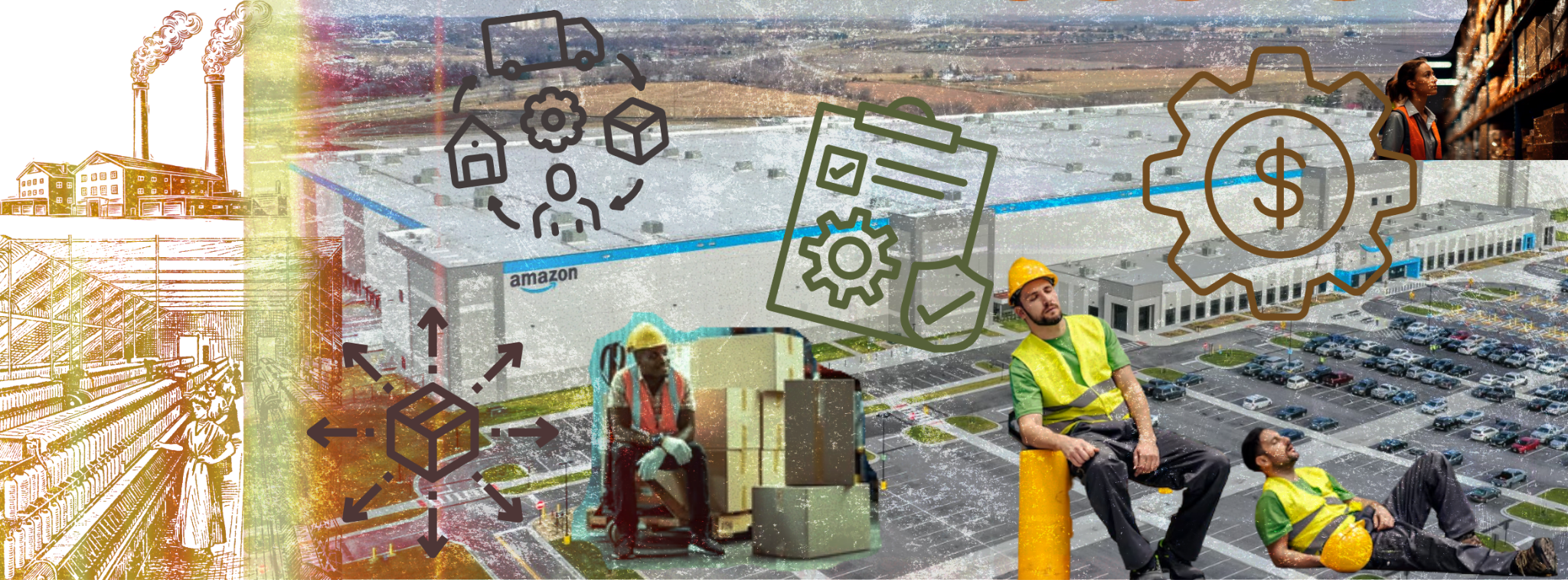
Now shift the scene to a rural highway exit outside a mid-sized American town. A sprawling Amazon fulfillment center hums where cornfields used to be. According to CNBC, Amazon plans to spend $4 billion to triple its rural delivery network, adding more than 200 new facilities, each promising roughly 170 jobs. Amazon calls this “transforming local economies.” This essay, however, argues something more unsettling: the company town never disappeared. It just got faster, larger, and wrapped in better PR.
II. The Sales Pitch of Prosperity
If you listen to Amazon tell it, these new facilities are an economic miracle. A glossy 2025 report on its website, citing Oxford Economics, claims that counties gaining at least 1,000 Amazon jobs saw higher wages, lower unemployment, more new businesses, and even reduced Medicaid enrollment. The company says its fulfillment centers now deliver “over $30 an hour” in total compensation and “sustained positive impacts” for local regions.
It’s a familiar story. In the early 1900s, coal companies published nearly identical pamphlets boasting of rising employment, tidy worker housing, and bustling local commerce. The numbers were often real, and also deeply misleading. A town can show wage growth and still become more dependent, more fragile and ultimately less free.
Even Inc. magazine, writing from a pro-business angle, admits the deeper reality: these facilities are placed just outside big cities to capture labor and consumers while avoiding taxes, regulations and political friction. Now that same model is spreading to data centers, vast, energy and water-hungry campuses that create far fewer permanent jobs than their footprint suggests.
This is not “revitalization.” It is the quiet consolidation of regional economies around a single corporate nervous system, one optimized for speed, not stability.
III. Dependency Is the Real Product
What Amazon really produces in these towns is not prosperity but dependency. This is because a warehouse or data campus doesn’t just bring jobs; it restructures the entire local economy around itself. Roads get widened for trucks, zoning laws get rewritten for logistics and public money gets steered toward keeping the corporate engine humming. Small businesses don’t disappear overnight, but they increasingly survive only by orbiting the same gravitational center: supplying Amazon workers, subcontracting Amazon services or renting space to Amazon’s contractors.
This is exactly how old company towns worked. The mill or mine didn’t need to own every store to control the town - it just had to be the one employer no one could afford to lose.
Amazon’s rural expansion makes this even more stark. CNBC reports that the company plans to add more than 200 new delivery stations in small towns, each employing about 170 workers. That sounds like opportunity. But it also means entire regions are being reorganized around a single corporate pipeline, one that sets the terms of work, pay, and survival from Seattle boardrooms.
So when UPS cuts 20,000 jobs to reduce its reliance on Amazon, we see the flip side of this power. One corporation can reshape the labor market far beyond its own payroll. That is not competition. It is quiet economic governance, and communities are being drafted into it whether they realize it or not.
IV. What the Numbers Don’t Say
Amazon loves to point to rising wages, falling unemployment and new business growth. Their Oxford Economics study reads like a victory lap: more people working, higher paychecks and fewer residents needing Medicaid. But what it never asks is what kind of economy is actually being built.
A 2.6 percent rise in weekly wages sounds impressive until you realize it often reflects long hours in physically punishing jobs with relentless productivity quotas. More people “entering the labor force” can just as easily mean more households forced to send more adults into grueling warehouse work to keep up with rising rents and food prices that follow Amazon’s arrival.
The same study celebrates 6,000 new businesses per county, but it doesn’t distinguish between a local hardware store and a strip of vape shops, storage units, and fast-food chains that spring up to serve a captive warehouse workforce. That isn’t diversification - it’s monoculture.
And the subsidies matter. Towns routinely give away tax breaks, land, and infrastructure to land these facilities, effectively paying Amazon to become their largest employer. When the corporation eventually automates, relocates, or downscales, the community is left with empty concrete shells and public budgets already hollowed out.
The spreadsheets say growth, however, the ground truth looks much more like extraction.
V. History, On Faster Trucks
A century ago, company towns rose wherever capital needed labor - coal seams, rail hubs, rivers with hydropower, etc. They came wrapped in the same promises Amazon and Google make today: jobs, growth, modernization and opportunity. And they delivered all of it, at first. What they also delivered was dependency. When a single corporation controls the payroll, the tax base, the housing market, and the political horizon, democracy quietly thins out. Workers may clock out, but they never really leave the company’s gravitational field.
What’s different now is scale and speed. The coal barons had railroads; today’s logistics giants have algorithms, predictive shipping, and global supply chains that pulse in real time. A fulfillment center can be opened, expanded, automated, and partially abandoned in the span of a few years - faster than a town can build schools, hospitals, or a diversified economy. The old company towns trapped people geographically, but the new ones trap entire regions economically.
Amazon’s warehouses and data centers don’t need to own the houses or the stores to recreate the same relationship. They just need to dominate employment and infrastructure. Once that happens, every local decision, from zoning, to wages, to environmental rules, to school funding, begins to orbit around keeping the corporation happy enough to stay.
This is why the glossy studies and ribbon cuttings miss the point. The danger isn’t that these facilities fail to produce growth. It’s that they succeed too well at organizing entire communities around the priorities of distant shareholders and delivery deadlines.
We have seen this movie before, just in black and white. Now it’s streaming in 4K, running on fiber-optic cable and diesel trucks. The names have changed, the technology is certainly pretty dazzling, but the underlying logic is familiar. And once again, history doesn’t repeat - it rhymes.
References
Palmer, A. (2025, April 30). Amazon to spend $4 billion on small town delivery expansion. CNBC. https://www.cnbc.com/2025/04/30/amazon-to-spend-4-billion-on-small-town-delivery-expansion.html?msockid=2b8fdbfd306665fc0a73c89a311d6461
Staff, A. (2025, October 21). Amazon fulfillment centers reduce unemployment rates, per Oxford Economics latest research. About Amazon. https://www.aboutamazon.com/news/policy-news-views/amazon-fulfillment-centers-local-economy-oxford-research
Tullman, H. (2024, October 1). Amazon, AI, and the New Company Towns. Inc.com. https://www.inc.com/howard-tullman/amazon-ai-and-the-new-company-towns/90982403
____________________________________________________________________________
Means and Meaning publishes every Tuesday. If you found value in this analysis, I’d be very grateful if you’d consider buying me a coffee — your support helps me dedicate time to this work while keeping all content free and accessible.
You can also support this project by subscribing (it’s free!), sharing with others who might appreciate it, or joining the conversation in the comments. Sometimes the best antidote to anxiety is knowing you’re not alone in seeing what’s happening.
Next week, we’ll examine another piece of the machinery — and another opportunity to resist it.
Until then, keep questioning, keep connecting, and keep believing that another world is possible.
~ Chris