


Signal/Noise is an ongoing series that cuts through the spectacle to find the structure underneath. Each installment takes a breaking moment (either political, cultural or economic) and traces the power dynamics most coverage misses. The signal is always there. You just have to know what to listen for.
I. Praise Be to Allah
On Easter Sunday, the President of the United States posted this on Truth Social:
“Tuesday will be Power Plant Day, and Bridge Day, all wrapped up in one, in Iran. There will be nothing like it!!! Open the Fuckin’ Strait, you crazy bastards, or you’ll be living in Hell — JUST WATCH! Praise be to Allah. President DONALD J. TRUMP.”
Easter. The resurrection of Christ. The holiest day on the Christian calendar. And the leader of the world’s most powerful nation used it to mock a religion practiced by two billion people while threatening to bomb a country he’s already been bombing for five weeks.
The profanity will get the headlines. The “Praise be to Allah” will reverberate across the Muslim world in ways no American pundit can fully calculate. But the real signal is underneath both.
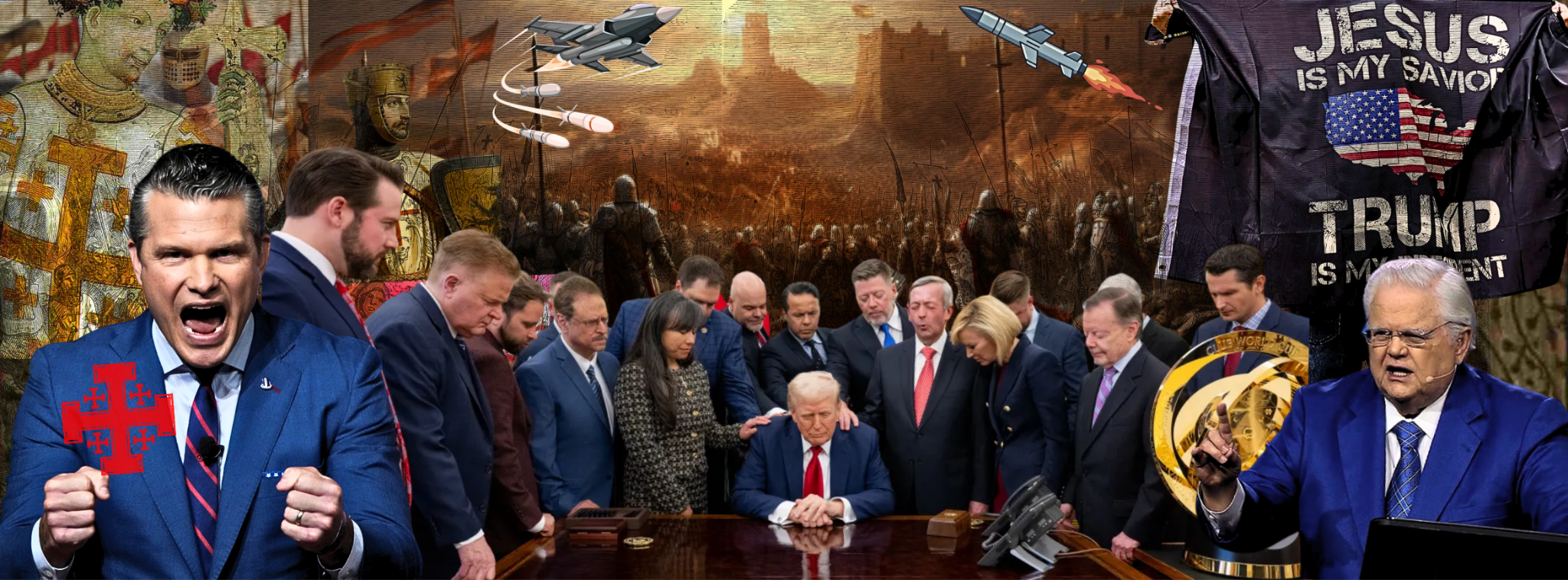
This is a president who doesn’t believe in anything except himself, performing crusader rhetoric for an audience of true believers who do. His “War Secretary” Pete Hegseth has been framing the Iran campaign in explicitly holy war terms for weeks. Hegseth has brought his personal pastor, an avowed Christian nationalist, into the Pentagon for press briefings and prayers during an active bombing campaign. Not a military chaplain offering counsel to troops. A Christian nationalist pastor, praying over targeting operations.
That’s not ceremony. That’s theology with a kill chain.
And here’s what Trump’s Easter post accidentally exposed: the religious architecture underneath the geopolitical surface. Four nuclear-armed or nuclear-adjacent civilizations are currently being driven by religious-nationalist projects that need each other to exist. They aren’t just fighting each other. They’re co-producing the conditions each one’s prophecy requires. Trump, who understands none of it, just made all of it visible in a single unhinged post on the day Christians celebrate the risen Christ.
He’s not driving this. He’s being driven by it. And that’s what makes this moment so dangerous.
II. The Four Holy Wars
This is not one war. It is four, wearing each other’s justifications like armor.
Start with the Pentagon. Pete Hegseth has brought his personal pastor, an avowed Christian nationalist, into the building for press briefings and prayers during an active bombing campaign. This is not military chaplaincy. This is operational theology. Behind Hegseth stands a movement of tens of millions: John Hagee’s Christians United for Israel, which has lobbied Washington for decades on the premise that supporting Israel militarily is a precondition for Christ’s return. Mike Pompeo, Trump’s first-term Secretary of State, publicly suggested America may be living out the Book of Esther. Peer-reviewed research by Nilay Saiya has found that when politicians empower Christian nationalist ideology, physical attacks against religious minorities increase. Sixty-five percent of white evangelicals told Pew that the Bible should override the will of the people when the two conflict. This is not faith. It is a political program with a theology attached.
Move to Jerusalem. Itamar Ben Gvir, Israel’s National Security Minister, has visited the Temple Mount over 200 times to assert Jewish sovereignty. He keeps a portrait of Baruch Goldstein, who massacred 29 Muslims at prayer in 1994, in his living room. The Greater Israel project isn’t metaphor for these people. It’s divine promise with military backing.
Move to Moscow. Patriarch Kirill has framed the war in Ukraine as a metaphysical struggle against the godless West. Putin receives “spiritual counsel” from him during wartime. The Third Rome doctrine holds that Russia is the final protector of true Christianity. Church and state as one organism with tanks.
Move to Tehran. The Revolutionary Guards have used explicitly theological language in operational communications throughout this war. Shia eschatology anticipates a final confrontation with the forces of falsehood, which map onto Israel and its American sponsor with a precision the ayatollahs find very useful. The assassination of Khamenei didn’t weaken the theocratic elements, it actually strengthened them.
Four forces. Four arsenals. One convergence point. And none of them can exit, because everybody’s enemy is everybody else’s evidence that they’re right.
III. Co-Producing the Apocalypse
Here’s the structural insight that should terrify you: these four forces aren’t just fighting each other. They’re feeding each other. Every escalation confirms every prophecy simultaneously.
When the US bombs Iran, the Revolutionary Guards tell their population that the Great Satan has arrived on schedule, exactly as the theology predicted. When Iran retaliates against Israel, Ben Gvir’s coalition points to the existential threat that justifies expanding into biblical territory. When the war destabilizes Europe’s energy supply, Kirill tells Moscow that the godless West is collapsing under the weight of its own decadence, right on cue. And when Hegseth prays in the Pentagon before selecting strike coordinates, tens of millions of American evangelicals see prophecy in motion, the cosmic struggle they’ve been waiting for, funded with their tax dollars and blessed by their pastors.
Nobody can exit this system. Everybody’s enemy is everybody else’s proof that God is on their side. The architecture is self-reinforcing, and the people inside it interpret every catastrophe as confirmation rather than consequence.
Tariq Ali saw this coming. I read his book The Clash of Fundamentalisms at Hampshire in 2003, and it restructured how I understood the relationship between Western imperial power and religious extremism. Ali’s argument was that Huntington’s “clash of civilizations” framework was wrong. The real clash was between fundamentalisms, religious and imperial, that mirror and feed each other. He called American imperialism “the mother of all fundamentalisms.” Twenty-three years later, his framework has expanded: two additional nuclear-armed forces, Zionist messianism and Russian Orthodox civilizationism, have entered the loop. The architecture has only gotten more dangerous.
More recently, a Beijing-based educator named Jiang Xueqin has called this the Law of Eschatological Convergence: when sincere belief is backed by nuclear arsenals, prophecy has a way of manufacturing its own confirmation. I don’t endorse his specific predictions. But the structural observation is sound.
And at the center of all of it sits a 79-year-old president who believes in nothing except himself, mocking Allah on Easter while his War Secretary prays for the apocalypse in the building where the missiles are ordered launched. Trump isn’t driving this. He’s being instrumentalized by people who believe, sincerely, that they are living in the end times. A leader who understood the religious architecture might exercise restraint. A leader who doesn’t understand it can be manipulated by anyone who does.
That’s not a metaphor. That’s Monday.
IV. How the Last Crusade Ended
Pete Hegseth should know how this story ends. He probably doesn’t.
The First Crusade captured Jerusalem in 1099. The Crusader kingdoms that followed lasted nearly two centuries, long enough to build castles and cathedrals and convince themselves that God had given them the land forever. They had military superiority, they had religious conviction, and they had supply lines stretching back to the most powerful kingdoms in Europe. And then Saladin retook Jerusalem in 1187, and within another century the Crusaders were gone entirely, expelled and absorbed back into a region that understood the geography as home, not as prophecy.
The lesson is always the same. Religious conviction and military superiority can take territory. They cannot hold it against populations with deeper roots, longer memories, and nowhere else to go. Every religious-military project in recorded history has believed it was the exception, the one God actually chose, the one that would succeed where all previous versions failed. That conviction isn’t a source of strength. It’s the architecture of failure. It’s what keeps you building castles in territory you will never be able to hold.
Look at the current map. Israel occupying roughly 30% of Lebanon. America bombing a 92-million-person nation into a succession crisis that consolidated the regime rather than collapsing it. Russia framing a grinding war of attrition as metaphysical destiny. Each one projecting power it cannot sustain into territory it does not understand, animated by a certainty that history says will not survive contact with reality.
The Crusaders built kingdoms that lasted 200 years. The British Empire lasted roughly 300. The American century is barely 80 years old and already bleeding out at a billion dollars a day in a war its own president cannot explain.
The castles always fall. The geography always wins.
V. Where It All Points
Four religious-nationalist projects, each one armed with or backed by nuclear weapons, each one accelerating the others, each one producing the evidence the others need to escalate. This is not a conspiracy theory. This is a structural observation grounded in documented statements, policy positions, and military operations by named individuals in positions of power. Hagee lobbies. Ben Gvir visits the Temple Mount. Kirill blesses the tanks. The IRGC frames its war in the language of the Hidden Imam. And a Christian nationalist pastor prays over targeting operations in the Pentagon while the president posts “Praise be to Allah” on Easter morning.
What Means and Meaning tries to do every week is name the architecture, the systems that shape what happens and who benefits. This week the architecture has stained glass windows and nuclear warheads. Saiya’s research demonstrates that when politicians empower this kind of religious nationalism, the violence doesn’t stay overseas. It comes home. It always comes home. Césaire told us this decades ago: the logic of domination abroad eventually returns to the society that launched it. The Crusaders didn’t just lose Jerusalem. They hollowed out the kingdoms that sent them.
The most dangerous “common sense” in the world right now isn’t economic. It’s theological. It’s the assumption, held by people with the capacity to end civilization, that the end is near and that their job is to bring it about. That mental architecture, when it shapes military operations, becomes self-fulfilling. And a president who mocks one religion on the holiest day of another while waging a war he can’t explain isn’t navigating these forces. He’s a passenger who thinks he’s driving.
So here is the question this moment demands of every one of us: if four fundamentalisms are co-producing the apocalypse, and none of them can stop because the others won’t, then who exactly is supposed to break the cycle, and what are we waiting for?
References
Ali, T. (2002). The clash of fundamentalisms : crusades, Jihads and modernity.
Saiya, N. (2024). Christian Nationalism’s Threat to Global Democracy. Review of Faith & International Affairs, 22(1), 102–107. https://doi.org/10.1080/15570274.2023.2204679
Saiya, N., & Manchanda, S. (2025). Christian Nationalism and Violence Against Religious Minorities in the United States: A Quantitative Analysis. Journal for the Scientific Study of Religion (John Wiley & Sons, Inc.), 64(1), 3–18. https://doi.org/10.1111/jssr.12942
Tomasky, M. (2026, April 6). You can smell it now: the Trump presidency is in total free fall. The New Republic. https://newrepublic.com/article/208633/trump-presidency-collapse-truth-social-iran?utm_source=Facebook&utm_medium=social&utm_campaign=SF_TNR&fbclid=IwY2xjawRArcVleHRuA2FlbQIxMABicmlkETF6VXp6bDd4dWFyWXVhTFNGc3J0YwZhcHBfaWQQMjIyMDM5MTc4ODIwMDg5MgABHoXrV8g6qXn2ticNpluYls4wXp3QzR5aJ55YcluoKhG25r1fo8OySIOCawZG_aem_t6FrQk7eKnFAr5BvRnhjfw
Wellmann, J. (2026, March 23). The end of the world according to Jiang. Coherent Reality.

____________________________________________________________________________
Means and Meaning publishes every Tuesday. If you found value in this analysis, I’d be very grateful if you’d consider buying me a coffee — your support helps me dedicate time to this work while keeping all content free and accessible.
You can also support this project by subscribing (it’s free!), sharing with others who might appreciate it, or joining the conversation in the comments. Sometimes the best antidote to anxiety is knowing you’re not alone in seeing what’s happening.
Next week, we’ll examine another piece of the machinery — and another opportunity to resist it.
Until then, keep questioning, keep connecting, and keep believing that another world is possible.
~ Chris