


Precarity Diaries is an ongoing series connecting personal economic experience to structural conditions. Each installment starts where most of us actually live — in the anxiety of bills, the grind of underpaid work, the impossible math of modern survival — and follows those threads back to the systems that produce them. These aren’t just personal stories. They’re the diaries of a system working exactly as designed.
I. The Spreadsheet and the Dream
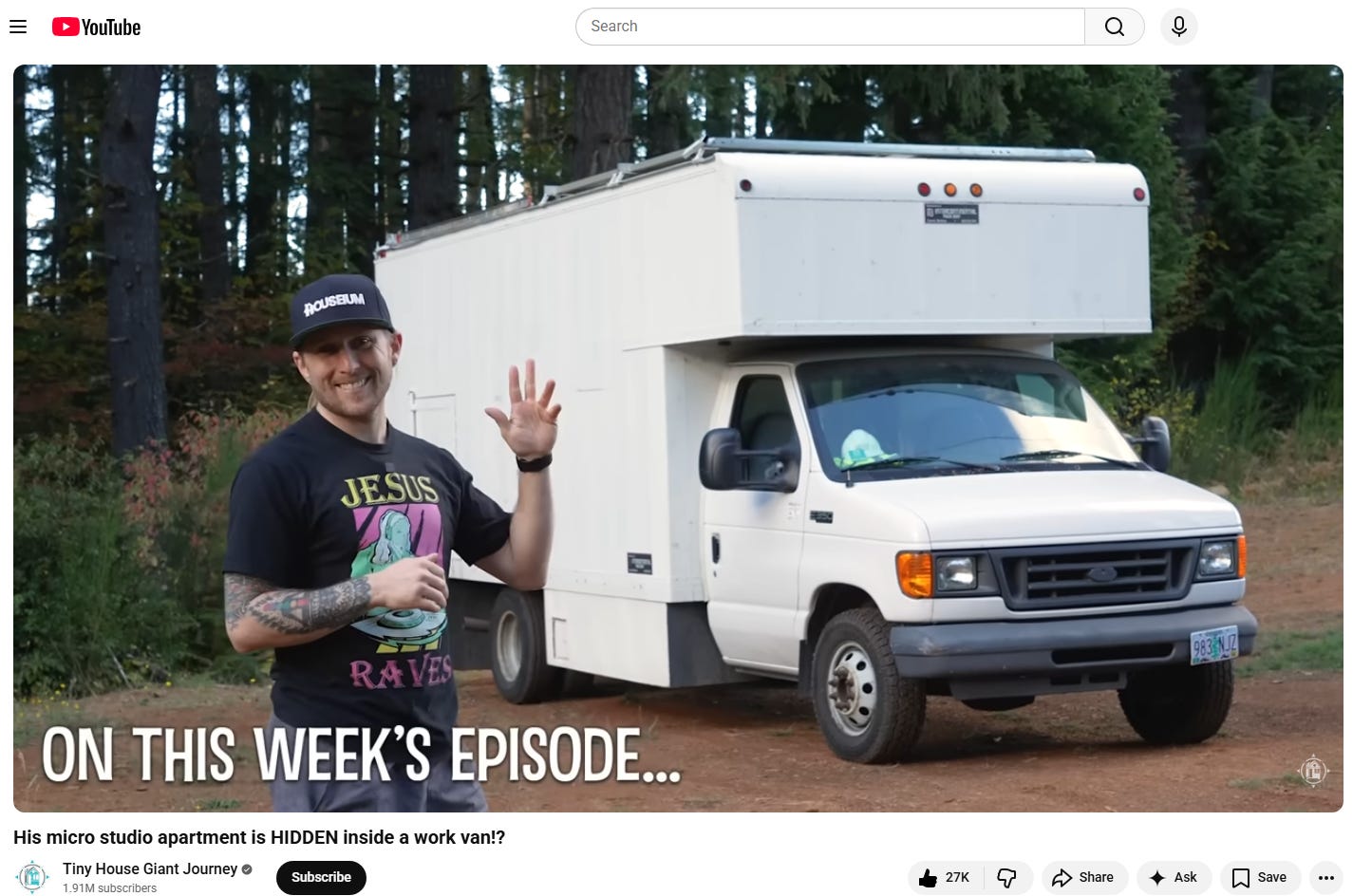
I have watched this video more times than I am comfortable admitting.
The man in it, Jake, lives full-time in a 2004 Ford E350 box truck. From the outside it looks like any contractor’s work van, white and forgettable, the kind of vehicle you glance past in a parking lot without registering it exists. That is by design. He keeps a neon safety vest draped over the passenger seat and a white hardhat visible through the windshield. When he pulls into a city block and people give him the side-eye, they see the vest, see the hat, and move on. Nobody thinks twice. Nobody knows that behind the cab, through a pass-through door he checks before opening to make sure no one is watching, there is a full-size bed, a hot shower, a composting toilet, a kitchen with an air fryer and a cast iron on an induction top, a music production studio, a closet with actual hanging space, two skylights, 500 watts of solar on the roof, and 55 gallons of fresh water. His dog Molly has her own spot on the couch.
I know all of this because I have been taking notes. Very detailed notes.
I am a high school teacher in Florida. I have two rescue dogs of my own and an Amazon vehicle conversion-specific list that includes solar panel kits, inverters, noise-canceling panels, an RV fridge, window night covers, Econoline floor mats, and - I am not making this up - a neon safety vest and a white hardhat. I have spent months researching E350 and E450 box trucks, specifically the 12,14, and 16-foot models, because their chassis can handle the additional weight of a full build without complaint, any mechanic in the country can work on the engine, and parts are everywhere. I have compared prices on used models from 2008 to 2018 with under 140,000 miles, trying to find the window between what is mechanically sound and what is financially possible. I even looked at Jake’s actual listing when he put his truck up for sale. I did the math, and then decided I could find a cheaper one, do the conversion myself, and still come out ahead.
I want to be clear about something. I am not writing about van life from the outside. I am not a journalist who visited a van meetup or a cultural critic who finds the aesthetics interesting. I am a working teacher who has looked at the numbers (including what I earn, what housing and utilities cost, and what is left over) and started planning. The spreadsheet is open, and the research is ongoing. But the deeper question I cannot stop turning over in my head is not whether I could actually live in a box truck. It is what it means that I am even asking this question in the first place.
Because somewhere between the third and fourth hour of watching conversion videos, something eventually shifted. I was no longer watching for entertainment. I was watching the way you study the layout of a place you might actually live. And I realized that millions of Americans were doing the same thing, at the same hour, for the same reasons, and that the country that invented the road trip was producing a generation that might need to live on the road just to survive. The algorithm that served me Jake’s box truck has served over fourteen million Instagram posts under a single hashtag to the rest of the world. The story those posts tell looks nothing like the spreadsheet on my office desk.
This is a piece about that distance.
II. The Hashtag and the Parking Lot
In 2011, a designer named Foster Huntington quit his job at Ralph Lauren, moved into a 1987 Volkswagen van, and started posting photos on Instagram. The hashtag he coined for those posts, #vanlife, was a joke. It was a tongue-in-cheek riff on Tupac Shakur’s “Thug Life” tattoo, a semi-ironic caption for the less glamorous moments of living in a vehicle. Within a few years, it was no longer a joke. It was a lifestyle brand, a book deal and, ultimately, a movement. The man who left a luxury fashion house to reject consumer culture had, without quite meaning to, created one of the most successful consumer aesthetics of the decade.
That origin story is worth sitting with, because the irony at its core has never really resolved. What began as one person documenting the unglamorous reality of vehicle dwelling became, through the machinery of social media, an aspirational fantasy consumed by millions of people who would never sleep in a van. The owner of GoWesty, a Volkswagen repair shop that sponsors vanlife content creators, once compared the movement to surfing: most people who identify with the culture have never actually done it. By the mid-2010s, the #vanlife feed had become a curated gallery of sun-flared interiors and open roads, and the distance between the image and the experience had become the experience itself.
Rachel Monroe documented that distance up close in a 2017 New Yorker profile of two of vanlife’s most visible creators, a couple named King and Smith. Monroe watched their Instagram feed transform in real time, scrolling chronologically as what she described as “a life” became “a life-style brand.” Early posts were blackberries and sunsets. Later posts were optimized for engagement: the algorithm rewarded certain compositions over others, and the couple learned to give the algorithm what it wanted. Behind the images was the labor of producing them. Monroe describes more than seventy emails exchanged with a television network over a single sponsored Instagram post, and over thirty minutes spent staging a photo of King appearing to read a book with a branded laptop decal visible in the frame. Smith directed from the front seat: “Lift your head up a little bit more, look like you’re reading.” Then the post went up. The comments read: “Such a beautiful lifestyle.” “This looks like heaven.” The work of making effortlessness look effortless was invisible to everyone consuming it.
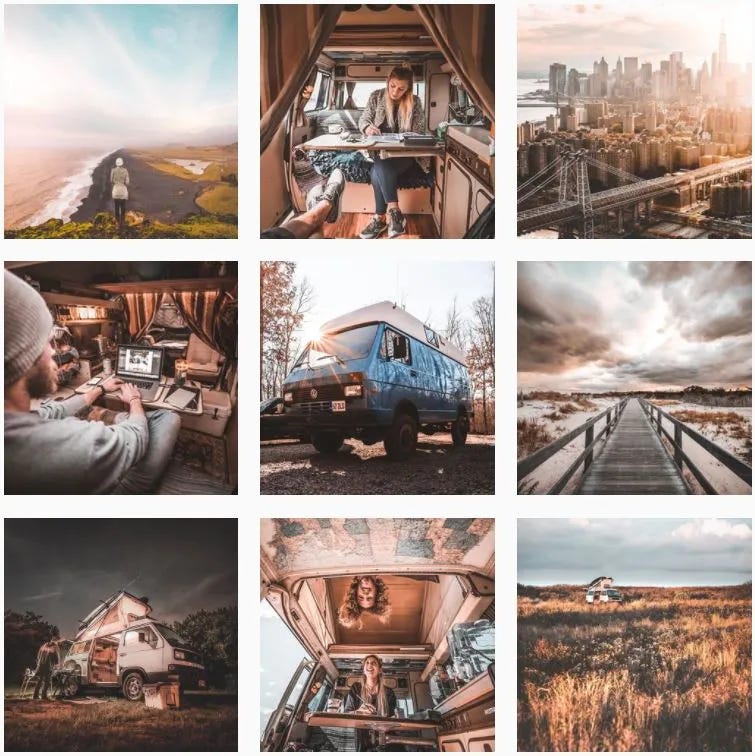
What interests me is not the deception itself, which is how most social media operates, but what it conceals. Underneath the aesthetic, a different vanlife has been growing, one driven less by wanderlust than by the arithmetic of survival. On YouTube, channels like Serene and Simple Life and Lady Bugout, both run by solo women living full-time in their vehicles, draw large audiences not with sun flares and bikinis but with practical demonstrations of how to make a small space actually work. They are performing competence, not aspiration. And as Catherine Faith Gastin has argued, these women are quietly rewriting a road narrative that has been coded as masculine since the frontier, placing themselves onto the American road as active participants in a story that, from Kerouac to Easy Rider, was never written for them.
But the most telling divide is not between men and women on the road. It is between the version of vanlife that gets curated for Instagram and the version that parks in a Walmart lot at 2 a.m. hoping no one knocks on the window. The vanlife community has worked hard to distinguish itself from homelessness, adopting language like “houseless, not homeless” to signal that vehicle dwelling is a choice, not a condition. That distinction matters to the people making it. But it also does ideological work, drawing a line between the deserving mobile and the undeserving poor that the material reality does not always support. When research suggests that upward of half of all unsheltered homeless Americans are sheltering in their vehicles, the border between lifestyle and necessity is thinner than either community is comfortable admitting.
III. The Open Road and the Closed Market
Americans have always treated the road as an answer. When the factory closed, you went west. When the town dried up, you hit the highway. When the system broke, you kept moving. The mythology runs so deep it feels like geography rather than ideology: from the frontier to Kerouac to Easy Rider to Springsteen, the open road has functioned as the national escape valve, the promise that if things fall apart where you are, there is always somewhere else. For most of that history, the road was imagined as a man’s domain, populated by cowboys and outlaws and Beat poets performing what one scholar calls “renegade masculinity,” with women appearing mainly when the men paused in stationary space. The vanlife movement, whatever else it has done, has begun to change that. But the deeper question is not who gets to be on the road. It is why so many people need to be.
The structural answer is not complicated. Since 1960, median home prices in the United States have increased 121 percent. Over the same period, median household income has increased 29 percent. That gap is the engine underneath every van conversion video, every #vanlife Instagram post, every teacher in Florida with a spreadsheet and an Amazon list. Monroe, in her New Yorker profile, lets one of vanlife’s original creators say the quiet part plainly: “I think there’s a sense of hopelessness in my generation, in terms of jobs. And it’s cheap to live in a van.” His generation, she notes, carries significantly more student debt and has lower homeownership rates than any before it. Monroe calls vanlife, along with staycations and minimalism, “an attempt to aestheticize and romanticize the precariousness of contemporary life.” She is right. But she stops short of asking who benefits from the aestheticization, and that is where the analysis needs to go.
Consider for a moment what the vanlife movement actually represents when you strip the filters away. These are, in large part, working people. An ethnographic study of vanlife meetups found participants earning between $25,000 and $40,000 a year, working as customer support agents, technical writers and therapists. A peer-reviewed study of van dwellers in British Columbia documented paramedics, grocery store workers, café employees, substitute teachers and bus drivers, all living in vehicles in one of Canada’s most expensive cities. These are not people who failed at capitalism. They are people capitalism has failed to pay enough for housing. And they have responded not with protest but with ingenuity, redesigning their entire lives around the problem the market created.
One of the sharpest observations in the academic literature comes from Angus Duff and Scott Rankin, who studied working van dwellers and noticed something that decades of workplace research had missed. For fifty years, organizational scholars have focused on making work more flexible to accommodate home life: remote work, flex hours, telecommuting. Van dwellers have inverted that equation entirely. They have made their homes flexible to accommodate work. They move their vehicle to wherever the next job is, park near the worksite the night before, and wake up already there. A teacher on call in their study, who could be assigned to a different school fifty kilometers away each day, drove his van to the vicinity of the next morning’s school every evening. He also hid his living situation from his employer, afraid that if parents found out their child’s teacher lived in a van, he would lose his job. The same system that does not pay him enough to afford housing will punish him for not being able to afford housing. That is not a paradox. It is a design.
Teachers in Finland are not making van conversion content. The vanlife movement is not a universal expression of human wanderlust. It is a specifically American response to a specifically American failure: an economy that has decoupled the cost of shelter from what it pays the people who need it.
IV. What They Build There
What strikes me most about the conversion videos is not the finished product. It is the problem-solving.
I have watched a woman design a kitchen around the exact length of a charging cord. I have watched a man build a table that folds into a bed frame that folds into a storage bench, three functions from a single piece of wood, because in seventy-five square feet there is no room for anything that only does one thing. I have watched people route plumbing through wheel wells, mount solar panels flush against rooflines so they disappear from the street, wire 12-volt systems with the quiet confidence of electricians, and insulate against desert heat and mountain cold using materials they found at Lowes or Home Depot for a fraction of what a contractor would charge. I have watched people build showers in spaces where a shower should not be possible, hang closets behind panels that look like walls, and install composting toilets with the precision of someone who understands that dignity is not optional just because your home has an engine.
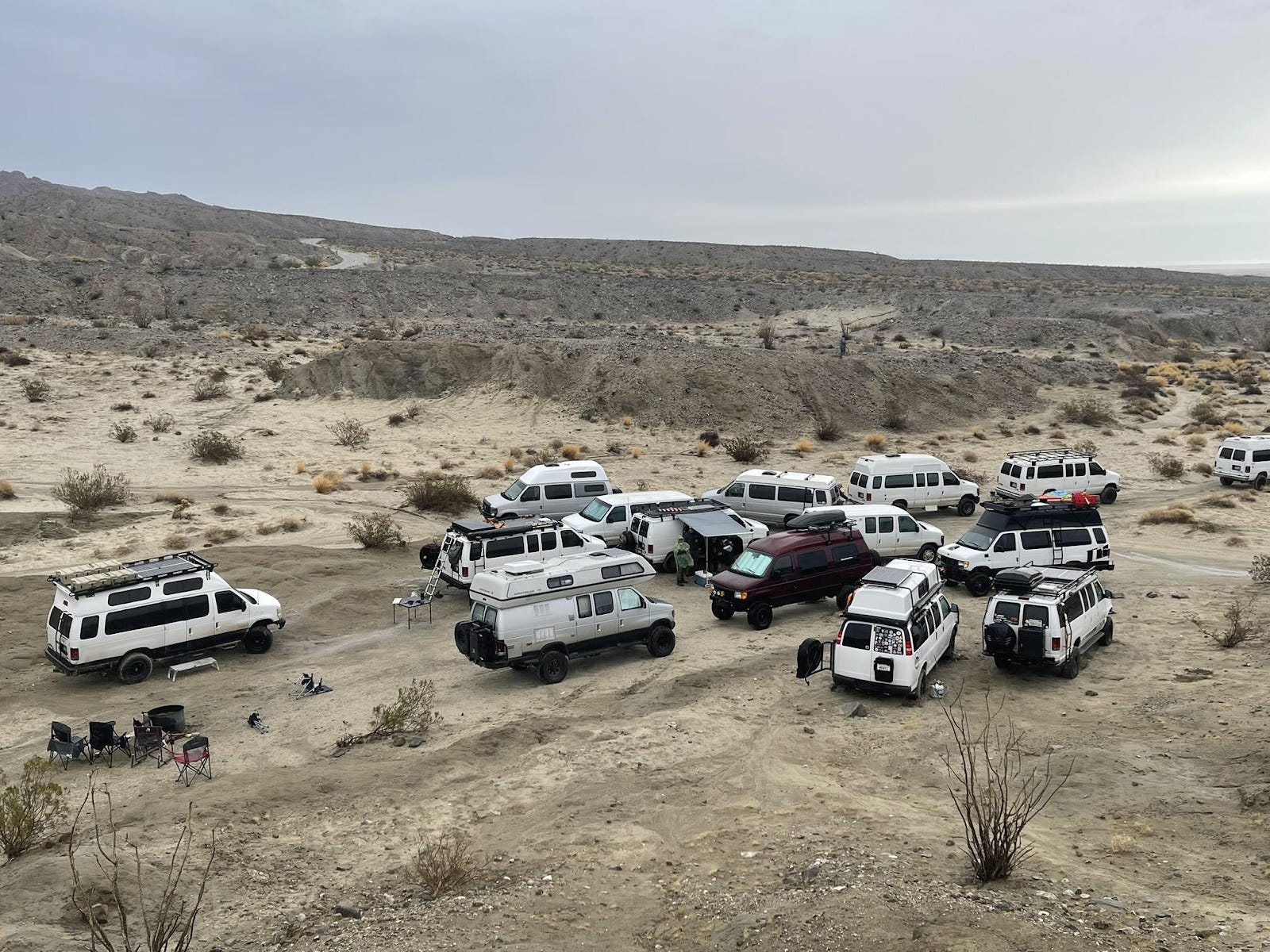
These are not hobbyists. They are people solving, with extraordinary creativity and limited resources, a problem that the richest country in the history of the world has refused to solve for them. The ingenuity is real. The community that has formed around it is real. At large meetups on public land in the American West, researchers have documented entire neighborhoods forming spontaneously: young professionals in one area, families in another, content creators in a third, each cluster developing its own culture and rhythm, people recreating the texture of community on Bureau of Land Management desert because the housing market priced them out of the communities they came from. They share tools, trade knowledge, and look out for each other’s vehicles when someone has to leave for a supply run. It is genuine. It is beautiful. And it deserves to be honored on its own terms before we ask the harder question.
The harder question is what happens to this ingenuity once the market notices it.
The arc is predictable because it has happened to every subculture that ever threatened to mean something. What begins as a creative response to material conditions gets noticed, gets documented, gets aestheticized, and then gets sold back to the people it was responding on behalf of. The DIY ethos that defined early vanlife, people hand-building living spaces in cargo vans because they could not afford housing, has been steadily repackaged into a luxury consumer product. Mercedes-Benz now manufactures vans specifically designed for the vanlife market. Winnebago has entered the conversion space. Companies charge $100,000 to $300,000 for custom builds, not including the cost of the vehicle itself. You can now rent a fully outfitted van for a weekend through companies like Outdoorsy and Escape Campervans, experience the aesthetics of precarity as a vacation, and return to your apartment on Sunday night. The resistance has become the product. The product has become the industry. And the people who actually need to live in their vehicles are still out there, pricing used E350s on Craigslist and watching YouTube tutorials on how to wire a solar panel, while the algorithm serves them ads for $200,000 Sprinter conversions they will never be able to afford.
Monroe watched this happen in real time. The couple she profiled went from a $3,500 van and genuine adventure to a dozen corporate sponsors, branded content for a television show they found distasteful but accepted because it paid triple their normal rate, and a sponsorship from GoWesty that provided thousands of dollars in free repairs. Meanwhile, a Duke graduate student named Ken Ilgunas, who lived in a van to avoid student debt, described his experience as mice in the ceiling, fear of heatstroke, and loneliness so severe he could not imagine dating. His van, he said, never looked like anything out of a Wes Anderson film. Those are the two vanlifes. One is a content economy. The other is a housing strategy. They share a hashtag and almost nothing else.
V. Where It All Points
Here is what the country does to people who cannot afford to live in it. First, it prices them out. Between 2006 and 2019, the number of American cities criminalizing sleeping in a vehicle increased by 213%. Penalties include fines of up to $3,000, vehicle impoundment, and incarceration. Read that again. A person who moved into their vehicle because they could not afford rent can be fined three thousand dollars for sleeping in it. The system that failed to house them does not simply ignore the adaptation. It prosecutes it.
And the legal architecture goes deeper than local ordinances. Under current Fourth Amendment doctrine, a motorcycle parked in someone’s driveway receives the full constitutional protection against warrantless search afforded to a home, because the driveway is considered part of the home’s curtilage. A converted van parked on the street, containing a bed, a shower, a kitchen, a closet full of someone’s clothes, photographs of their family, the entirety of their personal life, can be searched without a warrant, because the law classifies it as a vehicle regardless of whether anyone lives in it. The government will tax your van as a home. The IRS defines “home” broadly enough to include any vehicle with sleeping, cooking, and toilet facilities. But it will not protect your van as a home. That is not an oversight. It is a statement about whose shelter counts.
There are people working against this. In Denver, community organizations and churches have established safe parking lots, designated spaces where people living in vehicles can park legally overnight with access to bathrooms, case management, and basic services. The programs are modest but effective, since studies have documented significant improvements in perceived safety among participants. These are also not government initiatives. They are what happens when communities decide to protect people the system has chosen to punish. It is worth noticing that the most humane responses to vehicle homelessness in America are coming from church parking lots, not from the institutions that allowed the housing crisis to happen in the first place.
But I want to be honest about the limits of where this analysis leads. The vanlife movement, even at its most clear-eyed, even when the Instagram filters drop away and people are speaking plainly about economic survival, remains framed almost entirely in the language of individual adaptation. Get mobile. Lower your overhead. Build a life the system cannot take from you. There is real wisdom in that, and I do not dismiss it. The people I have spent months watching and learning from have built something genuinely remarkable with their hands and their resourcefulness. But the energy, the creativity, the sheer problem-solving intelligence that goes into designing a life inside seventy-five square feet is energy that is not being directed at the question of why seventy-five square feet is all the richest country on earth has offered them.
This is what precarity looks like when it has been processed through the American mythology of freedom. It looks like adventure. It looks like choice. It looks like a sunset photographed through the open doors of a Sprinter or Econoline van. And underneath all of it, there are working people, people who teach and build and drive and care for others, quietly engineering the most creative possible response to a system that has decided their labor is essential but their housing is not.
I still have the spreadsheet open. I am still doing the math. And I want to be honest: part of me, a real part, still watches Jake’s box truck tour and feels something that is not despair. It is admiration. It is possibility. It is the part of the American imagination that genuinely believes you can build something better with your own hands. I am not immune to the mythology, and I do not think I should be. The desire for freedom is not a lie. It is just incomplete. Freedom that requires you to give up housing security is not the same as freedom that lets you choose how to live. And until we can tell the difference, we will keep watching people engineer extraordinary lives inside seventy-five square feet and calling it resilience, when what it actually reveals is a country that has substituted the resourcefulness of its people for the responsibilities of its institutions.
Somewhere on a city street tonight there is a white box truck with the engine off and the curtains drawn. Inside it there might be a full-size bed and a composting toilet and a dog on the couch and a closet with hanging space and 500 watts of solar on the roof. Someone built all of that with their own hands. Whether we see that as freedom or as something a country should never have made necessary probably says more about us than it does about them.
References
Calhoun, K. H., Brisson, D., Wilson, J. H., Bacon, B., & Cordle, E. (2023). Safety and Safe Parking for People Experiencing Vehicle Homelessness: A Mixed Methods Study. Journal of Progressive Human Services, 34(3), 234–247. https://doi.org/10.1080/10428232.2023.2242754
Clark, B. (2025, November 5). The rise of camper vans and van life culture. FAST LANE ONLY. https://fastlaneonly.com/the-rise-of-camper-vans-and-van-life-culture/
Duff, A. J., & Rankin, S. B. (2020). Exploring flexible home arrangements – an interview study of workers who live in vans. Career Development International, 25(7), 747–761. https://doi.org/10.1108/CDI-02-2020-0029
Garcia, S. 2024. “Vanlife.” Subcultures and Sociology. https://haenfler.sites.grinnell.edu/vanlife/
Gastin, C. (2025). Home on the Road: Women, Mobility, and Space in Van Life. Current Objectives of Postgraduate American Studies, 26(1). https://doi.org/10.5283/copas.401
Luke. (2026, February 16). Why more Americans are living in their vehicles. The Digital Nomad Guy. https://thedigitalnomadguy.com/why-more-americans-are-living-in-their-vehicles/
Merritt, E. (2023). Vanlife: An Argument to Reconsider the Automobile Exception and Ensure Fourth Amendment Protections for All Citizens. Indiana Law Review, 56(3), 599–622. https://doi.org/10.18060/27245
Monroe, R. (2017, April 17). #Vanlife, the Bohemian Social-Media movement. The New Yorker. https://www.newyorker.com/magazine/2017/04/24/vanlife-the-bohemian-social-media-movement
Rizvi, A., Morayko, K., Hancock, M., and Song, A.. 2021. Provocations from #vanlife: Investigating Life and Work in a Community Extensively Using Technology Not Designed for Them. In Proceedings of the 2021 CHI Conference on Human Factors in Computing Systems (CHI ‘21). Association for Computing Machinery, New York, NY, USA, Article 92, 1–16. https://doi.org/10.1145/3411764.3445393
____________________________________________________________________________
Means and Meaning publishes every Tuesday. If you found value in this analysis, I’d be very grateful if you’d consider buying me a coffee — your support helps me dedicate time to this work while keeping all content free and accessible.
You can also support this project by subscribing (it’s free!), sharing with others who might appreciate it, or joining the conversation in the comments. Sometimes the best antidote to anxiety is knowing you’re not alone in seeing what’s happening.
Next week, we’ll examine another piece of the machinery — and another opportunity to resist it.
Until then, keep questioning, keep connecting, and keep believing that another world is possible.
~ Chris