


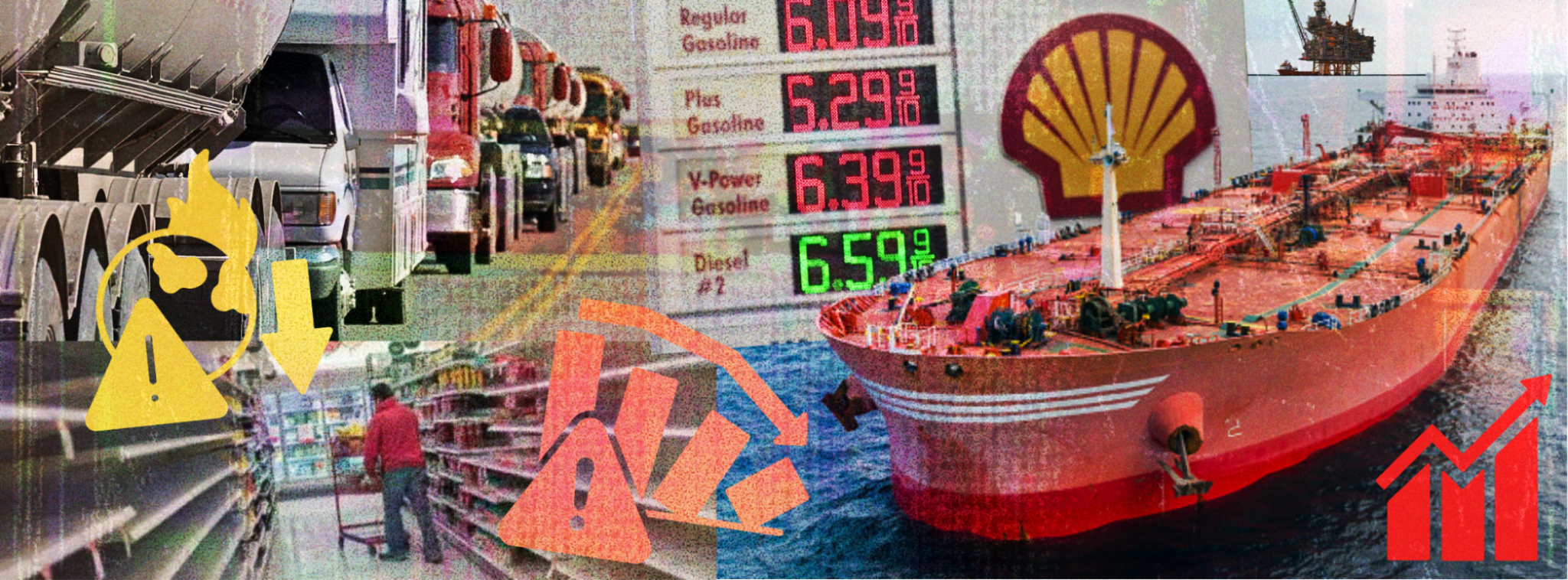
Precarity Diaries is an ongoing series connecting personal economic experience to structural conditions. Each installment starts where most of us actually live, in the anxiety of bills, the grind of underpaid work and the impossible math of modern survival, and follows those threads back to the systems that produce them. These aren’t just personal stories. They’re the diaries of a system working exactly as designed.
I. The Pantry
There are five months of freeze-dried food neatly stacked in durable totes along the closet wall in my office (I couldn’t pass up a recent buy 3, get 2 free deal from 4patriots.com), and every time I reach over them for a shirt or tie I have the same argument with myself: this is either the most rational thing I’ve done in some time or a sign that I’ve lost my grip entirely. I am, after all, a high school social studies teacher in Florida who writes weekly structural analysis about systems of power, and I’ve been comparison-shopping freeze-dried beef stroganoff on Amazon at midnight while watching the price of diesel climb to levels not seen since 2005. I monitor gas prices the way I used to monitor weather before hurricane season. I do the math at the pump every time I fill up, and the math, as we all know, has changed significantly: $2.81 in January, $4.55 today, up more than a dollar fifty since the war began in late February. I drive a car in a city with no meaningful public transit, and every fill-up is now a small act of accounting.
I have been doing this since March, since the Strait of Hormuz closed and the architecture I spent the spring writing about stopped being something I analyzed from a distance and became something I could feel in my own kitchen. The same chokepoint I traced across five centuries in an earlier piece is now showing up in the price of eggs, in the cost of a bag of dog food, in the calculations I run every week about whether to stay in Florida or drive to Maine for the summer. The structural analysis isn’t abstract anymore. It’s in my pantry. And the pantry is getting fuller because the world is getting more fragile, and I am no longer sure those are separate observations.
II. What Diesel Moves
The International Energy Agency has called the Hormuz closure the largest oil supply disruption on record. Larger than the 1973 Arab embargo. Larger than the 1979 Iranian Revolution. Larger than the disruptions following Russia’s invasion of Ukraine. Roughly 600 million barrels of oil have been removed from global supply since late February, and the loss is not just a price problem. It is becoming an availability problem, and the difference between those two things is the difference between expensive groceries and empty shelves.
Seventy percent of all food in the United States moves by truck. Every truck runs on diesel. Every tractor in every field runs on diesel. Every refrigerated trailer keeping food cold on the highway runs on diesel. Diesel inventories are currently at their lowest levels since 2005 and falling, eleven percent below the five-year average according to the most recent EIA data. When diesel becomes scarce, trucks slow down. When trucks slow down, the food doesn’t get picked up from farms, doesn’t reach processing plants, and doesn’t arrive at your grocery store. That isn’t inflation. Inflation is when prices go up. This is when there is nothing to put on the shelf at any price. And it’s already happening at the margins. For example, in Bayou La Batre, Alabama, shrimp boats that burn up to 500 gallons of diesel a day are sitting idle at the dock because the math no longer works. As the town’s mayor put it this week, “a lot of these guys are just not going out until diesel fuel comes down. You can’t go work for the fuel.” When the boats don’t go out, there’s nothing to bring in, nothing to process, nothing to pack, just nobody working. Every dollar a fisherman generates creates roughly six dollars in the broader economy. When that dollar disappears, the community hollows out behind it.
But the dependency runs deeper than fuel. A third of the world’s fertilizers normally pass through the Strait of Hormuz, and planting seasons in parts of Africa and Asia are ending within weeks. The graphite in every lithium-ion battery, from your phone to an electric vehicle, is made from needle coke, a byproduct of oil refining, baked in furnaces at over 3,000 degrees for weeks at a time. The sulfuric acid used to leach copper ore in Chile comes from sulfur produced by refining Persian Gulf crude. As the Substack writer known as the Honest Sorcerer observed earlier this year, “we still cannot make ‘renewables’ with ‘renewables,’ let alone maintain the six continent supply chain necessary to continue with civilization as it is.” It reminds me of an early episode of the excellent drama series Landman, where Billy Bob Thornton’s character lectures the young company lawyer and asks her if she has any idea how much diesel it takes to mix the concrete, make the steel, haul the components, and assemble a single wind turbine with a 450-foot crane. The data says he was not exaggerating.
The crisis is not energy alone. It is material. It is agricultural. It is everything.
III. The Lag
Here is the fact that should unsettle every assumption about a quick resolution. If the Strait of Hormuz opened completely and permanently this afternoon, the first drop of new Persian Gulf gasoline would not reach an American gas pump until late August at the earliest. A tanker takes roughly forty days to cross from the Gulf to the U.S. coast. Refining takes weeks. Pipeline and truck distribution to 150,000 gas stations takes another ten to fourteen days. That is twelve to sixteen weeks from strait to pump, and it assumes everything goes perfectly, which it will not. Shipping lanes need mine clearance. Insurance companies will maintain war-risk premiums for months. Production that was shut in takes months to restart, and some damaged facilities, including Qatar’s Ras Laffan LNG complex, which lost an estimated seventeen percent of its capacity, may need up to five years to repair.
Jeff Currie, senior advisor at the Carlyle Group, put it plainly on Bloomberg Television last week: “It’s baked in, full stop. It’s going to take so long to get all this restarted that those inventories will continue to draw.” Even the head of the U.S. Energy Information Administration, Tristan Abbey, acknowledged the unprecedented nature of the situation: “Just as we had never before seen the strait close, we’ve never seen it reopen.”
And the lag clock has not even started. As of today, the ceasefire is on what President Trump himself called “life support.” Iran is demanding war reparations and sovereignty over the strait. The diplomatic positions are hardening, not converging. On May 3, a tanker called the New Corolla docked at Long Beach, California, carrying Iraqi crude that was loaded four days before the war began. It was the last Middle East oil shipment to reach American shores. The buffer of tankers that were already at sea when the conflict started is now exhausted.
There is no more coming. And the clock to recovery has not begun.
IV. What I Don’t Know
I don’t know if store shelves will be empty by mid-July. I don’t know if the worst-case scenarios materialize on schedule. I don’t know if diplomatic breakthroughs, emergency rationing, strategic reserve releases, or demand destruction will buy enough time to prevent the cascade the analysts are warning about. I am a high school teacher, not an energy analyst, and I want to be precise about the limits of what I can claim.
What I do know is that the structural vulnerability is real, the dependencies are documented, the inventories are falling, and the gap between what the data shows and what the government is communicating is wide enough to drive a very large, very empty tanker through. The chief economist at Rystad Energy told Fortune that we are “still kind of sleepwalking into this approaching disaster.” That is not a fringe voice. It is one of the world’s most respected energy research firms.
The people writing with absolute certainty that civilization collapses in eight weeks are not doing analysis. They are doing prophecy. But the people insisting everything will be fine are not doing analysis either. They’re arguably doing denial. The honest position, I suspect, is somewhere between those poles, and it is deeply uncomfortable to stand there. The data is serious. The architecture that produced this vulnerability is the same architecture I have been tracing all year. And none of us, not the analysts, not the prophets, not the president with his gas tax proposal, knows exactly how this plays out.
V. Where It All Points
Whether or not the worst case arrives this summer, the structural lesson is already clear. A civilization that routes its fuel supply through a 21-mile strait, moves it on a fuel with no short-term substitute, and funds a $1.5 trillion military budget while cutting $73 billion from everything else has built fragility into its foundation. That fragility was not an accident. It was an architecture, and it was designed.
Means and Meaning has spent this spring tracing that architecture across domains. A chokepoint that has shaped empires for five centuries. A war budget that shows up in your grocery bill. A college that taught people to see systems and couldn’t survive in a system that doesn’t value seeing. What the #vanlife movement says about America’s housing crisis. These are not separate stories. They are the same story, told in different registers, about a civilization that has optimized for extraction and efficiency while quietly eliminating every buffer, every reserve and every margin of safety that might have absorbed a shock like the one now arriving.
I am still stacking freeze-dried food in my office closet. I am still doing the math at the pump. I am still having that argument with myself every morning about whether this is wisdom or anxiety, and I am still not sure the answer matters, because the vulnerability is real either way. The inventories are falling whether I’m being rational or paranoid. The diesel is running low whether I call it preparation or panic.
The point was never prediction. The point is that structural vulnerabilities do not disappear because the immediate crisis passes. They wait. And the question this country has never been willing to honestly ask, the question the architecture was designed to make unthinkable, is whether we will rebuild the systems that feed us and fuel us and shelter us around something more resilient than a single 21-mile strait, or whether we will simply wait for the next shock, and the next one after that, until there is nothing left to cushion the fall.
References
Afp. (2026, May 11). Tens of millions risk hunger as Hormuz standoff blocks fertiliser, UN official says. The Economic Times. https://economictimes.indiatimes.com/news/international/world-news/tens-of-millions-risk-hunger-as-hormuz-standoff-blocks-fertiliser-un-official-says/articleshow/131016481.cms
Martin, J. (2026, April 14). Two wars. one you can see. one you can’t. Jay’s Letter.

McCreesh, S. (2026, May 11). Trump proposes suspending the federal gas tax until prices fall. The New York Times. https://www.nytimes.com/2026/05/11/us/politics/trump-gas-tax.html?smid=url-share
Newbury, S. J. (2025, November 25). The thermodynamic blind spot: Why “Peak Oil” failed, and why we are finally at the singularity. The Ultimate Avatar of Balance.

Pathak, R. (2026, March 24). Is the World Heading for an Energy Lockdown in 2026? Oil Prices, Blackouts, and What’s Really Coming. International Business Times UK. https://www.ibtimes.co.uk/global-energy-lockdown-2026-crisis-impact-1787852
Science Insights Team. (2026, March 29). Is there an energy crisis? What’s really happening now. ScienceInsights. https://scienceinsights.org/is-there-an-energy-crisis-whats-really-happening-now/
Shryock, M. A. (2026, May 9). EIGHT WEEKS TO EMPTY SHELVES. SIXTY DAYS TO FAMINE. Mark A. Shryock.

Shukla, P. (2026, April 20). 600 million barrels gone, gas +47%, jet fuel +100%: is the global energy crisis 2026 from US– Iran war abo. The Economic Times. https://economictimes.indiatimes.com/news/international/us/600-million-barrels-gone-gas-47-jet-fuel-100-is-the-global-energy-crisis-2026-from-us-iran-war-about-to-trigger-inflation-shock-and-global-recession/articleshow/130398244.cms#google_vignette
Snapp, E. (2026, May 11). Rising fuel costs force shrimp boats to stay docked in Bayou La Batre. (2026, May 11). WEAR2. https://mynbc15.com/news/local/rising-fuel-costs-force-shrimp-boats-to-stay-docked-in-bayou-la-batre
Sorcerer, H. (2026, February 15). China: The end of an economic miracle. The Honest Sorcerer.

Sorcerer, H. (2026, April 10). There is no “Next economy.” The Honest Sorcerer.
____________________________________________________________________________
Means and Meaning publishes every Tuesday. If you found value in this analysis, I’d be very grateful if you’d consider buying me a coffee — your support helps me dedicate time to this work while keeping all content free and accessible.
You can also support this project by subscribing (it’s free!), sharing with others who might appreciate it, or joining the conversation in the comments. Sometimes the best antidote to anxiety is knowing you’re not alone in seeing what’s happening.
Next week, we’ll examine another piece of the machinery — and another opportunity to resist it.
Until then, keep questioning, keep connecting, and keep believing that another world is possible.
~ Chris