


Signal/Noise is a series that cuts through the spectacle of breaking events to find the structural signal underneath. This installment cuts through 250 years of mythology to find the signal the founders actually sent, and asks whether we’re still willing to receive it.
I. The Most Radical Document Ever Written
Four days from now, the United States will turn 250 years old. Fireworks will go off. Flags will wave. Politicians will give speeches about freedom while building the machinery to ensure it can never threaten their power. And most Americans will treat the Fourth of July the way they always do: as a barbecue with a soundtrack.
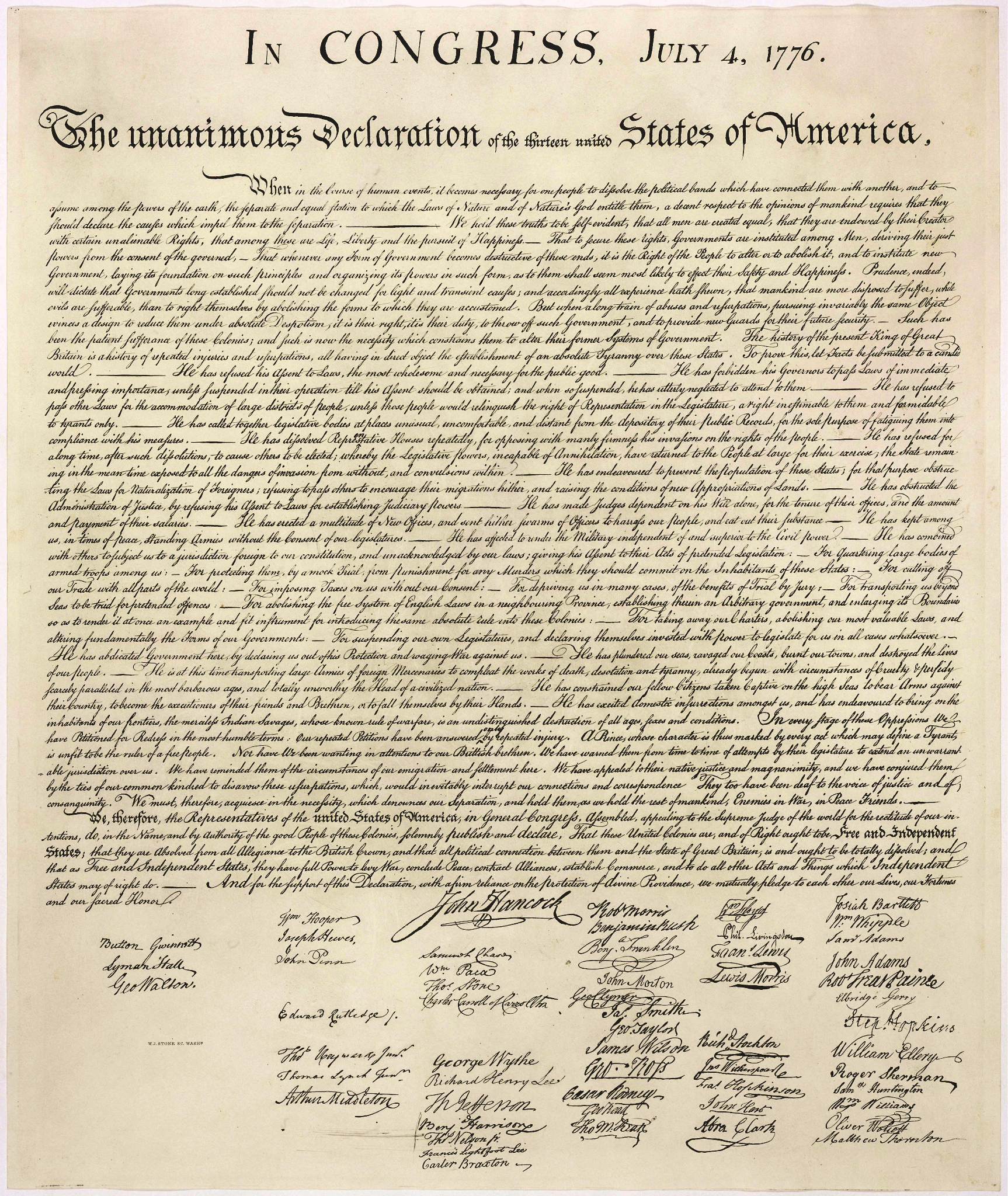
I want to ask you to do something different this year. I want to ask you to read the actual words.
Not the parts you already know. Not “life, liberty, and the pursuit of happiness,” which has been so thoroughly absorbed into the national background noise that it functions more as bumper sticker than as battle cry. I mean the parts they don’t put on T-shirts. The exit clause:
“Whenever any Form of Government becomes destructive of these ends, it is the Right of the People to alter or to abolish it.”
That is not a suggestion. It is an instruction. Jefferson wrote a manual for revolution into the founding document of the nation and the Continental Congress signed it. They didn’t just declare independence from Britain. They declared that any people, anywhere, at any time, have the right to overthrow any government that stops serving them. That is not a conservative text. That is the most radical political document in the history of the Western world.
Gordon Wood, the preeminent historian of the Revolution, called it “the most radical and most far-reaching event in American history.” It “destroyed aristocracy as it had been understood in the Western world for at least two millennia.” Karl Marx said it “gave the first impulse to the European revolution of the eighteenth century.” The Revolution inspired the French Revolution, the Haitian Revolution, and every liberation movement that followed.
And Jefferson wrote one more thing that most people never read. “Mankind are more disposed to suffer, while evils are sufferable, than to right themselves by abolishing the forms to which they are accustomed.” He knew. People will endure what they can endure for as long as they can endure it. The question the 250th anniversary poses is whether we’ve reached the threshold he described, a “long train of abuses pursuing invariably the same Object,” and if so, what the document he wrote tells us to do about it.
II. What Was Actually Radical
The Revolution didn’t just replace one government with another. It overturned a principle that had organized Western civilization for two thousand years: that some people were born to rule and others were born to be ruled. Before 1776, society operated on what was called the “great chain of being,” a hierarchy of ranks stretching from God to king to lord to commoner, each link fixed by birth and blood. The Revolution snapped that chain. As David Ramsay, the South Carolina physician and historian, explained at the time, Americans were “changed from subjects to citizens,” and “the difference is immense: subject is derived from the latin words, sub and jacio, and means one who is under the power of another; but a citizen is an unit of a mass of free people, who, collectively, possess sovereignty.”
And it was not gentlemen in powdered wigs who drove this transformation. In Philadelphia, the city’s working class had been gradually taking over political leadership since the mid-1760s, and a horrified clergyman reported that “the poorest laborer upon the shore of the Delaware thinks himself entitled to deliver his sentiments in matters of religion or politics with as much freedom as the gentleman or scholar.” In Savannah, a royal governor shook his head that the revolutionary committee running the city consisted of “a Parcel of the Lowest People, chiefly carpenters, shoemakers, blacksmiths etc. with a Jew at their head.” Carpenters and shoemakers and blacksmiths running the government. That was the Revolution.
Before 1776 there was 1649, the English Revolution that killed a king and established a republic, and the American revolutionaries knew it. The Levellers and the Diggers had crossed the Atlantic in the bodies and memories of the colonists themselves, and when Thomas Paine, a working-class immigrant and corset-maker’s son from England, wrote “we have it in our power to begin the world over again,” he was not being rhetorical. He was describing what they were actually doing, and the world they were beginning was one where no person was born with a saddle on their back and no other person was born booted and spurred to ride them.
But honesty demands holding the contradiction alongside the promise. Jefferson wrote “all men are created equal” while owning enslaved people. The Revolution’s radical vision coexisted with slavery, genocide, and colonial extraction. Yet as Wood insisted, “to focus on what the Revolution did not accomplish is to miss the great significance of what it did accomplish; indeed, the Revolution made possible the anti-slavery and women’s rights movements of the nineteenth century and in fact all our current egalitarian thinking.” The contradiction doesn’t invalidate the promise. It makes the work of redeeming it more urgent, not less.
III. The Unfinished Revolution
The founders didn’t just fight for independence. They fought against a world in which, as John Adams put it in 1775, there were “but two sorts of men in the world, freemen and slaves.” That sentence collapsed every careful distinction of rank and title that monarchical society had spent centuries constructing, and it laid the foundation for a republic built on a single radical premise: consent of the governed. No one rules you without your permission. No one holds power except through your voice. The government serves the people, or the people have the right, indeed the duty, to change it.
That premise is why Frederick Douglass, speaking as an escaped slave on July 5, 1852, did not reject the Revolution. He embraced it. He called the signers “brave men” and “great men, great enough to give fame to a great age,” and then he turned the Declaration back on the nation that had failed to keep its promise. His biting observation that the legacy of the American Revolution “stands out the more as we contrast it with these degenerate times” was not cynicism. It was the most patriotic act available to him: demanding that the country measure itself against its own founding words and answer honestly.
Douglass’s challenge has never been more relevant than it is right now, 250 years into the experiment. Consent of the governed is being structurally dismantled through voter suppression, gerrymandering, and a Supreme Court the majority didn’t choose and can’t remove. The founders banned hereditary titles, yet the United States now has a wealth gap that would have horrified the men who wrote the New Hampshire constitution’s declaration that “no office or place whatsoever in government shall be hereditary.” A president’s sons sell $12,000 commemorative coins bearing their father’s face. A golden statue stands at a golf resort. A ballroom rises where the East Wing used to be. In 1786, an ex-weaver named William Findley stood up in the Pennsylvania legislature and told the richest merchant in the state to stop disguising his private interests as public virtue. Two hundred and forty years later, we could use a few more Findleys.
You don’t have to celebrate what America is to celebrate what it promised to become. But you do have to be honest about the distance between the two.
IV. Reclaiming the Flag
Somewhere along the way, many Americans who believe most deeply in the promises of 1776 stopped showing up to claim them. They ceded the flag, the founders, the Declaration, and the language of liberty to people who invoke them without reading them, who wave the red, white, and blue while quietly dismantling the self-governance it represents. The critique of America’s failures was often valid, but in the retreat from patriotic language, something essential was lost: the moral authority of the most radical political tradition in Western history.
But that tradition has always belonged to the people who fought to expand its promise, not to those who fought to contain it. Paine was a working-class immigrant who attacked monarchy, inherited wealth, and the divine right of kings. Douglass turned the Declaration back on a nation that had enslaved him, not to reject the founding but to hold it accountable. Debs described the promise of self-governance as “the equal rights of all to manage and control” society. King stood in Montgomery and declared that “the great glory of American democracy is the right to protest for right.” Every one of them showed up, claimed the tradition, and insisted that its promises be kept for everyone, not just the privileged few.
A cousin of mine, a Navy veteran who served in Iraq, understood this instinctively. Despite our many political differences, last Fourth of July he sent me a message I haven’t stopped thinking about: “We can both celebrate radicalism and patriotism this weekend. Of course they were all both.” He passed away last August, but those words have stayed with me ever since, because he was right, and the thread he was pulling on runs from Paine through Douglass through King and through every American who ever loved this country enough to demand that it do better.
Some of my family members have said they don’t feel like celebrating this year. I understand the impulse. But don’t give them the holiday. The founders were radicals. The abolitionists were radicals. The suffragists, the labor movement, the civil rights movement, they all showed up on the Fourth and said: this belongs to us, too. You don’t have to celebrate what America is to celebrate what it promised to become. Show up. Read the actual words. And mean them.
V. Begin the World Over Again
Two hundred and fifty years. A quarter of a millennium since a collection of radicals in Philadelphia, farmers and lawyers and printers and smugglers, signed a document that told the most powerful empire on earth that its authority was no longer recognized, that governments exist only by the consent of the governed, and that when they stop serving the people, the people have not just the right but the duty to alter or abolish them and begin again.
They were not perfect. They held slaves and denied women the vote and dispossessed the people whose land they stood on. The radical promise of 1776 was betrayed in the very moment it was written, and that betrayal echoes through every generation since. But the words were bigger than the men who wrote them. They outlived the contradictions. They crossed oceans. They inspired the French Revolution and the Haitian Revolution and the abolitionists and the suffragists and the labor movement and the civil rights movement and every person who ever stood in front of power and said: you promised this, now deliver it.
That is the tradition we inherit this Saturday. Not a finished project. Not a victory to commemorate. An unfinished revolution that requires every generation to pick it up and carry it further than the one before. The stream of revolution, as the historian J. Franklin Jameson wrote, “once started, could not be confined within narrow banks, but spread abroad upon the land.” It is still spreading. It has not been dammed. And it will not be, as long as there are people willing to show up and insist that the promises be kept.
John Adams predicted how this day would be celebrated. In a letter to Abigail written on July 3, 1776, the day before the Declaration was signed, he wrote that it ought to be “solemnized with pomp and parade, with shows, games, sports, guns, bells, bonfires, and illuminations, from one end of this continent to the other, from this time forward, forevermore.” He certainly was right about the fireworks! But he also understood that the celebration was not a reward for something completed. It was a commitment to something begun.
So here is what I believe, 250 years later, standing on the same rocky coast of Maine where my family has gathered for generations, watching the fireworks rise over Casco Bay the way Adams imagined they would, the way my brothers and cousins and I watched them together so many times before.
I believe the American Revolution was the most radical political event in the history of the Western world, and that its most daring promises remain unfulfilled. I believe that the founders were revolutionaries, not the cautious gentlemen in powdered wigs we’ve been taught to imagine, and that the tradition they started belongs to every person in this country who has ever been told their voice doesn’t matter, their labor isn’t valued, or their consent isn’t required. I believe that the distance between what was promised and what was delivered is not a reason to walk away from the experiment but a reason to fight harder for it. I believe that a carpenter in Philadelphia in 1774 who insisted on governing himself and a teacher in 2026 who insists on the same thing are part of the same unbroken line. And I believe that the most patriotic thing any of us can do this Fourth of July is not just to wave a flag but to read the words on the document that made the flag possible, and to mean them, every one, for everyone, finally.
Thomas Paine, the working-class immigrant who lit the fuse of the Revolution with a pamphlet and a pen, wrote a sentence 250 years ago that still rings like a bell in a country that desperately needs to hear it:
“We have it in our power to begin the world over again.”
We do. We always have. And the Revolution isn’t over until we do.
References
Cutterham, T. (2026, May 24). Class struggle was a crucial part of the American Revolution. Jacobin. https://jacobin.com/2026/05/american-revolution-britain-class-struggle?fbclid=IwY2xjawSAAatleHRuA2FlbQIxMABicmlkETFONWtod3NOVXNJOENMWjkyc3J0YwZhcHBfaWQQMjIyMDM5MTc4ODIwMDg5MgABHt9Sa1nlBBzCLCcylyI49WDkdKQlzOazJLiy2RfpwveqAOcpJcCPNxpGh0U3_aem_gfKEPTCFeeNadIihkvs9Wg
Damon, A. (2016, July 4). Two hundred forty years since the Declaration of Independence. World Socialist Web Site. https://www.wsws.org/en/articles/2016/07/04/pers-j04.html
Kazin, M. (2026, June 4). The left needs to rediscover its patriotism. The Atlantic. https://www.theatlantic.com/ideas/2026/06/left-patriotism-liberals-socialism/687398/?utm_source=facebook&utm_medium=cr&utm_campaign=2024_Content_ContentTestingII_Prospecting_Sales_Advantage&utm_content=060426_LeftRediscoverSocialism_NA_NA_LearnMore&utm_term=ContentTestingII_Advantage&referral=FB_PAID&utm_id=6581568102677&fbclid=IwY2xjawSO_opleHRuA2FlbQEwAGFkaWQAAAZQCfJX1XNydGMGYXBwX2lkEDIyMjAzOTE3ODgyMDA4OTIAAR5e9KtlXtr9FnZv_A3CZ1pJEkzdLGM4_O9kwXJM80Xhy6VqAOtJXvttPr2ovw_aem_bWkCovGx6f_d034YrmEm_g&campaign_id=6581568102677&ad_id=6940833729477
Mackaman, T. (2016, July 14). In Defense of the American Revolution. World Socialist Web Site. https://www.wsws.org/en/articles/2016/07/14/revo-j14.html
Monahan, S. (2015, March 6). Reading Paine From the Left. Jacobin. https://jacobin.com/2015/03/thomas-paine-american-revolution-common-sense/
Rees, J. (2026, June 27). Before 1776, there was 1649. Jacobin. https://jacobin.com/2026/06/before-1776-there-was-1649?fbclid=IwY2xjawSs6sFleHRuA2FlbQIxMABicmlkETE0Q0FkbXZHd1RETXU2cHp1c3J0YwZhcHBfaWQQMjIyMDM5MTc4ODIwMDg5MgABHtpLGtDd-1J9vcHd_JqBZBjDKu-QkmXAN8tSxMRr_qLWJ_PjNvYfUcXHxVdU_aem_X8oG9bi74lIro4pJBdhTHA
Representatives of the United Colonies of North America. (1775). Declaration of the Causes and Necessity of Taking Up Arms, 6 July 1775. https://archive.csac.history.wisc.edu/9_Declaration_of_the_Causes_and_Necessity_of_Taking_up_ArWood, G. S. (1993). The radicalism of THE AMERICAN REVOLUTION (FIRST). Vintage Books. https://ia600408.us.archive.org/18/items/wood-gordon-the-radicalism-of-the-american-revolution-2011-1/Wood%2C_Gordon_The_Radicalism_of_the_American_Revolution_2011_1.pdf ms.pdf
Wood, G. S. (1993). The radicalism of THE AMERICAN REVOLUTION (FIRST). Vintage Books. https://ia600408.us.archive.org/18/items/wood-gordon-the-radicalism-of-the-american-revolution-2011-1/Wood%2C_Gordon_The_Radicalism_of_the_American_Revolution_2011_1.pdf
____________________________________________________________________________
Means and Meaning publishes every Tuesday. If you found value in this analysis, I’d be very grateful if you’d consider buying me a coffee — your support helps me dedicate time to this work while keeping all content free and accessible.
You can also support this project by subscribing (it’s free!), sharing with others who might appreciate it, or joining the conversation in the comments. Sometimes the best antidote to anxiety is knowing you’re not alone in seeing what’s happening.
Next week, we’ll examine another piece of the machinery — and another opportunity to resist it.
Until then, keep questioning, keep connecting, and keep believing that another world is possible.
~ Chris
Bravo!! So very well stated!! Thank you! 🙏 A 3-dose remedy to the current government corruption is in the first paragraph of the 1776 Declaration of Independence:
When in the Course of human events, it becomes necessary for one people
(1) to dissolve the political bands which have connected them with another, and
(2) to assume among the powers of the earth, the separate and equal station to which the Laws of Nature and of Nature's God entitle them, a decent respect to the opinions of mankind requires that they should
(3) declare the causes which impel them to the separation.
https://www.archives.gov/founding-docs/declaration-transcript.