


This piece is part of “Signal/Noise,” rapid responses to breaking events — cutting through media static to find the patterns and power structures beneath the headlines.
I. The Feeling We Know Too Well
There is a particular feeling that often settles in before a war begins. It isn’t panic. It isn’t certainty. It’s something quieter and more disorienting….a kind of low-grade unreality, a sense that something enormous is moving just out of view.
I recognize this feeling because I’ve stood inside it before. On a bitter February morning in 2003, during my second year at Hampshire College, I rode a bus to New York City with classmates to join the global protests against the looming invasion of Iraq. The streets were packed, the air sharp, helicopters circling overhead. Hundreds of thousands of us filled Manhattan — students, veterans, families, clergy — all insisting, loudly and collectively, that this war was a mistake before it began. We (and the millions of other protestors gathered in cities around the world that day) were right. And we were ignored.
That same feeling is back. Each week brings another headline that should stop us cold: boats bombed in international waters, civilians killed without names or evidence, aircraft carriers repositioned and language about “terrorists” expanding to swallow entire countries. The pace is relentless, but the tone is strangely flat. No emergency sessions of Congress. No national reckoning. Just a steady normalization of the unthinkable.
What’s happening with Venezuela is often described as escalation. That’s accurate, but definitely incomplete. This isn’t a sudden lurch toward war. It’s a careful drift, engineered through repetition. A strike here. A threat there. A legal justification floated, then quietly abandoned. Each move small enough to feel deniable. Together, unmistakable.
Many people sense that something is wrong but can’t quite name it. The story doesn’t cohere. The reasons shift. The stakes feel both enormous and oddly distant. That confusion isn’t accidental. It’s how wars are made palatable in advance, by making them feel abstract, inevitable, already underway. The danger isn’t just what is being done. It’s how quickly we are being trained to accept it.
II. War Without a Vote
What makes this moment especially dangerous is not just the violence itself, but how little process stands between the president and the trigger. After all, there has been no authorization for the use of military force, and not even any serious congressional debate. And really no substantial public accounting of evidence. Instead, we are told (after the fact) that people killed at sea were “narcoterrorists,” that entire operations are defensive by definition and that secrecy itself is proof of necessity.
This is war without a vote. But the Constitution is unambiguous on this point: Congress declares war. Presidents execute it. That line has been blurred for decades, eroded by emergencies real and manufactured alike. The War on Terror did a good deal of the damage, habituating Americans to the idea that lethal force could be deployed anywhere, indefinitely, on the basis of classified claims and elastic definitions of threat. And what we are seeing now builds directly on that precedent. Just label a criminal network a “terrorist organization.” Redefine drug trafficking as armed conflict. Declare entire regions “hostile environments.” Once that logic is accepted, the machinery runs on its own. Legal review becomes a formality. Oversight becomes optional. Death becomes…administrative.
What’s striking is how little resistance this has provoked. Polling shows most Americans don’t see Venezuela as a serious national security threat. And yet, lethal strikes continue, justified by numbers that don’t add up and scenarios that don’t withstand scrutiny. The gap between public skepticism and governmental action is wide…and widening.
That gap is not accidental. It is the product of executive power untethered from democratic constraint. When war no longer requires persuasion, it no longer requires consent. It becomes something that simply happens, to people elsewhere, in our name, without our say. And once that becomes normal, the threshold for violence collapses.
III. Empire’s Backyard
None of this is new to the Caribbean or Latin America. What’s new is how openly it’s being revived, and how many Americans have forgotten the script.
From the Monroe Doctrine onward, the region has been treated less as a collection of sovereign societies than as a managed zone: unstable by default, dangerous if left unattended and perpetually in need of supervision. The language shifts, but the logic does not.
Theodore Roosevelt’s corollary made that logic explicit. The United States, he declared, would act as an “international police power,” intervening whenever instability threatened American interests. What followed was not order but occupation: Haiti, the Dominican Republic, Nicaragua, Cuba and Panama. Military rule, customs supervision, debt control, political engineering—always framed as temporary, always experienced as permanent.
Puerto Rico stands as a particularly stark example. Seized in 1898, governed without consent, its independence movement crushed through surveillance, imprisonment and assassination. The message was unmistakable: sovereignty in the Caribbean would exist only on Washington’s terms.
Venezuela fits squarely within this lineage. Not because its government is virtuous—it isn’t—but because it insists on control over its own resources. Oil. Territory. Political direction. That insistence has made it intolerable.
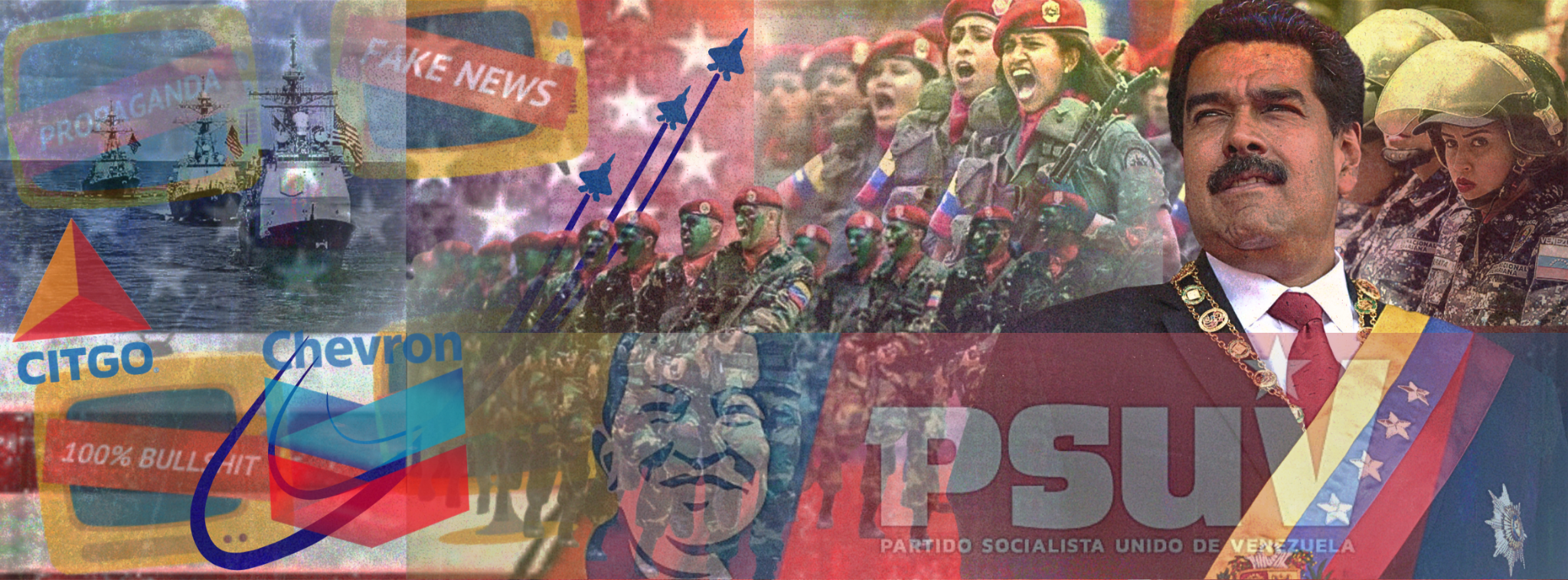
This is where the war moves beyond bombs. CITGO, majority-owned by Venezuela’s state oil company PDVSA, was once a crucial artery connecting Venezuelan oil to global markets. Through sanctions, legal maneuvers, and the fiction of an “interim government,” that artery has been seized and slowly drained. Assets frozen. Dividends diverted. A strategic national resource auctioned off at a fraction of its value—money that would otherwise fund food, medicine, infrastructure and wages. This is not collateral damage. It is policy.
Economic warfare precedes military force because it softens resistance. It hollows out daily life. It produces shortages that can later be blamed on incompetence or corruption. When sanctions fail to deliver regime change, escalation follows. Naval blockades become “counter-narcotics.” Air patrols become “deterrence.” Bombs become “stability.”
Meanwhile, everyday people (the campesinos, the dockworkers, the factory hands) are rendered invisible. Reduced to abstractions. Or worse, reframed as obstacles.
Empire does not announce itself. It normalizes itself. It repeats familiar moves until repetition feels like inevitability. And once again, the Caribbean is treated as the proving ground. Not because it is chaotic - but because it has always been close enough to control, and distant enough to ignore.
IV. From Pressure to Posture
This is no longer abstract. It is no longer rhetorical. And it is no longer confined to press releases and cable-news speculation. Pentagon sources now privately acknowledge that the current naval concentration in the Caribbean is the largest since the U.S. invasions of Grenada and Panama—interventions remembered not as policing actions, but as regime change carried out under thin legal cover. Thousands of U.S. personnel, including Marines and naval aviators, are operating within hours of Venezuelan territory. Joint exercises grow more aggressive by the week. The choreography is familiar. The destination less so.
What began as economic strangulation has hardened into military posture. Venezuela’s collapse did not happen in a vacuum. It unfolded through a brutal convergence of sanctions, oil dependency, and deliberate isolation. The country sits atop the largest proven oil reserves on Earth, yet much of that oil is costly to extract, technologically demanding and now functionally inaccessible. Production has cratered. Infrastructure has decayed. Between 2013 and 2025, the economy shrank by roughly three-quarters—one of the worst peacetime collapses in modern history.
Sanctions didn’t merely pressure elites; they hollowed out society. Currency redenominations. Black-market exchange rates. Pipelines rupturing daily. Refineries running at a fraction of capacity. A population forced to improvise survival while being told this is the price of “democracy.”
Then came criminalization. Recently this year, Washington designated Venezuela’s entire military apparatus a terrorist organization—an unprecedented move that collapses the distinction between state and cartel, soldier and criminal. Once that line is erased, almost anything becomes permissible. Blockades can masquerade as counter-narcotics. Airstrikes can be framed as law enforcement. Invasion can be rehearsed as contingency planning.
Add the presence of Russian advisers, Cuban security forces, and Iranian technicians, and the script shifts again—from hemispheric discipline to great-power rivalry. Venezuela is no longer just a problem to be managed, but a signal to be sent.
And the danger isn’t just the weapons. It’s the tempo. Each escalation accelerates the next. Each move shrinks the space for diplomacy. One misread radar ping. One “defensive” strike. One incident at sea. This is how wars stop feeling hypothetical, right up until they aren’t.
V. Say the Word: Blockade
Now, tonight, there is no ambiguity left. A “total and complete blockade” is not pressure. It is not sanctions. It is not law enforcement. A blockade is an act of war - full stop. Every international lawyer knows this. Every naval officer knows this. Every historian knows this.
And Trump didn’t just threaten one. He claimed ownership. “Our oil. Our land. Our assets.” Not influence. Not access. Ownership. This is nineteenth-century imperial language spoken out loud in the twenty-first century, broadcast casually on social media like a rage-text to the world. No congressional authorization. No international mandate. No pretense of legality. Just entitlement backed by ships and missiles.
The administration has spent months insisting this is about drugs. But drug interdiction does not require armadas. It does not require blockades. It does not require F-35s, carrier strike groups, or amphibious assault capabilities. It does not require killing survivors clinging to wreckage at sea.
What it requires is intelligence cooperation and coast guards—not siege warfare.
A blockade targets civilians first. Oil is Venezuela’s economic lifeline. Cut it off, and hospitals lose power. Food imports stall. Public wages evaporate. This is collective punishment by design, dressed up as morality. Economic warfare meant to make daily life unlivable until a government collapses—or a population breaks.
And notice what Trump didn’t say. He didn’t talk about democracy. He didn’t mention elections, corruption, or human rights. He talked about oil. Assets. Possession. Tribute. This is not an accidental escalation. It is the logical endpoint of years of sanctions, seizures, and criminalization. When economic strangulation fails, force waits in reserve. When the target still stands, the language shifts from pressure to plunder.
The most chilling part isn’t the threat itself. It’s how normal it’s becoming to hear it.
VI. Not in Our Name
Let’s stop pretending this is hypothetical. A blockade has been declared. Warships are in position. Oil tankers are being seized. Civilians are already dead. The language has shifted from implication to command: total and complete. In international law, a blockade is not pressure. It is not sanctions-plus. It is an act of war.
And the justification has finally slipped. This is no longer just about drugs, or migration, or “stability.” The president has said the quiet part out loud, via Truth Social: Venezuela’s oil, land, and assets are being claimed as ours. Not negotiated. Not regulated. Returned. Immediately. This is nineteenth-century imperial logic, delivered via social media, enforced with twenty-first-century firepower.
What follows a blockade is not surgical. It is starvation. It is medicine that doesn’t arrive. It is electricity that fails. It is ports that go quiet and black markets that explode. It is always working people who absorb the shock first - dockworkers, nurses, pensioners, sailors ordered forward, civilians told to brace. The elderly militia members training with unloaded rifles in Caracas will not decide this conflict. Neither will the U.S. sailors steaming south under orders they didn’t write. But they will pay for it.
We are told this is about stopping chaos. In reality, it is chaos being applied as policy. Economic strangulation backed by overwhelming force, justified by moral language and executed without democratic consent. Congress has not debated this. The public has not chosen it. It is war by executive momentum, normalized by distance and distraction.
And there is a deeper danger here. What is rehearsed abroad does not stay abroad. A government that grows comfortable blockading another country’s economy, criminalizing an entire military, and treating civilian casualties as collateral noise is practicing a form of power that does not recognize clear borders. As Arellano warned, this is the logic of a president who dreams of treating enemies—including cities—like drug boats. This is how empire forgets where its borders end, until the warships are aimed inward.
But despair is not a politics. Attention is. Action begins with accountability. That means demanding public hearings on the blockade and the killings already carried out in its name. It means amplifying Caribbean and Venezuelan voices instead of laundering policy through Pentagon briefings. It means defending independent journalism against the fog of patriotic inevitability. It means refusing spectator politics—outrage without consequence, doomscrolling without organization. Above all, it means insisting on a simple, unfashionable truth: working people do not deserve to be bombed, starved or blockaded for refusing to surrender their country’s resources.
History is not confused about this pattern. It is only us who keep forgetting. And forgetting, right now, is a luxury we no longer have.
References
Bacon, P. (2025, November 25). Um . . . Is Donald Trump Seriously Going to Start a War with Venezuela? The New Republic. https://newrepublic.com/article/203612/trump-start-war-venezuela
Damon, A. (2025, December 14). Trump says US will start ground attacks “soon” as US surges military assets near Venezuela. World Socialist Web Site. https://www.wsws.org/en/articles/2025/12/15/vexd-d15.html
El-Fekki, A. (2025, December 12). US-Venezuela tensions: 3 Signs of looming war. Newsweek. https://www.newsweek.com/us-venezuela-tensions-3-signs-of-looming-war-11201094
Keating, J. (2025, December 9). There is a real chance of a US-Venezuela war — so why does it feel fake? Vox. https://www.vox.com/politics/471639/venezuela-war-unreality
Kolster, N. (2025, September 27). As US-Venezuela tensions rise, Maduro trains civilians for “undeclared war.” https://www.bbc.com/news/articles/c5y5q173053o
Lobo, R. (2025, December 8). El despojo de Citgo: La agresión económica continúa de EE.UU contra el pueblo venezolano. PSUV. http://www.psuv.org.ve/temas/noticias/despojo-citgo-agresion-economica-continua-ee-uu-contra-pueblo-venezolano/
Lubin, R. (2025, December 17). Trump calls for ‘total and complete blockade’ of sanctioned oil tankers from Venezuela in escalation of tensions. The Independent. https://www.independent.co.uk/news/world/americas/us-politics/trump-venezuela-oil-truth-social-post-b2885914.html
Schogol, J., & Lawrence, D. F. (2025, November 19). What 3 former SOUTHCOM commanders say troops should know about Venezuela. Task & Purpose. https://taskandpurpose.com/news/us-military-operations-venezuela/
____________________________________________________________________________
Means and Meaning publishes every Tuesday. If you found value in this analysis, I’d be very grateful if you’d consider buying me a coffee — your support helps me dedicate time to this work while keeping all content free and accessible.
You can also support this project by subscribing (it’s free!), sharing with others who might appreciate it, or joining the conversation in the comments. Sometimes the best antidote to anxiety is knowing you’re not alone in seeing what’s happening.
Next week, we’ll examine another piece of the machinery — and another opportunity to resist it.
Until then, keep questioning, keep connecting, and keep believing that another world is possible.
~ Chris